





The following is the established format for referencing this article:
Peer, B. D., and P. Page. 2026. A flood-resistant nest box for wetland-dependent secondary cavity-nesting birds. Journal of Field Ornithology 97(2):5.ABSTRACT
Artificial nest boxes are an important tool for studying the breeding biology of birds. Additionally, they can provide valuable nest sites for secondary cavity-nesting birds when they are limited, but despite these potential benefits, if poorly constructed or placed, artificial cavities may act as ecological traps. The Prothonotary Warbler (Protonotaria citrea) is a wetland-dependent secondary cavity-nesting bird that prefers to nest over water and as a consequence, its nests are vulnerable to flooding. The Prothonotary Warbler has declined by 38% in the past 50 years and floods are becoming more frequent with the changing climate making this species more susceptible to nest loss from flooding. Nest boxes mounted at heights of 1.5 m to maximize ease of sampling by researchers are prone to inundation even in moderate flood conditions. Here, we describe a novel design for a flood-resistant nest box that provides both convenient access for researchers and a safe location for Prothonotary Warblers above most flood waters. Our nest box is made of polyvinyl chloride (“PVC”) and is attached to a 3 m electrical conduit pole. The box is attached to the pole allowing it to be elevated with paracord safely above flood waters and then lowered to the check nest contents. We began using these nests boxes in 2018 and they remained above flood waters in 2018 and 2023, but they were submerged during the historic flood of the Mississippi River in 2019, which crested at a record high level. Our flood-resistant nest box is ideal for researchers studying the breeding biology of secondary cavity-nesting birds that nest near water.
RESUMEN
Las cajas nido artificiales son una herramienta importante para estudiar la biología reproductiva de las aves. Además, pueden proporcionar valiosos sitios de anidación para aves que anidan en cavidades secundarias cuando estos sitios son escasos. Sin embargo, a pesar de estos beneficios potenciales, si están mal construidas o ubicadas, las cavidades artificiales pueden actuar como trampas ecológicas. El chipe dorado (Protonotaria citrea) es un ave que anida en cavidades secundarias y depende de humedales, que prefiere anidar sobre el agua y, en consecuencia, sus nidos son vulnerables a las inundaciones. Sus poblaciones han disminuido un 38 % en los últimos 50 años, y las inundaciones son cada vez más frecuentes debido al cambio climático, lo que hace que esta especie sea más susceptible a la pérdida de nidos por inundaciones. Las cajas nido instaladas a una altura de 1,5 m para facilitar el muestreo por parte de los investigadores son propensas a inundarse incluso en condiciones de inundación moderadas. Aquí describimos un diseño novedoso para una caja nido resistente a inundaciones que proporciona un acceso conveniente para los investigadores y un lugar seguro para los chipes dorados por encima de la mayoría de los niveles de inundación. Nuestra caja nido está hecha de cloruro de polivinilo (PVC) y se fija a un poste de conducto eléctrico de 3 m. La caja se sujeta al poste, de manera que permite ser elevada mediante una cuerda de paracaidista de forma segura por encima de las aguas de inundación y luego bajarla para revisar el contenido del nido. Comenzamos a usar estas cajas nido en 2018 y permanecieron por encima de las aguas de inundación en 2018 y 2023, pero quedaron sumergidas durante la histórica crecida del río Misisipi en 2019, que alcanzó un nivel récord. Nuestra caja nido resistente a inundaciones es ideal para investigadores que estudian la biología reproductiva de aves que anidan en cavidades secundarias cerca del agua.
INTRODUCTION
Artificial nest boxes are valuable for researchers studying the breeding biology of birds because they are easily accessible and amenable to experimental manipulation (Hoover and Robinson 2007, Aitken and Martin 2008, Lambrechts et al. 2010, Sudyka et al. 2022). Nest boxes also allow mounting of equipment such as cameras and Radio Frequency Identification (RFID) readers to collect behavioral data that would otherwise be difficult to obtain (Zárybnická et al. 2015, Bridge et al. 2019). In addition to providing convenient sampling, nest boxes increase the availability of nest sites for secondary cavity-nesting birds, which unlike primary cavity-nesting species, cannot excavate their own nest cavities. These sites can be limited, which can lead to intense competition within species and between cavity-nesting species (Newton 1994, Potti et al. 2021, Scerbicke et al. 2024). The use of artificial nest boxes can help alleviate this competition and can benefit the populations of many species (Purcell et al. 1997, Lambrechts et al. 2010, Brazill-Boast et al. 2013, Gowaty and Plissner 2015, Raleigh et al. 2019). Overall, the use of nest boxes has significantly increased our knowledge of the breeding biology of secondary cavity-nesting birds (Lambrechts et al. 2010).
Despite the advantages of using nest boxes, there can also be negative effects (reviewed in Lambrechts et al. 2010, Zhang et al. 2023). Target species may not benefit from nest boxes (Stojanovic et al. 2021), and in some cases, they can serve as ecological traps. For example, nest boxes placed in open habitats for Wood Ducks (Aix sponsa) had higher rates of conspecific brood parasitism than those in wooded areas (Semel and Sherman 2001). Although nest boxes increased the number of breeding Common Goldeneyes (Bucephala clangula), the number of fledglings in the population did not increase because of density-dependent effects (Pöysä and Pöysä 2002). Great Tits (Parus major) provided with a choice of cavities chose the largest, which resulted in lower fledging success (Demeyrier et al. 2016), and Blue Tits (Cyanistes caeruleus) had lower fledging rates in nest boxes compared to natural cavities (Sudyka et al. 2022). Great Tits also experienced reduced reproductive success when nest boxes increased breeding density beyond optimal levels (Mänd et al. 2005) and attracted birds to lower quality habitat (Krams et al. 2021).
Nest box placement is often designed for ease of access by researchers (Sudyka et al. 2022). However, some species prefer higher cavities likely because it provides greater safety from predators (Nilsson 1984, Svensson 1991, Serrano et al. 2017, Zhang et al. 2021). Researchers in Europe also tend to mount nest boxes higher than researchers in North America for this reason (range 1.5 to > 3 m, 1.5–2.5m, respectively; Lambrechts et al. 2010). Boxes mounted at heights optimized for convenience sampling (1.5 m) can be problematic for species that nest in habitat that is frequently flooded (Walkinshaw 1938, Diggs and Wood 2009) and may serve as an ecological trap because many species appear to prefer nest boxes over natural cavities (Drent 1984, Drilling and Thompson 1988).
The Prothonotary Warbler (Protonotaria citrea) is one of two New World warblers that nest inside of cavities. They prefer nests located over water (Petit et al. 1987, but see Mueller et al. 2019) and nest boxes to natural cavities (Petit and Petit 1996). Prothonotary Warbler nests located in natural cavities range from 0.5 m above water to 6.0 m above ground (Walkinshaw 1938, Brown 2001) and predation rates are lower when nests are located over deep water (Hoover 2006). Nest boxes for Prothonotary Warblers are typically mounted approximately 1.5 m above water and are consequently submerged during floods, a common occurrence in the floodplains and wetlands where this species breeds, resulting in the loss of all eggs and nestlings (Walkinshaw 1938, Flaspohler 1996).
The Prothonotary Warbler was recently listed as a species of conservation concern because of a 38% decline in the past 50 years (Rosenberg et al. 2016); therefore, placement of nest boxes to benefit the population of this species should be done above potential floodwaters, otherwise these nest sites could become an ecological trap. Here, we describe a novel nest box design that resists flooding while maintaining easy access for researchers and report the flooding rates of standard versus modified boxes.
METHODS
Study site and nest monitoring
Our research on Prothonotary Warblers was conducted at the Princeton Wildlife Management Area north of Princeton, Iowa (41°72′46″ N, 90°34′59″ W) along the Mississippi and Wapsinicon River floodplains. The area consists of a wetland complex surrounded by oak-hickory forest with floodplain species including silver maple (Acer saccharinum) and eastern cottonwood (Populus deltoides). In 2017, we used standard wooden nest boxes mounted on 1.5 m electrical conduit (Fig. 1). In 2018, we developed the flood-resistant nest box and used this design from 2018 to 2023 (Fig. 2). In addition to Prothonotary Warblers, the nest boxes were occupied by Northern House Wrens (Troglodytes aedon) and Tree Swallows (Tachycineta bicolor; Scerbicke et al. 2024).
Nests were monitored every 1–3 days during the breeding season (May–July), but Northern House Wren and Tree Swallow nests were not monitored with the same frequency because they were not our focal species. Nests were considered flooded when the water reached the level of the nest box and the contents became inundated. All nests that remained above water fledged young unless they were usurped by other species, which we have previously documented (Scerbicke et al. 2024). We only report data for years that our study site was flooded (2017–2019, and 2023) and for our focal species, the Prothonotary Warbler because the objective of the study was to determine whether the nest boxes remained above the water. Last, we compiled historical data from the U.S. Army Corps of Engineers (2024) on flooding rates by decade from 1880 to 2019 at the nearest monitoring station on the Mississippi River (Lock and Dam 15, Rock Island, Illinois).
Nest box design
The concept behind our flood-resistant nest box is one that allows researchers to easily check the nest contents and to position the nest box above potential flood waters. Our system was inspired by Purple Martin (Progne subis) houses mounted on telescoping poles that permit the houses to be lowered for cleaning (Ray 2012, Anderson and Hvenegaard 2021). The flood resistant nest box is cylindrical and made of polyvinyl chloride (hereafter PVC) sewer pipe and mounted on a 3-m piece of 1.27 cm wide electrical conduit (Fig. 2; see Table A1.1 in Appendix 1 for the components used in construction). The box is 10.1 cm wide and approximately 18 cm long. The area of the base is 80.1cm² and the volume of the box is 1442 cm³. The bottom is a PVC cap secured to the box with PVC glue (Fig. 3). The top is a PVC cleanout plug screwed into a cleanout adapter with a female connector that is attached to the top of the box with PVC glue (Fig. 3). The cleanout plug can be unscrewed to check the nest contents and to clean the inside of the nest boxes.
A screw-eye hook is inserted into the top of the cleanout plug, and paracord is tied to the hook (Fig. 4) and passed through a ring attached to a conduit hanger mounted at the top of the conduit pole (Fig. 5). The conduit pole is inserted 15–25 cm into the ground. The box is secured to the electrical conduit pole using conduit straps loosely attached to the pole to allow free movement of the box up and down the pole (Fig. 6). If the straps are screwed too tightly, the box will not move freely. The box is raised to its elevated position by pulling the paracord down and it is secured to a screw drilled into the conduit. The nest box is lowered to check the contents and then returned to the top of the pole. The weight of the boxes is supported entirely by the paracord and we have never had to replace paracord because of wear since we began using this nest box design.
Both the PVC and wooden nest boxes were placed over water or in cases of deep water, placed immediately adjacent to the water. During drought conditions, some boxes were located above dry land as the water receded. Wooden boxes were mounted at the top of 1.5 m pieces of conduit and the PVC boxes were raised to the top of 3 m conduit. The distance between nest boxes and the water varied depending on the depth of the water in which they were placed.
RESULTS
Flooding affected most nests when standard wooden boxes were used but was largely prevented by flood-resistant PVC boxes except during the record flood of 2019 (Table 1). In 2017, when wooden boxes were mounted on 1.5-m conduit, 81.2% of Prothonotary Warbler nests were flooded during a late-May crest of the Mississippi River (Table 1). In contrast, none of the flood-resistant PVC boxes flooded in 2018 or 2023 despite major flood events (Table 1). However, during the record 2019 flood, when the Mississippi River reached its highest level on record at Lock and Dam 15, all accessible flood-resistant boxes were submerged.
DISCUSSION
Our flood-resistant nest box design provided a safe location above flood waters in most years for the Prothonotary Warbler. After we began using our nest boxes mounted on 3-m poles, they remained above flood waters in 2018 and 2023, the latter of which was 7th highest recorded crest of the Mississippi River at our study location. However, our nest boxes could not withstand the highest recorded crest of the Mississippi River in 2019. Thus, while our boxes are not “flood proof,” they can withstand flooding to a much greater extent than standard nest boxes that are typically mounted at 1.5 m and were inundated during moderate flooding that occurred at our site in 2017 and 2018. Nest loss from flooding is a common occurrence in studies of Prothonotary Warblers (Walkinshaw 1938, Flaspohler 1996, Diggs and Wood 2009) and could create an ecological trap for birds in nest boxes that are not mounted high enough to withstand high water. The standard nest boxes used in North America are mounted low enough to maximize researcher access, whereas our modified pulley system provides researchers with sampling convenience in addition to a safe location for birds to nest above most floodwaters in our region. Prothonotary Warblers also appear to prefer nests that are higher than 1.5 m (Walkinshaw 1938, Brown 2001). Not only are our nest boxes beneficial for birds nesting near water, but they are also useful for species that prefer to nest higher than 1.5 m in habitats not inundated by water (Lambrechts et al. 2010).
Prothonotary Warblers have declined by 38% in the past 50 years and they were subsequently listed as a species of conservation concern in 2016 (Rosenberg et al. 2016). It is therefore critical for researchers and wildlife managers to mount nest boxes high enough to withstand potential flood waters, otherwise this could lead to significant nest losses. Moreover, Prothonotary Warblers are at a greater risk of nest failure from flooding caused by climate change. The warming climate appears to be associated with an increased frequency of flooding in some regions including portions of the Mississippi River (Chris and Luo 2017, but see Alifu et al. 2022) where much of the Prothonotary Warbler population is located in the northwestern periphery of its range (Flaspohler 1996, Fink et al. 2023, Scerbicke et al. 2024). Indeed, flooding at our study site along the Mississippi River has increased dramatically over the past three decades (Fig. A1.1). From 1880 to 2019, there were 1010 days in which the Mississippi River was at flood stage. Fifty-nine percent of those days occurred in the past three decades and the decade from 2010 to 2019 had the most at 356 days above flood stage. Providing Prothonotary Warblers with nest sites above floodwaters has never been more important and our novel nest box design can provide them and any other secondary cavity-nesting birds nesting near water with a safe nest location above floodwaters in most years. Future studies should evaluate the effectiveness of these flood resistant nest boxes by comparing occupancy rates and breeding success to traditional nest boxes.
RESPONSES TO THIS ARTICLE
Responses to this article are invited. If accepted for publication, your response will be hyperlinked to the article. To submit a response, follow this link. To read responses already accepted, follow this link.
ACKNOWLEDGMENTS
We thank Jake Dodson and Matt Scerbicke for assistance in the field. The study was supported in part by a grant from the Iowa DNR.
DATA AVAILABILITY
All relevant data are contained within the manuscript.
LITERATURE CITED
Aitken, K. E. H., and K. Martin. 2008. Resource selection plasticity and community responses to experimental reduction of a critical resource. Ecology 89:971-980. https://doi.org/10.1890/07-0711.1
Alifu, H., Y. Hirabayashi, Y. Imada, and H. Shiogama. 2022. Enhancement of river flooding due to global warming. Scientific Reports 12:20687. https://doi.org/10.1038/s41598-022-25182-6
Anderson, B. C., and G. T. Hvenegaard. 2021. Purple Martin nest house selection in central Alberta, Canada. Wildlife Society Bulletin 45:55-61. https://doi.org/10.1002/wsb.1161
Brazill-Boast, J., S. R. Pryke, and S. C. Griffith. 2013. Provisioning habitat with custom-designed nest-boxes increases reproductive success in an endangered finch. Austral Ecology 38:405-412. https://doi.org/10.1111/j.1442-9993.2012.02424.x
Bridge, E. S., J. Wilhelm, M. M. Pandit, A. Moreno, C. M. Curry, T. D. Pearson, D. S. Proppe, C. Holwerda, J. M. Eadie, T. F. Stair, A. C. Olson, B. E. Lyon, C. L. Branch, A. M. Pitera, D. Kozlovsky, B. R. Sonnenberg, V. V. Pravosudov, and J. E. Ruyle. 2019. An Arduino-based RFID platform for animal research. Frontiers in Ecology and Evolution 7:257. https://doi.org/10.3389/fevo.2019.00257
Brown, R. E. 2001. Breeding biology, habitat, nest site, and nest box selection by Prothonotary Warblers and other species in eastern Texas. Thesis. Stephen F. Austin State University, Nacogdoches, Texas, USA.
Chris, R. E., and M. Luo. 2017. Increasing risk and uncertainty of flooding in the Mississippi River basin. Hydrological Processes 31:1283-1292. https://doi.org/10.1002/hyp.11097
Demeyrier, V., M. M. Lambrechts, P. Perret, and A. Gregoire. 2016. Experimental demonstration of an ecological trap for a wild bird in a human-transformed environment. Animal Behaviour 118:181-190. https://doi.org/10.1016/j.anbehav.2016.06.007
Diggs, M. L., and D. R. Wood. 2009. Prothonotary Warbler (Protonotaria citrea) post-flood response at Tishomingo National Wildlife Refuge, Oklahoma. Proceedings of the Oklahoma Academy of Science 89:23-30.
Drent, P. J. 1984. Mortality and dispersal in summer and its consequences for the density of Great Tits Parus major at the onset of autumn. Ardea 55:127-162. https://doi.org/10.5253/arde.v72.p127
Drilling, N. E., and C. F. Thompson. 1988. Natal and breeding dispersal in House Wrens (Troglodytes aedon). Auk 105:480-491. https://doi.org/10.1093/auk/105.3.480
Fink, D., T. Auer, A. Johnston, M. Strimas-Mackey, S. Ligocki, O. Robinson, W. Hochachka, L. Jaromczyk, C. Crowley, K. Dunham, A. Stillman, I. Davies, A. Rodewald, V. Ruiz-Gutierrez, and C. Wood. 2023. eBird status and trends, Data Version: 2022; Released: 2023. Cornell Lab of Ornithology, Ithaca, New York, USA. https://doi.org/10.2173/ebirdst.2022
Flaspohler, D. J. 1996. Nesting success of the Prothonotary Warbler in the upper Mississippi River Bottomlands. Wilson Bulletin 108:457-466.
Gowaty, P. A., and J. H. Plissner. 2015. Eastern bluebird (Sialia sialis), version 2.0. In A. F. Poole, editor. The birds of North America. The birds of North America. Cornell Lab of Ornithology, Ithaca, New York, USA. https://doi.org/10.2173/bna.easblu.02
Hoover, J. P. 2006. Water depth influences nest predation for a wetland-dependent bird in fragmented bottomland forests. Biological Conservation 127:37-45. https://doi.org/10.1016/j.biocon.2005.07.017
Hoover, J. P., and S. K. Robinson. 2007. Retaliatory mafia behavior by a parasitic cowbird favors host acceptance of parasitic eggs. Proceedings of the National Academy of Sciences 104:4479-4483. https://doi.org/10.1073/pnas.0609710104
Krams, R., T. Krama, G. Brūmelis, D. Elferts, L. Strode, I. Dauškane, S. Luoto, A. Šmits, and I. A. Krams. 2021. Ecological traps: evidence of a fitness cost in a cavity-nesting bird. Oecologia 196:735-745. https://doi.org/10.1007/s00442-021-04969-w
Lambrechts, M. M., F. Adriaensen, D. R. Ardia, A. V. Artemyev, F. Atiénzar, J. Bańbura, E. Barba, J.-C. Bouvier, J. camprodon, C. B. Cooper, R. D. Dawson, M. Eens, T. Eeva, B. Faivre, L. Z. Garamszegi, A. E. Goodenough, A. G. Gosler, A. Grégoire, S. C. Griffith, L. Gustafsson, L. S. Johnson, W. Kania, O. Keišs, P. E. Llambias, M. C. Mainwaring, R. Mänd, B. Massa, T. D. Mazgajski, A. Pape Møller, J. Moreno, B. Naef-Daenzer, J.-Å. Nilsson, A. C. Norte, M. Orell, K. A. Otter, C. Ryul Park, C. M. Perrins, J. Pinowski, J. Porkert, J. Potti, V. Remes, H. Richner, S. Rytkönen, M.-T. Shiao, B. Silverin, T. Slagsvold, H. G. Smith, A. Sorace, M. J. Stenning, I. Stewart, C. F. Thompson, P. Tryjanowski, J. Török, A. J. van Noordwijk, D. W. Winkler, and N. Ziane. 2010. The design of artificial nestboxes for the study of secondary hole-nesting birds: a review of methodological inconsistencies and potential biases. Acta Ornithologica 45:1-26. https://doi.org/10.3161/000164510X516047
Mänd, R., V. Tilga, A. Lõhmus, and A. Leivits. 2005. Providing nest boxes for hole-nesting birds - does habitat matter? Biodiversity & Conservation 14:1823-1840. https://doi.org/10.1007/s10531-004-1039-7
Mueller, A. J., D. J. Twedt, and E. K. Bowers. 2019. Rapid adoption of nest boxes by Prothonotary Warblers (Protonotaria citrea) in mesic deciduous forest. Canadian Journal of Zoology 97:1109-1115. https://doi.org/10.1139/cjz-2019-0059
Newton, I. 1994. The role of nest sites in limiting the numbers of hole-nesting birds: a review. Biological Conservation 70(3):265-276. https://doi.org/10.1016/0006-3207(94)90172-4
Nilsson, S. G. 1984. The evolution of nest-site selection among hole-nesting birds: the importance of nest predation and competition. Ornis Scandinavica 15:167-175.
Petit, L. J., W. J. Fleming, K. E. Petit, and D. R. Petit. 1987. Nest-box use by Prothonotary Warblers (Protonotaria citrea) in riverine habitat. Wilson Bulletin 99:485-488.
Petit, L. J., and D. R. Petit. 1996. Factors governing habitat selection by Prothonotary Warblers: field tests of the Fretwell-Lucas models. Ecological Monographs 66:367-387. https://doi.org/10.2307/2963523
Potti, J., C. Camacho, D. Canal, and J. Martínez-Padilla. 2021. Three decades of crimes and misdemeanours in the nest box life of European Pied Flycatchers Ficedula hypoleuca. Ardeola 68:315-333. https://doi.org/10.13157/arla.68.2.2021.ra1
Pöysä, H., and S. Pöysä. 2002. Nest-site limitation and density dependence of reproductive output in the Common Goldeneye Bucephala clangula: implications for the management of cavity-nesting birds. Journal of Applied Ecology 39:502-510. https://doi.org/10.1046/j.1365-2664.2002.00726.x
Purcell, K. L., J. Verner, and L. W. Oring. 1997. A comparison of the breeding ecology of birds nesting in boxes and tree cavities. Auk 114:646-656. https://doi.org/10.2307/4089284
Raleigh D., J. D. Ray, B. A. Grisham, J. Siegrist, and D. U. Greene. 2019. Nest survival data confirm managed housing is an important component to the conservation of the eastern purple martin. Wildlife Society Bulletin 43:93-101. https://doi.org/10.1002/wsb.941
Ray, J. D. 2012. The Purple Martin and its management in Texas. Fourth edition. Texas Parks and Wildlife Department, Austin, Texas, USA.
Rosenberg, K. V., J. A. Kennedy, R. Dettmers, R. P. Ford, D. Reynolds, J. D. Alexander, C. J. Beardmore, P. J. Blancher, R. E. Bogart, G. S. Butcher, A. F. Camfield, A. Couturier, D. W. Demarest, W. E. Easton, J. J. Giocomo, R. H. Keller, A. E. Mini, A. O. Panjabi, D. N. Pashley, T. D. Rich, J. M. Ruth, H. Stabins, J. Stanton, and T. Will. 2016. Partners in flight landbird conservation plan: 2016 revision for Canada and continental United States. Partners in Flight Science Committee.
Scerbicke, M. J., J. K. Dobson, P. J.-R. Page, A. R. Hall, and B. D. Peer. 2024. Nest usurpation and adult mortality in a secondary cavity-nesting songbird. Journal of Field Ornithology 95(2):7. https://doi.org/10.5751/JFO-00477-950207
Semel, B., and P. W. Sherman. 2001. Intraspecific parasitism and nest-site competition in Wood Ducks. Animal Behaviour 61:787-803. https://doi.org/10.1006/anbe.2000.1657
Serrano, E., R. Barrientos, and J. Sanz. 2017. The role of nest-box density and placement on occupation rates and breeding performance: a case study with Eurasian Blue Tits. Ornis Fennica 94:21-32. https://doi.org/10.51812/of.133909
Stojanovic, D., G. Owens, C. M. Young, F. Alves, and R. Heinsohn. 2021. Do nest boxes breed the target species or its competitors? A case study of a critically endangered bird. Restoration Ecology 29:e13319. https://doi.org/10.1111/rec.13319
Sudyka, J., I. Di Lecce, L. Wojas, P. Rowiński, and M. Szulkin. 2022. Nest-boxes alter the reproductive ecology of urban cavity-nesters in a species-dependent way. Journal of Avian Biology 2022:e03051. https://doi.org/10.1111/jav.03051
Svensson, S. 1991. Preference for nest site height in the Starling Sturnus vulgaris: an experiment with nest-boxes. Ornis Svecica 1:59-62. https://doi.org/10.34080/os.v1.23100
United States Army Corps of Engineers. 2024. Rivergages.com: water levels of rivers and lakes. U.S. Army Corps of Engineers, Washington, D.C., USA. https://rivergages.mvr.usace.army.mil/WaterControl/new/layout.cfm
Walkinshaw, L. H. 1938. Nesting studies of the Prothonotary Warbler. Bird-Banding 9:32-46. https://doi.org/10.2307/4509491
Zárybnická, M., P. Kubiznák, J. Šindelář, and V. Hlaváč. 2015. Smart nest box: a tool and methodology for monitoring of cavity-dwelling animals. Methods in Ecology and Evolution 7(4):483-492. https://doi.org/10.1111/2041-210X.12509
Zhang, L., L. M. Bai, J. Wang, D. M. Wan, and W. Liang. 2021. Occupation rates of artificial nest boxes by secondary cavity-nesting birds: the influence of nest site characteristics. Journal for Nature Conservation 63:12605. https://doi.org/10.1016/j.jnc.2021.126045
Zhang, L., X. Ma, Z. Chen, C. Wang, Z. Liu, X. Li, and X. Xing. 2023. Negative effects of artificial nest boxes on birds: a review. Avian Research 14:100101. https://doi.org/10.1016/j.avrs.2023.100101
Fig. 1
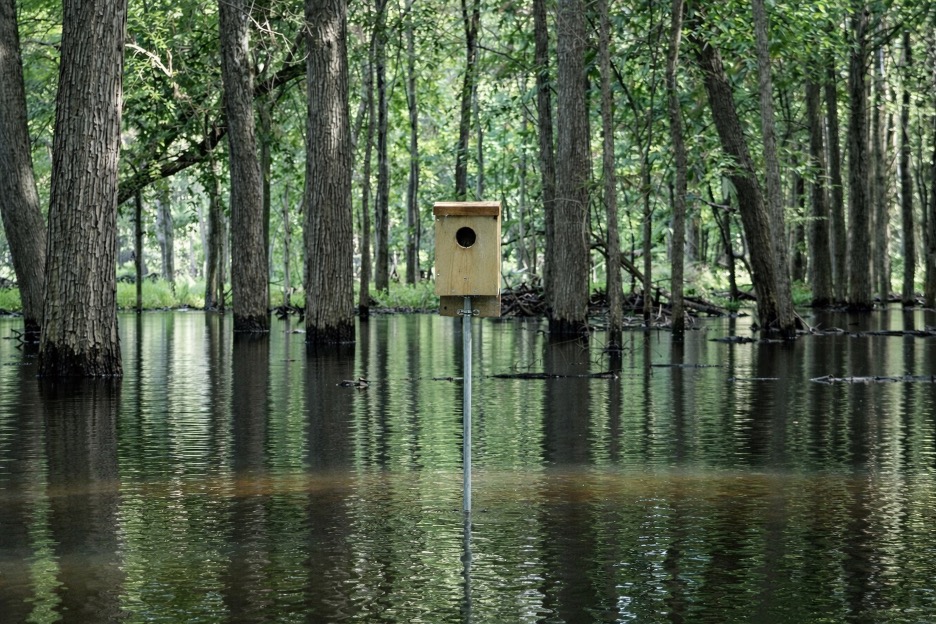
Fig. 1. A standard wooden nest box mounted on a 1.5-m pole at our study site in Scott County, Iowa.
Fig. 2
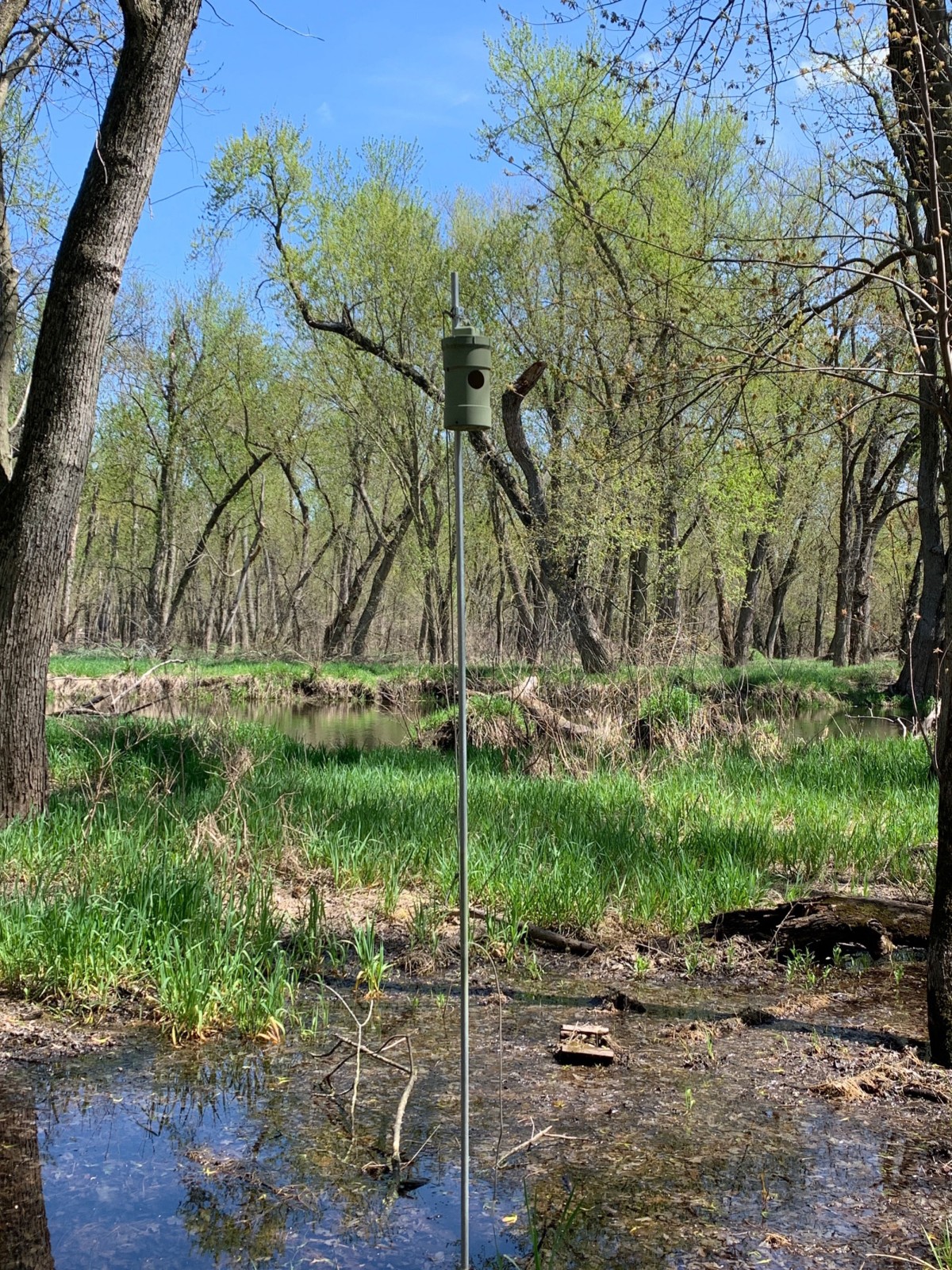
Fig. 2. A flood resistant PVC nest box designed to be elevated above potential flood waters at our study site in Scott County, Iowa. It is mounted on a 3 m electrical conduit pole.
Fig. 3
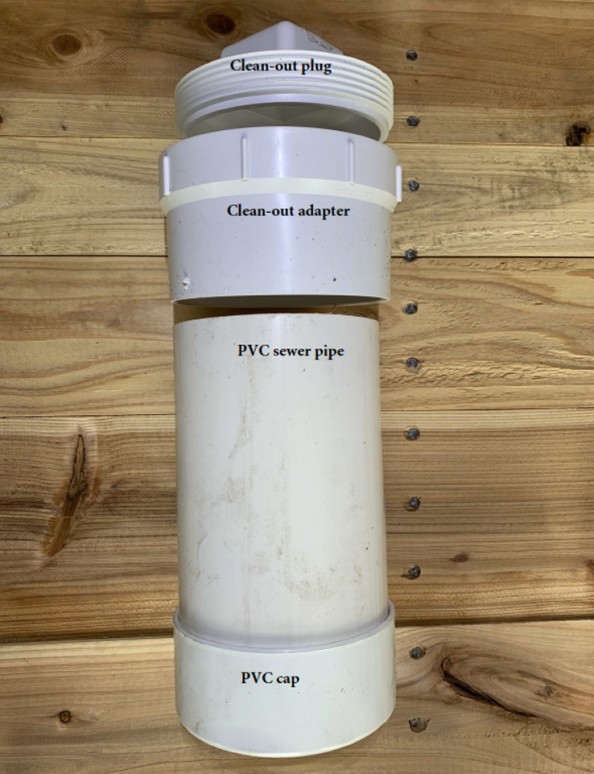
Fig. 3. A flood resistant PVC nest box showing the individual pieces before assembly. The body is a PVC sewer pipe that is approximately 18 cm long and 10.1 cm wide. A PVC cap is glued to the bottom and the top consists of a cleanout plug screwed into a cleanout adapter. The adapter is unscrewed to check the nest contents and for cleaning.
Fig. 4
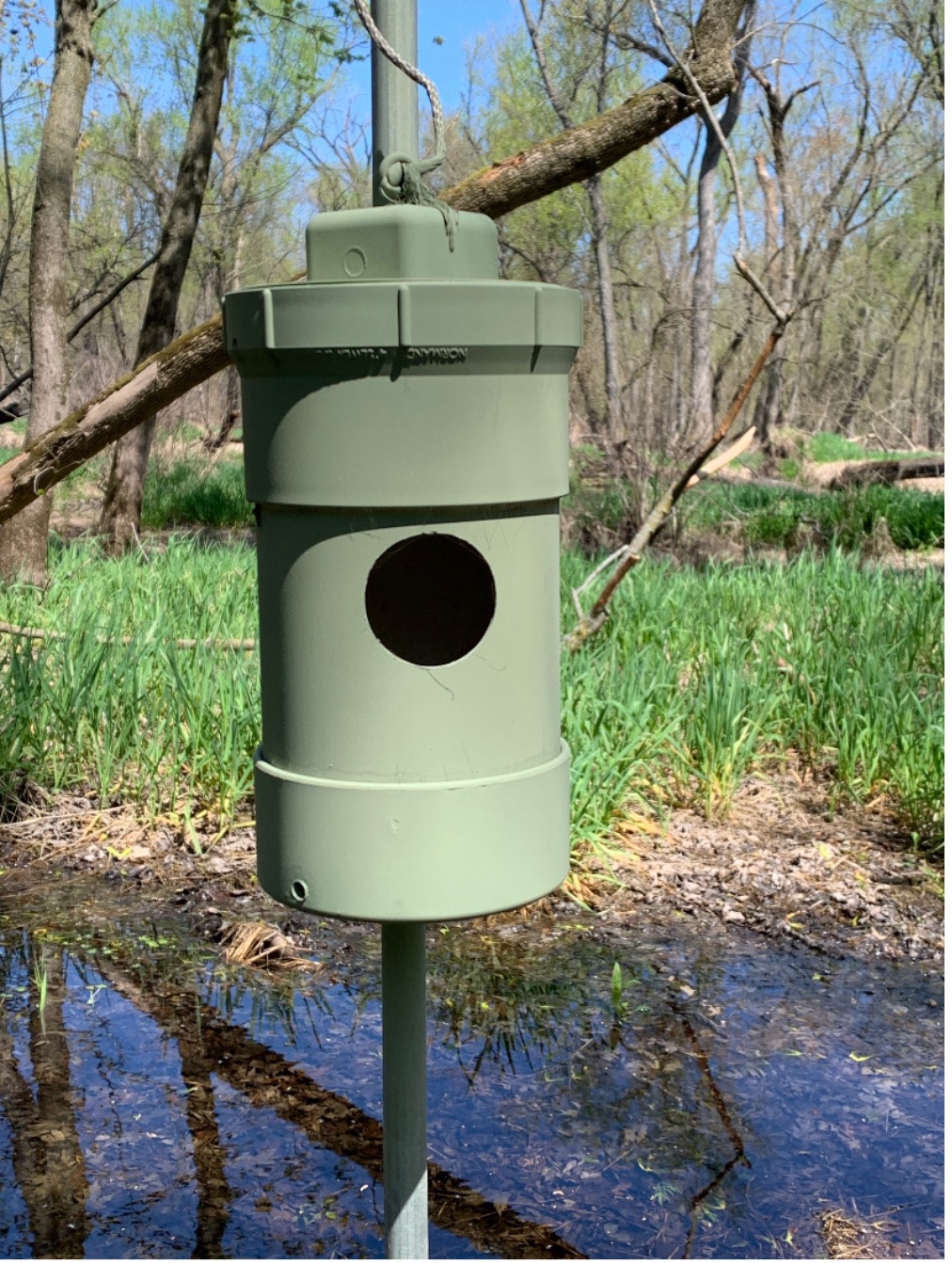
Fig. 4. A flood resistant PVC nest box attached to the electrical conduit pole showing the paracord attached to the screw-eye hook on top of the nest box. The nest box is raised above potential flood waters and then lowered to check the nest contents using the paracord.
Fig. 5
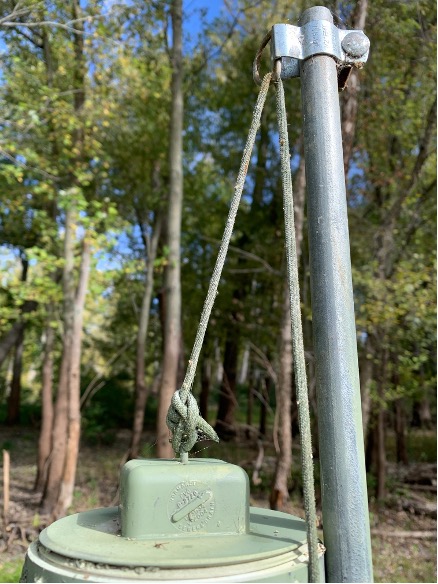
Fig. 5. A conduit hangar is attached at the top of the electrical conduit pole and has a ring through which the paracord is pulled up and down to check the nest box contents and then to return it to its resting location at the top of the electrical conduit pole.
Fig. 6
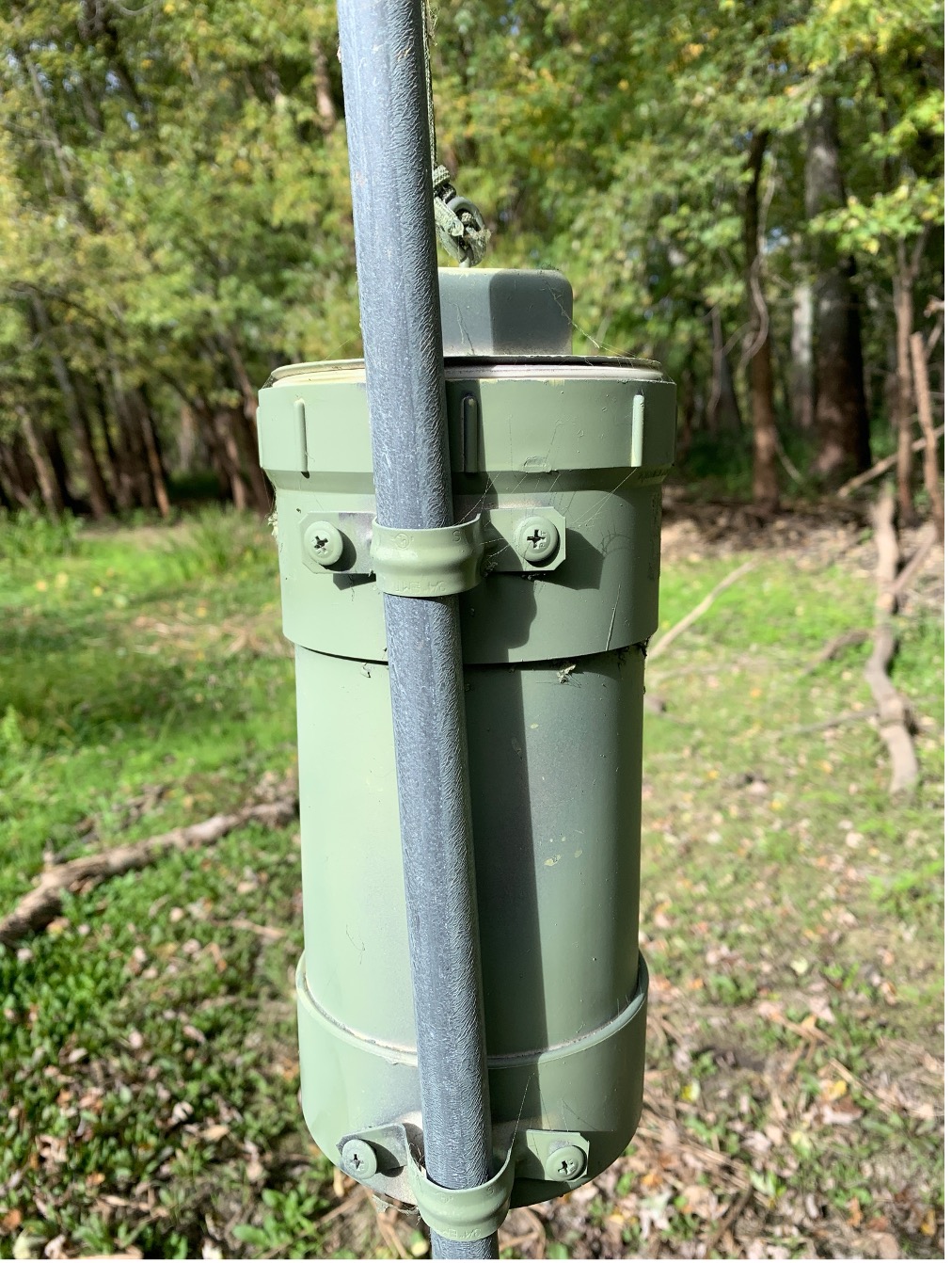
Fig. 6. The rear side of the flood resistant PVC nest box showing the nest box mounted onto the electrical conduit pole with conduit straps.
Table 1
Table 1. Flooding outcomes for nest boxes at our study site in Scott County, Iowa by year and box type, including the percentage of nests flooded (sample size in parentheses), maximum flood depth recorded for the Mississippi River at the Rock Island Lock and Dam 15, and the historical crest ranking for that flood event (U.S. Army Corps of Engineers 2024).
| Year | Nest box type | Percent of nests flooded (n) | Maximum flood depth | Record crest level | |||||
| 2017 | Standard wooden | 81.2 (48) | 5.2 m | 34th highest | |||||
| 2018 | Flood resistant PVC | 0 (30) | 5.3 m | 28th highest | |||||
| 2019 | Flood resistant PVC | 100 (50) | 6.92 m | 1st highest | |||||
| 2023 | Flood resistant PVC | 0 (80) | 6.6 m | 7th highest | |||||