





The following is the established format for referencing this article:
Caparroz, R., K. C. E. Leite, A. V. Rocha, D. J. Brightsmith, G. Vigo-Trauco, and I. Berkunsky. 2026. Genetic evaluation of reproductive strategies and breeding-site fidelity in the socially monogamous Turquoise-fronted Amazon (Amazona aestiva, Psittaciformes: Aves). Journal of Field Ornithology 97(4):1.ABSTRACT
Genetic monogamy, conspecific brood parasitism, and breeding-site fidelity are key components of avian reproductive strategies but remain poorly documented in parrots. We examined these traits in the Turquoise-fronted Amazon (Amazona aestiva) using microsatellite-based sibship reconstruction of 35 broods sampled in central Brazil and northern Argentina. Overall, 63% of sampled broods consisted exclusively of full siblings, 23% included half-siblings, and 17% contained at least one unrelated nestling, indicating moderate levels of extra-pair paternity and conspecific brood parasitism. Our results demonstrate that the Turquoise-fronted Amazon is not genetically monogamous, exhibits conspecific brood parasitism, and moderate breeding-site fidelity across seasons. These findings suggest a complex interplay between social behavior and reproductive strategies, providing new insights into the evolution of mating systems in socially monogamous, cavity-nesting Neotropical parrots.
RESUMEN
La monogamia genética, el parasitismo de cría entre congéneres y la fidelidad al lugar de cría son componentes clave de las estrategias reproductivas de las aves, pero siguen estando poco documentados en los loros. Examinado estos rasgos Amazona aestiva mediante la reconstrucción de parentesco basada en microsatélites de 35 nidadas muestreadas en el centro de Brasil y el norte de Argentina. En general, el 63 % de las crías muestreadas estaban compuestas exclusivamente por hermanos plenos, el 23 % incluía medio hermanos y el 17 % contenía al menos un polluelo no emparentado, lo que indica niveles moderados de paternidad extrapareja y parasitismo de nido por congéneres. Nuestros resultados demuestran que A. aestiva no es genéticamente monógama, presenta parasitismo de nido por congéneres y una fidelidad moderada al lugar de cría a lo largo de las estaciones. Estos hallazgos sugieren una compleja interacción entre el comportamiento social y las estrategias reproductivas, lo que aporta nuevos conocimientos sobre la evolución de los sistemas de apareamiento en los loros neotropicales socialmente monógamos que anidan en cavidades.
INTRODUCTION
Beneath the seemingly faithful partnerships of socially monogamous birds lies a complex web of reproductive strategies that challenges our understanding of avian mating systems. Although more than 80% of bird species are socially monogamous (forming single-pair bonds during the breeding season and providing care by both parents; Cockburn 2006), the majority are not genetically monogamous (Griffiths et al. 2002). A recent review suggests that 76% of 255 socially monogamous bird species with biparental care exhibited some level of extra-pair paternity (EPP), with females more frequently engaging in extra-pair copulations (Brouwer and Griffith 2019). Nevertheless, the authors emphasize that, despite the relatively large number of species examined, overall EPP estimates remain strongly shaped by taxonomic and geographic biases. For instance, although approximately 400 Psittaciformes species exist, EPP rates had been examined in only five by the time of the review.
Psittaciformes are generally socially monogamous, forming strong pair bonds that may last a lifetime (Forshaw 1989, Sick 1997). Moreover, most parrot species exhibit traits hypothesized to favor genetic monogamy, including high levels of biparental investment (Forshaw 1989) and long lifespans (Griffiths et al. 2002, Brouwer et al. 2007). These characteristics make parrots a particularly suitable group for investigating the relationship between social and genetic monogamy. The limited number of genetic studies conducted so far has revealed highly variable levels of EPP among socially monogamous parrot species (Caparroz et al. 2001, Masello et al. 2002, Beissinger 2008, Taylor and Parkin 2009, da Silva et al. 2010, Caparroz et al. 2011, Martinez et al. 2013, Eastwood et al. 2018, Heinsohn et al. 2019, Stojanovic et al. 2023). Although no EPP has been detected in species such as the Crimson Rosella (Eastwood et al. 2018) and the Burrowing Parrot (Masello et al. 2002), rates as high as 50% have been reported in a population of Swift Parrots (Heinsohn et al. 2019). In addition, varying levels of conspecific brood parasitism have also been reported in some parrot species (Eastwood et al. 2018), suggesting the presence of complex and diverse reproductive strategies within this order.
Psittaciformes also constitute an interesting group for studying cavity reoccupation and nest-site fidelity, as nearly all species in this order are obligate secondary cavity nesters (Forshaw 1989). Several studies have shown that many bird species, including parrots, tend to reuse nesting sites across successive breeding seasons (Greenwood 1980, Ingold 1991, Berkunsky and Reboreda 2009, Salinas-Melgoza et al. 2009). In some parrot species with low reoccupation rates, this behavior appears to be linked to high predation levels (Brightsmith 2005). In contrast, species with high reoccupation rates often inhabit areas with scarce suitable cavities (White et al. 2005, Sanz and Rodríguez-Ferraro 2006). Because most studies have been conducted on unmarked individuals, they have generally been unable to determine whether the same or different pairs reuse a given cavity. However, the few studies that have tracked marked individuals indicate that populations with high rates of cavity reoccupation are typically composed of pairs exhibiting strong nest-site fidelity (Snyder et al. 1987, Waltman and Beissinger 1992, Berkunsky and Reboreda 2009). Therefore, further studies of other socially monogamous parrot species are essential to improve our understanding of reproductive strategies and nest-site fidelity, both within this group and across birds more broadly.
One of the main challenges in studying breeding behavior and breeding-site fidelity in wild populations is establishing kinship relationships. Genetic mating systems have been successfully characterized by using microsatellite-based relatedness analyses, comparing the genotypes of social parents with those of their offspring within broods (Wang 2004, Jones et al. 2010). However, obtaining adult samples remains difficult for many wild species, including parrots, because of difficulty accessing nest cavities and the high risk of injury to both birds and researchers during capture. As a result, some studies have relied on genetic sibship reconstruction among nestlings within broods to infer patterns of relatedness and mating systems, even in the absence of parental genotypes (Wang 2004, Miño et al. 2011).
Under these circumstances, broods composed entirely of full siblings cannot be unequivocally interpreted as evidence of genetic monogamy by the social pair, as similar patterns may also result from extra-pair fertilizations involving non-social males or from conspecific brood parasitism. In contrast, the presence of half-siblings or unrelated nestlings within the same brood provides strong evidence of extra-pair paternity and conspecific brood parasitism, respectively. When considered alongside information on cavity reuse across breeding seasons, sibship patterns among nestlings can help elucidate mating systems and breeding-site fidelity. However, these interpretations remain constrained by the absence of parental genetic data.
The Turquoise-fronted Amazon (Amazona aestiva) is a widely distributed Neotropical parrot inhabiting habitats ranging from dry tropical forests to subtropical vegetation, primarily within Argentina’s Chaco province and Brazil’s Cerrado (savanna) biome (Forshaw 1989, Sick 1997). Like other Amazons, the species is considered socially monogamous (Forshaw 1989, Sick 1997) and exhibits high nest-site reoccupation rates (Seixas and Mourão 2002, Berkunsky and Reboreda 2009). In addition, this Amazon is a non-excavating cavity species, making cavity availability a key factor influencing its reproductive success (Seixas and Mourão 2025). However, no genetic studies have investigated its mating system, and nest-site fidelity has been evaluated in only a small number of banded females across successive breeding seasons (Berkunsky and Reboreda 2009), which limits our ability to determine the rates of cavity reuse by the same pairs across seasons. Although currently listed as Near Threatened by the IUCN (BirdLife International 2019) and the Brazilian Ministry of the Environment (MMA 2022), population declines have been reported in several regions, primarily because of habitat loss and the harvesting of chicks for the illegal wildlife trade (Seixas and Mourão 2000, Seixas and Mourão 2002, Berkunsky et al. 2017). Consequently, gaining detailed knowledge of its reproductive biology is critical for informing effective conservation strategies.
In this study, we used multilocus microsatellite genotypes to reconstruct sibship relationships among nestlings of the Turquoise-fronted Amazon in order to address two primary objectives: (1) to characterize the species’ genetic mating system, and (2) to evaluate patterns of cavity and site fidelity across breeding seasons in the absence of parental genotypes. To assess the genetic mating system, we reconstructed sibships within broods and classified nestlings as full siblings (FS), half-siblings (HS), or unrelated (UR). We interpreted broods composed exclusively of full siblings as indicative of genetic monogamy, while acknowledging that such patterns cannot exclude alternative reproductive scenarios in the absence of parental genotypes. In contrast, we interpreted broods with half-siblings as evidence of extra-pair paternity and the presence of unrelated nestlings as evidence of conspecific brood parasitism.
To evaluate breeding-site fidelity, we distinguished between cavity fidelity and broader site fidelity. We interpreted the repeated occurrence of full-sibling or half-sibling broods in the same cavity across breeding seasons as evidence of cavity fidelity. Site-level fidelity was inferred when genetically identified parents were detected across seasons within the study area but not in the same cavity. This study provides the first genetic assessment of the mating system and breeding-site fidelity in the Turquoise-fronted Amazon, contributing to a clearer understanding of its reproductive strategies.
METHODS
Study area and data collection
The study was conducted in two natural reserves in the Distrito Federal (DF), Central Brazil, and one in the Chaco Province (CP), northern Argentina (Table 1). In the Distrito Federal, the two study areas consisted of remnants of Cerrado (Brazilian savanna) embedded within an anthropogenic matrix composed of urban zones and rural areas extensively modified by agriculture. In total, 14 cavities used by Turquoise-fronted Amazons were monitored in these reserves for up to six consecutive breeding seasons (2004–2009). Of these, 11 were located in dead Mauritia flexuosa palms, one in a Pterodon emarginatus tree, and two in artificial wooden nest boxes previously installed by our team in live palm trees (Table A1). In the Chaco Province, Argentina, 14 natural cavities were monitored during a single breeding season (2004–2005): 12 in Aspidosperma quebracho-blanco and 2 in Schinopsis quebracho-blanco (Table A1). The breeding season spans from July to December in DF/Brazil and from October to February in Chaco Province. All cavities in both populations were first inspected at the onset of the breeding season and subsequently revisited at intervals of fewer than 20 d until a final outcome was determined (either total brood loss or successful fledging). Some cavities in Brazil could not be inspected every season for several reasons, such as unsafe conditions when climbing dead palms (N07 and N08), difficulty in reaching the site (N10, N12 and N13), or restricted access, typically because of flooding (N11). Eggs were classified as unhatched only after the expected incubation period had elapsed (more than 30 d). The specific biological causes for hatching failure (e.g., infertility vs. early embryo death) were not the primary focus of this study and thus not systematically investigated.
Cavity occupancy
A cavity was considered occupied when a clutch was initiated and reoccupied when the same cavity was used for clutch initiation in more than one breeding season. Clutch and brood loss were categorized as follows: flooding (eggs or nestlings found drowned); predation (eggs or nestlings disappeared before the expected fledging date without signs of nest destruction); and human interference (cavity contents disappeared and signs of human disturbance were observed). Throughout the study, when it was possible, we recorded whether cavities occupied in previous years remained available in subsequent years. Cavities were classified as unavailable when the entire tree or the portion containing the cavity had fallen.
DNA samples
Blood samples (0.1 mL) were collected from the brachial vein of 84 nestlings from 35 different broods using sterile, disposable syringes (Table 1). Because capturing adults is difficult and stressful, it was not possible to sample the majority of their putative parents. Only incubating females captured inside three cavities in Argentina were sampled. Blood samples were stored in microtubes containing 100% ethanol at room temperature while in the field and then kept at 4 °C until DNA isolation.
Total genomic DNA was extracted overnight from incubated blood samples at 37 °C in a solution containing 0.1% SDS, 100 mM Tris-HCl (pH 8.0), 10 mM NaCl, 10 mM EDTA, and 10 mg/mL proteinase K, and subsequently purified by using the standard phenol-chloroform-isoamyl alcohol method (Bruford et al. 1998).
Microsatellite genotyping
Six microsatellite loci (AgGT07, AgGT12, AgGT21, AgGT29, AgGT72, and AgGT83) described by Russello et al. (2001, 2005) for the St. Vincent Amazon (Amazona guildingii) and previously optimized for the Turquoise-fronted Amazon (Caparroz et al. 2007) were used to genotype all individuals. Forward primers were labeled with a fluorescent dye: 6-FAM, HEX, or NED. The reactions were performed separately for each locus in a final volume of 12.5 μL containing 20–50 ng of DNA, 10 mM Tris-HCl (pH 8.3), 50 mM KCl, 2.5 mM MgCl2, 0.8 mM dNTPs, 0.8 μM of each primer and 0.5 U Taq polymerase (Pharmacia). Each reaction consisted of an initial step at 95 °C for 10 min, followed by 35 cycles at 95 °C for 60 s, 48–59 °C (depending on the locus) for 40 s, and 72 °C for 40 s, and a final step at 72 °C for 10 min. PCR products were electrophoresed in 5% denaturing acrylamide gels by using an ABI 377 DNA automated sequencer and analyzed with GeneScan and Genotyper, version 2.1 (Perkin-Elmer).
Leite et al. (2008) analyzed the genetic structure of all Turquoise-fronted Amazon populations studied here and found no evidence of genetic differentiation among them. Therefore, we considered all Turquoise-fronted Amazon individuals to belong to a single panmictic population for the following analyses. To avoid redundancy in allele frequency estimates, genotypes from only one nestling per cavity (28 nestlings, 14 from each location) were used to calculate population allele frequencies. The number of alleles, observed and expected heterozygosity, polymorphic information content, probability of identity, and non-exclusion probability (both parents) were computed by using CERVUS 3.0.7 (Kalinowski et al. 2007). Deviations from Hardy–Weinberg equilibrium and linkage disequilibrium were tested for all pairs of loci by using exact tests based on the Markov chain method (Guo and Thompson 1992), as implemented in Genepop 1.2 (Raymond and Rousset 1995), with 1000 dememorizations, 1000 batches, and 10,000 iterations. To correct for multiple comparisons, type I error rates for tests of LD and HWE deviations were adjusted by using the sequential Bonferroni procedure (Rice 1989). The presence of null alleles, allelic dropout, and scoring errors was assessed by using Micro-Checker 2.2.3 (Van Oosterhout et al. 2004).
Sibship reconstruction
To reconstruct the sibship relationships among nestlings, we used two approaches: (1) assessing the maximum-likelihood estimates relationship for each pair of nestlings using ML-Relate (Kalinowski et al. 2006), and (2) searching for the maximum-likelihood configuration of sibship structures across the entire sample using Colony 2.0 (Jones and Wang 2010). The former compares the probabilities of different relationship hypotheses, full-sibs (FS), half-sibs (HS), unrelated (UR), and parent–offspring (PO), between two individuals, based on simulations and population allele frequencies, while correcting for deviations caused by the presence of null alleles.
In contrast, Colony assigns individuals to full-sib and half-sib families by inferring the minimum number of parents necessary to explain the observed genotypes (clusters) when parental genotypes are unknown. Sampled candidate females and males may or may not be assigned to these groups. Offspring were classified as full siblings (FS) when they shared both parents (sampled or not), half siblings (HS) when they shared only one parent, and unrelated (UR) when they shared neither parent. The algorithm assumes that candidate parents are unrelated to each other. We performed three independent “very long” runs for each population using the full likelihood method. The dataset was analyzed under the assumption of male monogamy and female polygamy, with genotyping error rates set at 0.025 per locus, as recommended by Wang (2004). Although the approach implemented in Colony is more powerful than the pairwise method implemented in ML-Relate for reconstructing family relationships (Wang and Santure 2009), it does not use a strict inclusion or exclusion threshold to form family groups. Therefore, we adopted a conservative criterion and only HS and UR relationships that represented the maximum-likelihood outcome in both approaches were considered acceptable, ensuring that only robust, well-supported relationships were included in the analysis. Singleton nestlings were not assigned to a sibship category (FS, HS, or UR) and were excluded from summary statistics requiring within-brood comparisons. However, they were included in comparisons among broods from different breeding seasons to evaluate nest-site fidelity.
For reconstructed broods containing mixed sibship relationships, any brood including at least one half-sibling relationship was classified as HS, whereas a brood was designated as UR when at least one nestling was genetically unrelated to the other within the same brood. In broods containing three or more nestlings, cases in which one nestling was unrelated to a group of full siblings were classified as mixed broods (FS + UR), rather than as purely UR.
To evaluate potential differences in the distribution of sibship categories (FS, HS, and UR) between the two populations, we performed a chi-square test of homogeneity using a contingency table to assess whether the relative frequency of each category was independent of population. Because of the small sample size and the presence of cells with expected counts < 5, we additionally applied the Freeman–Halton extension of Fisher’s exact test. Effect size was quantified using Cramér’s V, and standardized residuals were examined to identify the categories contributing most to any observed differences. All analyses were conducted in R (version 4.3.2, R Core Team 2023) by using the functions chisq.test and fisher.test.
To specifically assess whether broods classified as unrelated (UR) tended to be larger, potentially due to CBP, we tested for differences in brood size among sibship categories (FS, HS, and UR) using a Generalized Linear Model (GLM) with a Poisson error distribution and a log link function (McCullagh and Nelder 1989, Zuur et al. 2009). Analyses were by conducted in R using the stats package, and statistical significance was assessed by using likelihood ratio tests.
The nest-site fidelity analysis was based on a subsample of 25 nestlings from four cavities in the DF (N02, N04, N05, and N06; see Table A2), for which nestlings were sampled in more than one breeding season. In addition, we estimated the number of genetically breeding females and males identified through sibship reconstruction using Colony across all breeding seasons in the DF. For each genetically inferred parent, we quantified the number of breeding seasons in which it contributed to the sampled nestlings. This approach provides a complementary, site-level measure of fidelity based on repeated parental occurrence across seasons, rather than on reuse of a specific cavity.
RESULTS
A total of 32 nesting attempts were monitored across up to six breeding seasons in Brazil (Table 1 and Table A2). Complete clutch or brood loss occurred in 13 attempts (41%), including ten during the egg-laying or incubation stages and three during the early nestling stage. Most losses were likely attributable to predation by unidentified species. One cavity (N05) was flooded during the 2006 breeding season, causing total brood loss, and another (N12) was likely poached in both 2005 and 2006 (Table A2). Four of the previously occupied cavities were subsequently destroyed by wind or heavy rain. The cavities N05, N13, and B14 previously occupied by Turquoise-fronted Amazons were subsequently used by Toco Toucans (Ramphastos toco), Barn Owls (Tyto alba), and Honeybees (Apis mellifera), respectively (Table A2). Interspecific agonistic interactions were not observed during the field work.
Among the 14 nesting attempts monitored in Argentina, three (21.4%) suffered predation or brood loss. In two additional cases, the incubating females were predated inside the cavity.
All six loci were moderately to highly polymorphic in the Turquoise-fronted Amazon population of 28 individuals considered for the allele frequency estimates. The number of alleles per locus varied from 14 (AgGT29) to 21 (AgGT83), and the expected heterozygosity ranged from 0.86 to 0.94 (Table A3). The allele frequencies were within expectations of the Hardy-Weinberg equilibrium at each locus, and there was no evidence of linkage disequilibrium for any pair of loci. No loci showed evidence of significant null allele frequencies, allelic dropout, or scoring errors. Considering all of the loci analyzed, we found an extremely low combined probability of genetic identity (1.58x10⁻¹¹) and a low probability of non-parent exclusion (3.0x10⁻⁸) (Table A3), indicating that the battery of microsatellites used in this study is a powerful tool to allow the examination of parentage in the Turquoise-fronted Amazon.
Sibship reconstruction
The two sibship estimation approaches yielded congruent results, with discrepancies observed only in two sampled broods from Brazil. In the first case, both methods classified the N04_2007 brood nestlings as UR. However, one of these nestlings was estimated as HS or FS of the others from the same cavity but different seasons (2004 and 2008) by ML-Relate, whereas Colony assigned it as UR (Table A4). In the second case (N10), ML-Relate inferred a FS relationship among the nestlings, while Colony classified them as UR. Following our consistency criterion between the two approaches, these latter nestlings were ultimately classified as FS.
The maximum-likelihood analysis by Colony reconstructed 22 and 18 full-sib groups (GFS) in Brazil and Argentina (AR), respectively (Tables A4 and A5). Most of these reconstructed groups (22 of 40, 55%) consisted of nestlings sampled from the same brood and cavity: 9 of 22 (41%) in DF and 13 of 18 (72%) in AR. Three full-sib reconstructed groups were formed by nestlings from different broods, sampled either within the same breeding season (GFS 2 and 5 in DF) or across different seasons (GFS 7 in DF). The remaining 14 reconstructed groups (10 in DF and 4 in AR) consisted of a single nestling that was assigned to a distinct group, rather than clustering with the other nestlings from the same brood.
Of the 30 sampled broods for which genetic relationships among nestlings could be estimated (i.e., broods containing two or more nestlings), 60% (18/30) were classified as FS, 23% (7/30) as HS, and 10% (3/30) as UR, according to our consistency criterion (Fig. 1; Table A6). In addition, two FS broods (one in each population) also contained one unrelated nestling (FS+UR category), resulting in five broods (17%; 5/30) containing one UR nestlings. All 12 sampled broods classified as HS or UR consisted of two nestlings (n = 6) or three nestlings (n = 6). In broods containing three nestlings, only one nestling was identified as half sibling (n = 4) or unrelated (n = 2). The FS, HS, and UR categories were interpreted as indicative of genetic monogamy, extra-pair paternity (EPP), and conspecific brood parasitism (CBP), respectively (Fig. 2). Of the 79 nestlings distributed across 30 sampled broods containing two or more nestlings, seven (8.9%) were identified as originating from extra-pair copulations, including four in Brazil and three in Argentina (Tables A4 and A5). All three females captured inside their cavities were correctly identified as the mothers of their respective nestlings (Table A5).
The proportions of sibship categories (ratio of FS to UR) did not differ significantly between the two populations, (chi-square test, χ² = 1.01, p = 0.60; Cramér’s V test−φc= 0.18) (Table A6). Likewise, there was no significant difference in the proportions of sibship types between populations (Fisher’s exact test, p = 0.76).
Mean brood size tended slightly higher in full-sibling broods (2.79 ± 0.51, n = 24) than in broods containing half-siblings (2.57 ± 0.54, n = 7) or unrelated nestlings (2.40 ± 0.55, n = 5). However, these differences were not statistically significant among sibship categories (Poisson GLM, χ² = 0.29, df = 2, p = 0.865).
Cavity reoccupation and breeding-site fidelity
Ten cavities were successfully monitored for more than one breeding season in Brazil and eight (80%) were reused at least once by the Turquoise-fronted Amazons (Table A2). Four were used in two seasons, one in three seasons, and three in five seasons. Overall, most cavities were reoccupied in consecutive years and were only not reused by parrots in subsequent seasons when they fell down and became unavailable or were taken over by other species (interspecific competition). Furthermore, five of the six cavities (83%) that experienced clutch or brood loss in one season were reoccupied in the following season. No cases of cavity reuse by Turquoise-fronted Amazons were recorded within the same breeding season in either population.
Sibship reconstruction indicated that, in the four cavities for which nestlings from different breeding seasons were genetically analyzed (N02, N04, N05, and N06), the same Amazon pair occupied each cavity at least twice during the monitoring period (Fig. 3; Table A4). However, the reoccupancy rates may have been higher, because in all these cavities at least one unsuccessful and non-genotyped clutch/brood occurred between successful breeding attempts.
Patterns of cavity use further suggest temporal turnover of breeding pairs and cavity switching across seasons. In one cavity (N05), a pair reused the cavity following a successful breeding attempt by a different pair in the previous season. In another cavity (N04), at least two pairs appeared to occupy the cavity alternately (Fig. 3). However, in the latter, genetic relationships among nestlings from different seasons were inconsistent, with discordant sibship assignments between ML-Relate and Colony for a single nestling from the 2007 brood. This uncertainty precluded a definitive assessment of whether one nestling from 2007 were related to the pair breeding in 2004 and 2008, highlighting limitations imposed by incomplete genetic sampling and methodological differences among sibship inference approaches. Nevertheless, the nestling consistently assigned as unrelated to those from 2004 and 2008 was produced by the same pair that occupied a different cavity (N10) in 2004, indicating cavity switching by that pair.
At the population level, sibship reconstructions inferred 13 genetically females and 22 males as parents of all genetically analyzed nestlings (n = 47) across all breeding seasons in the DF. In addition to the four females that reused the same cavities across different seasons, three additional females produced offspring in different cavities in two breeding seasons. In contrast, only one male produced offspring in different cavities across two breeding seasons. Overall, 54% (7/13) of genetically inferred females and 23% (5/22) of males returned at least once to the same site for reproduction (Fig. A1).
DISCUSSION
Using genetic sibship reconstruction, we provide the first evidence of extra-pair paternity in an Amazona species, with a moderate rate (23%) detected among sampled broods of Turquoise-fronted Amazon. We also found a moderate incidence of conspecific brood parasitism (17%), as well as repeated use of the same or different cavities within the study site by some individuals during the monitoring period. Specifically, 54% of genetically inferred females and 23% of males reused cavities, either the same cavity (31% of females; 18% of males) or different cavities within the site, indicating some degree of breeding-site fidelity in this species.
Turquoise-fronted Amazons form strong, year-round pair bonds and are considered socially monogamous (Forshaw 1989, Sick 1997). They are long-lived tropical parrots (Young et al. 2012), with documented lifespans of at least 49 years in captivity (Brouwer et al. 2007). Field observations made by the authors suggest that Turquoise-fronted Amazon males exhibit strong parental care, feeding females and chicks during the breeding season (R.C. and I.B., personal observations). In addition, apparent mate guarding is commonly observed, as most individuals are usually seen flying in pairs or family groups during the breeding season, except when females are incubating or brooding (Seixas and Mourão 2018).
These behavioral traits are generally associated with genetic monogamy and low rates of extrapair fertilization in birds (Birkhead and Møller 1996, Wink and Dyrcz 1999, Arnold and Owens 2002, Griffth et al. 2002). Contrary to these expectations, our sibship reconstruction revealed that the Turquoise-fronted Amazon is not genetically monogamous, with approximately 23% of broods containing one nestling likely sired by an extra-pair male. This frequency is relatively high for parrots, though lower than the rates reported for other socially monogamous species, such as the Monk Parakeet (40%, Martinez et al. 2013) and the Swift Parrot (50%, Heinsohn et al. 2019).
Extra-pair paternity (EPP) has been definitively reported in only four species of socially monogamous parrots: the Green-rumped Parrotlet (Melland 2000), Monk Parakeet (Martinez et al. 2013), Swift Parrot (Heinsohn et al. 2019), and Superb Parrot (Stojanovic et al. 2023). In three additional species, studies have identified broods containing nestlings that were not full siblings: the Red-and-green Macaw (Caparroz et al. 2001), Blue-and-yellow Macaw (Caparroz et al. 2001, 2011), and Echo Parakeet (Taylor and Parkin 2009). However, in these cases, it was not possible to determine whether these patterns resulted from EPP or conspecific brood parasitism.
Variation in EPP among birds has been attributed to several adaptive and non-adaptive factors (Brouwer and Griffith 2019), and population and nest density have been proposed as potential correlates in parrots (Masello et al. 2002, da Silva et al. 2010, Caparroz et al. 2011, Martinez et al. 2013). However, empirical support for this association remains limited. For example, Martinez et al. (2013) provided indirect evidence, showing that EPP rate in Monk Parakeets reached 40% in dense native populations in Argentina but was absent in an expanding introduced population in the United States (da Silva 2010). Higher densities may increase encounter rates, including encounters with mature single males, and reduce the effectiveness of male mate guarding, thereby favoring extra-pair paternity (Westneat et al. 1990).
The Monk Parakeet is an exception among parrots, as it is the only species that builds large, conspicuous colonial nests composed of dozens of chambers shared by multiple breeding pairs (Burgio et al. 2025). In contrast, the Burrowing Parrot also breeds colonially, excavating dense clusters of burrows in sand cliffs, yet no cases of EPP have been observed for this species (Masello et al. 2002). Differences in EPP rates between these two colony nesters may be associated with differences in their breeding strategies. Monk Parakeets occasionally exhibit cooperative breeding (Martinez et al. 2013), whereas Burrowing Parrots breed in socially monogamous pairs (Masello et al. 2002).
Like other parrot species, particularly congeners in Amazona (Martinez and Prestes 2002, Pizo 2002, Cougil and Marsden 2004), Turquoise-fronted Amazons form large communal roosts in patches of native and exotic trees (Carrara et al. 2007, Seixas and Mourão 2018). Roost density varies markedly throughout the year, primarily in response to the breeding cycle: during incubation, pairs remain near their nests, with some individuals (presumably the females) sleeping in the nests, while other individuals return to the communal roosts to spend the night (Carrara et al. 2007, Martinez and Prestes 2008, Seixas and Mourão 2018). Seixas and Mourão (2018) systematically monitored five roosts in the southern Pantanal, Brazil, over a four-year period and found that roost maximum counts (median from 110 to 2896 Amazons) occurred during the pre-breeding period (June–July) and declined sharply (median from 100 to 940 Amazons) during incubation (August–October). These communal roosts represent major aggregation events in Amazons.
Extra-pair copulations may also occur away from communal roosts, possibly near the nests or even inside them, during periods of reduced mate guarding. Although males tend to remain close to their pair-bonded mate during the breeding season (Seixas and Mourão 2018), brief absences related foraging or nest activities could create opportunities for extra-pair interactions.
Nest density has also been hypothesized to influence EPP (Møller and Birkhead 1993). Although nest density was not quantified in our study, several nests were located in spatial proximity. In the monitored Brazilian population, most nests occurred in Mauritia flexuosa palms (Table A2), a species that naturally occurs in aggregated patches (veredas) and along rivers in gallery forests (Oliveira-Filho and Ratter 2002). In one of the areas studied, 82% (9/11) of nests were situated along the same gallery forest within a linear distance of less than 1 km. Nevertheless, because density metrics were not systematically measured, any association between aggregation patterns and EPP in this population remains speculative. Overall, although variation in population and nest density may contribute to differences in EPP levels across species, we did not directly assess these variables. Therefore, their potential influence on the moderate EPP rate observed here should be interpreted cautiously and evaluated in future studies.
Conspecific brood parasitism
We identified 22% (4/18) and 8% (1/12) of sampled broods composed of unrelated nestlings in the Brazil and Argentina populations, respectively (Fig. 1). Broods comprising nestlings from different parental pairs have been reported in few socially monogamous parrot species (Caparroz et al. 2001, Masello et al. 2002, Taylor and Parkin 2009, Caparroz et al. 2011, Martinez et al. 2013, Eastwood et al. 2018). In those studies, such patterns were generally interpreted as intra- or conspecific brood parasitism, in which a female lays eggs in the nest of another conspecific and provides no parental care to her own offspring (Yom-Tov 1980, Lyon and Eadie 2008). However, alternative processes, such as brood mixing between adjacent nest chambers, may generate similar genetic patterns, as reported for the colonially nesting Burrowing Parrot (Masello et al. 2002).
The level of CBP estimated for the Turquoise-fronted Amazon appears higher than previously reported values for parrots, even when compared with colonially nesting species, such as 4% in the Burrowing Parrot (Masello et al. 2002) and 3% in the Monk Parakeet (Martínez et al. 2013). However, comparisons among species should be made cautiously, as methodologies, sampling intensity, and ecological contexts differ among studies. Colonially nesting species are often expected to show higher CBP rates because of nest proximity (Rohwer and Freeman 1989). In our study populations, some nests were spatially clustered, potentially increasing opportunities for conspecific brood parasitism (CBP). However, because nest density was not systematically quantified, any relationship between nest proximity and CBP in this species requires further investigation.
CBP is unlikely to be explained by a single factor and may instead result from multiple interacting ecological and life-history variables (Semel and Sherman 2001). For example, Masello et al. (2002) suggested that CBP levels observed in the Burrowing Parrot may reflect a trade-off between increasing brood size at a relatively low additional parental cost and seasonal declines in chick survival, as hypothesized by Lyon (1993). In that species, a prolonged egg-laying period (approximately 32 d) may facilitate the production of additional eggs beyond a female’s own clutch. A long-term study in northern Argentina reported that the egg-laying period in the Turquoise-fronted Amazon may extend from six to eight wk and that clutch size and nestling survival decline over the breeding season (Berkunsky et al. 2017). These parameters are consistent with conditions under which CBP could occur, although direct evidence linking these traits to parasitic laying in this species is lacking.
Nonetheless, part of this behavior may also occur because of intraspecific competition for nesting cavities. Disputes between pairs over nest sites could result in situations in which the “winning” pair incubates eggs laid by the “losing” pair. Field observations in our study areas documented agonistic interactions between pairs near active cavities and at least two cavities containing unusually high numbers of eggs (R.C. and I.B., personal observations), suggesting the possibility of multiple laying females. However, such observations do not allow us to determine whether these events reflect adaptive parasitism, nest takeover, or other processes. Limited availability of suitable cavities, indicated by rapid occupation of artificial nest boxes (R.C., personal observations) and instances of interspecific cavity competition, may intensify these interactions, but this hypothesis requires systematic evaluation.
Clutch and brood loss in our study was moderate (32%), comparable to values reported for other Turquoise-fronted Amazon populations: approximately 40% in Pantanal (Seixas and Mourão 2002) and 49% in northern Argentina (Berkunsky et al. 2016). Nest predation risk has been identified as a potential driver of CBP in other cavity-nesting birds (Pöysä and Paasivaara 2015), but its role in shaping CBP patterns in this species remains unknown.
Finally, although broods classified as full siblings tended to be slightly larger than those containing half-siblings or unrelated nestlings, differences in brood size were small and statistically non-significant.
Cavity occupation and breeding-site fidelity
Among birds, cavity reoccupation varies widely and is influenced by factors such as nest-site fidelity, interspecific competition, and the availability of alternative sites (Ingold 1991). Although several studies have examined this behavior in Amazons, only one has tracked banded individuals (Berkunsky and Reboreda 2009), reporting that 68% of ringed Turquoise-fronted Amazon females reused the same cavity in the following year or two years later.
In our study, sibship reconstruction revealed repeated use of the same cavities by the same pairs across breeding seasons. The four cavities we monitored for more than one breeding season all were reused by the same genetically inferred pair for at least two breeding seasons (Fig. 3; Table A2). Although this pattern indicates cavity reuse by the same pair, we also detected one case of cavity switching for a pair across seasons. At a broader spatial scale, 54% of genetically inferred females and 23% of genetically inferred males reproduced at the same study site across multiple seasons. However, the small number of genetically monitored cavities and incomplete sampling of unsuccessful broods limit broader population-level inference.
Taken together, our findings are compatible with moderate breeding-site fidelity contributing to cavity reoccupation patterns in this species, as reported for other parrots (Snyder et al. 1987, Waltman and Beissinger 1992). However, longer-term monitoring combined with more comprehensive genetic sampling would be necessary to distinguish fidelity to specific cavities from broader site-level reuse and to quantify pair persistence more precisely across breeding seasons.
Breeding success in the previous season has been reported as a predictor of cavity reuse in some parrots species (Brightsmith 2005, Berkunsky et al. 2009, Olah et al. 2014), with pairs that fail to produce offspring or fledge fewer young are often more likely to switch cavities (Hoover 2003, Mazgajski 2007). In contrast, all cases in which the same genetically inferred pair reused a cavity in our study were preceded by at least one predation event or breeding failure (Table A2). This pattern does not align with expectations based solely on prior breeding success. However, because failed clutches were not genetically analyzed, it is not possible to confirm whether the same pairs were involved across consecutive seasons. In addition, limited availability of suitable cavities could potentially constrain cavity switching, although this hypothesis was not directly evaluated in our study.
CONCLUSIONS
Our findings align with the limited number of studies reporting extra-pair mating in socially monogamous parrot species and indicate that both extra-pair paternity and conspecific brood parasitism occur in the Turquoise-fronted Amazon. Although many parrot species exhibit life-history and behavior traits commonly associated with genetic monogamy, our results add to growing evidence that extra-pair paternity may occur more frequently in this group than previously recognized. Communal roosting represents a plausible context for extra-pair interactions, particularly among Amazona species; however, its role in facilitating extra-pair mating remains to be explicitly evaluated. Additionally, our results are consistent with previous reports of frequent cavity reoccupation in parrots. Although the available data remain limited, the observed patterns are compatible with the occurrence of nest-site fidelity and broader site-level reuse. Long-term monitoring combined with more comprehensive genetic sampling will be necessary to clarify the relative contribution of these processes and to better understand the dynamics of pair persistence across breeding seasons.
RESPONSES TO THIS ARTICLE
Responses to this article are invited. If accepted for publication, your response will be hyperlinked to the article. To submit a response, follow this link. To read responses already accepted, follow this link.
AUTHOR CONTRIBUTIONS
RC, KCEL, AVR and IB conceived and designed the research project and conducted the fieldwork; RC, KCEL and AVR performed the genotyping and conducted the population genetic analyses; RC wrote the manuscript. All authors discussed the results, contributed to the manuscript, and approved the final version.
ACKNOWLEDGMENTS
We would like to thank Rosane G. Collevatti for your contribution in the analysis and discussions that made this research possible, all students from the Molecular Ecology and Conservation Genetics Group at the Universidade Católica de Brasília for their kind help in the field and laboratory work, and the staff at the Jardim Botânico de Brasília, Reserva Ecológica do IBGE, Estação Ecológica de Águas Emendadas and the Loro Hablador Provincial Reserve, for their help during fieldwork. We greatly appreciate the support of Cristina Y. Miyaki who contributed some blood samples. We also sincerely thank the anonymous reviewer for their valuable comments and helpful suggestions. Research has been supported by Conselho Nacional de Desenvolvimento Científico e Tecnológico (CNPq). This publication was supported by FapDF Processo no. 00193-00000979/2026-15.
DATA AVAILABILITY
The microsatellite genotype data generated and analyzed in this study are available through Dryad at https://doi.org/10.5061/dryad.47d7wm3wm.
LITERATURE CITED
Arnold, K. E., and I. P. F. Owens. 2002. Extra-pair paternity and egg dumping in birds: life history, parental care and the risk of retaliation. Proceedings of the Royal Society B: Biological Sciences 269(1494):1263–1269. https://doi.org/10.1098/rspb.2002.2013
Beissinger, S. R. 2008. Long-term studies of the Green-rumped Parrotlet (Forpus passerinus) in Venezuela: hatching asynchrony, social system and population structure. Ornitología Neotropical 19:73–83.
Berkunsky, I., P. Quillfeldt, D. J. Brightsmith, M. C. Abbud, J. M. R. E. Aguilar, U. Alemán-Zelaya, R. M. Aramburú, A. Arce Arias, R. Balas McNab, T. J. S. Balsby, et al. 2017. Current threats faced by Neotropical parrot populations. Biological Conservation 214:278–287. https://doi.org/10.1016/j.biocon.2017.08.016
Berkunsky, I., and J. C. Reboreda. 2009. Nest-site fidelity and cavity reoccupation by Blue-fronted parrots (Amazona aestiva) in the dry Chaco of Argentina. Ibis 151(1):145–150. https://doi.org/10.1111/j.1474-919X.2008.00896.x
Berkunsky, I., L. N. Segura, R. M. Aramburú, R. A. Ruggera, W. S. Svagelj, and J. C. Reboreda. 2016. Nest survival and predation in Blue-fronted Parrots Amazona aestiva: effects of nesting behaviour and cavity characteristics. Ardea 104:143-151. https://doi.org/10.5253/arde.v104i2.a6
Berkunsky, I., L. N. Segura, R. A. Ruggera, S. I. K. Faegre, C. Trofino-Falasco, F. G. López, M. A. Velasco, F. P. Kacoliris, R. M. Aramburú, and J. C. Reboreda. 2017. Reproductive parameters of the Turquoise-fronted Parrot (Amazona aestiva) in dry Chaco forest. Avian Conservation and Ecology 12(2):6. https://doi.org/10.5751/ACE-01071-120206
BirdLife International. 2019. Amazona aestiva. The IUCN Red List of threatened species 2019. https://www.iucnredlist.org/species/22686332/154573813
Birkhead, T. R., and A. P. Moller. 1996. Monogamy and sperm competition in birds. Pages 323-343 in J. M. Black. Partnerships in birds. Oxford University Press, Oxford, UK. https://doi.org/10.1093/oso/9780198548614.003.0018
Brightsmith, D. J. 2005. Competition, predation and nest niche shifts among tropical cavity nesters: ecological evidence. Journal of Avian Biology 36(1):74–83. https://doi.org/10.1111/j.0908-8857.2005.03311.x
Brouwer, L., and S. C. Griffith. 2019. Extra-pair paternity in birds. Molecular Ecology 28(22):4864–4882. https://doi.org/10.1111/mec.15259
Brouwer, K., M. L. Jones, C. E. King, and H. Schifter. 2007. Longevity records for Psittaciformes in captivity. International Zoo Yearbook 37(1):299–316. https://doi.org/10.1111/j.1748-1090.2000.tb00735.x
Bruford, M. W., O. Hanotte, J. F. Y. Brookfield, and T. Burke. 1998. Multilocus and single-locus DNA fingerprinting. Pages 287-336 in A. R. Hoelzel, editor. Molecular genetic analysis of populations: a practical approach. Oxford University Press, New York, New York, USA. https://doi.org/10.1093/oso/9780199636341.003.0009
Burgio, K. R., C. B. van Rees, K. E. Block, P. Pyle, M. F. Spreyer, E. H. Bucher, and P. F. D. Boesman. 2025. Monk Parakeet (Myiopsitta monachus), version 1.1. In P. G. Rodewald and S. M. Billerman, editors. Birds of the world. Cornell Lab of Ornithology, Ithaca, New York, USA. https://doi.org/10.2173/bow.monpar.01.1
Caparroz, R., N. M. R. Guedes, C. Bianchi, and A. Wajntal. 2001. Analysis of the genetic variability and breeding behavior of wild populations of two Macaw species (Psittaciformes: Aves) by DNA fingerprinting. Ararajuba 9:43–49.
Caparroz, R., K. C. E. Leite, L. A. Chinalia, C. Y. Miyaki, and R. G. Collevatti. 2007. Characterization of microsatellite loci in three species of Amazona (Psittaciformes) using heterologous primers. Ornitología Neotropical 18(3):11.
Caparroz, R., C. Y. Miyaki., and A. J. Baker. 2011. Genetic evaluation of the mating system in the blue-and-yellow macaw (Ara ararauna, Aves, Psittacidae) by DNA fingerprinting. Genetics and Molecular Biology 34:161–164. https://doi.org/10.1590/S1415-47572010005000112
Carrara, L. A., L. Faria, F. Q. do Amaral, and M. Rodrigues. 2007. Dormitórios do papagaio-verdadeiro Amazona aestiva e do papagaio-galego Salvatoria xanthops em plantio comercial de eucalipto no noroeste de Minas Gerais. Revista Brasileira de Ornitologia 15(1):135-138.
Cockburn, A. 2006. Prevalence of different modes of parental care in birds. Proceedings of the Royal Society B: Biological Sciences 273(1592):1375–1383. https://doi.org/10.1098/rspb.2005.3458
Cougil, M. F., and S. J. Marsden. 2004. Patterns of roost use by the Orange-winged Amazon (Amazona amazonica) in Trinidad. Ornitología Neotropical 15:181–189.
da Silva, A. G., J. R. Eberhard, T. F. Wright, M. F. Avery, and M. A. Russello. 2010. Genetic evidence for high propagule pressure and long-distance dispersal in monk parakeet (Myiopsitta monachus) invasive populations. Molecular Ecology 19:3336–3350. https://doi.org/10.1111/j.1365-294X.2010.04749.x
Eastwood, J. R., M. L. Berg., R. F. H. Ribot, H. S. Stokes, J. M. Martens, K. L. Buchanan, K. Walder, and A. T. D. Bennett. 2018. Pair fidelity in long-lived parrots: genetic and behavioural evidence from the Crimson Rosella (Platycercus elegans). Emu – Austral Ornithology 118(4):369–374. https://doi.org/10.1080/01584197.2018.1453304
Forshaw, J. M. 1989. The parrots of the world. Third edition. Princeton University Press, Princeton, New Jersey, USA. https://doi.org/10.1515/9781400836208
Greenwood, P. J. 1980. Mating systems, philopatry and dispersal in birds and mammals. Animal Behaviour 28(4):1140–1162. https://doi.org/10.1016/S0003-3472(80)80103-5
Griffith, S. C., I. P. F. Owens, and K. A. Thuman. 2002. Extra pair paternity in birds: a review of interspecific variation and adaptive function. Molecular Ecology 11:2195–2212. https://doi.org/10.1046/j.1365-294X.2002.01613.x
Guo, S. W., and E. A. Thompson. 1992. Performing the exact test of Hardy-Weinberg proportion for multiple alleles. Biometrics 48:361–372. https://doi.org/10.2307/2532296
Heinsohn, R., G. Olah, M. Webb, R. Peakall, and D. Stojanovic. 2019. Sex ratio bias and shared paternity reduce individual fitness and population viability in a critically endangered parrot. Journal of Animal Ecology 88(4):502–510. https://doi.org/10.1111/1365-2656.12922
Hoover, J. P. 2003. Decision rules for site fidelity in a migratory bird, the prothonotary warbler. Ecology 84(2):416–430. https://doi.org/10.1890/0012-9658(2003)084[0416:DRFSFI]2.0.CO;2
Ingold, D. J. 1991. Nest-site fidelity in Red-headed and Red-bellied woodpeckers. Wilson Journal of Ornithology 103(1):118–122.
Jones, A. G., C. M. Small, K. A. Paczolt, and N. L. Ratterman. 2010. A practical guide to methods of parentage analysis. Molecular Ecology Resources 10(1):6–30. https://doi.org/10.1111/j.1755-0998.2009.02778.x
Jones, O., and J. Wang. 2010. COLONY: a program for parentage and sibship inference from multilocus genotype data. Molecular Ecology Resources 10(3):551–555.
Kalinowski, S. T., M. L. Taper, and T. C. Marshall. 2007. Revising how the computer program CERVUS accommodates genotyping error increases success in paternity assignment. Molecular Ecology 16(5):1099–1106. https://doi.org/10.1111/j.1365-294X.2007.03089.x
Kalinowski, S. T., A. P. Wagner, and M. L. Taper. 2006. ML-RELATE: a computer program for maximum likelihood estimation of relatedness and relationship. Molecular Ecology Notes 6(2):576-579. https://doi.org/10.1111/j.1471-8286.2006.01256.x
Leite, K. C. E., G. H. F. Seixas, I. Berkunsky, R. G. Collevatti, and R. Caparroz. 2008. Population genetic structure of the blue-fronted Amazon (Amazona aestiva, Psittacidae: Aves) based on nuclear microsatellite loci: implications for conservation. Genetics and Molecular Research 7(3):819–829. https://doi.org/10.4238/vol7-3gmr474
Lyon, B. E. 1993. Conspecific brood parasitism as a flexible female reproductive tactic in American coots. Animal Behaviour 46(5):911-928. https://doi.org/10.1006/anbe.1993.1273
Lyon, B. E., and J. M. Eadie. 2008. Conspecific brood parasitism in birds: a life-history perspective. Annual Review of Ecology, Evolution, and Systematics 39:343–363. https://doi.org/10.1146/annurev.ecolsys.39.110707.173354
Martínez, J. J., M. C. de Aranzamendi, J. F. Masello, and E. H. Bucher. 2013. Genetic evidence of extra-pair paternity and intraspecific brood parasitism in the monk parakeet. Frontiers in Zoology 10(1):68. https://doi.org/10.1186/1742-9994-10-68
Martinez, J., and N. P. Prestes. 2002. Biologia e conservação do papagaio-charão Amazona pretrei. Pages 173-192 in M. Galetti and M. A. Pizo, editors. Ecologia e conservação de psitacídeos no Brasil. Melopsittacus Publicações Científicas, Belo Horizonte, Minas Gerais.
Martinez, J., and N. P. Prestes. 2008. Tamanho populacional, tamanho médio de bando e outros aspectos demográficos do papagaio-charão Amazona pretrei. Pages 178-203 in J. Martinez and N. P. Prestes (Orgs.). Biologia da conservação: um estudo de caso do papagaio-charão e outros psitacídeos Brasileiros. Editora Universidade de Passo Fundo, Passo Fundo.
Masello, J. F., A. Sramkova, P. Quillfeldt, J. T. Epplen, and T. Lubjuhn. 2002. Genetic monogamy in burrowing parrots Cyanoliseus patagonus? Journal of Avian Biology 33(1):99–103. https://doi.org/10.1034/j.1600-048X.2002.330116.x
Mazgajski, T. D. 2007. Effect of old nest material on nest-site selection and breeding parameters in secondary hole nesters - a review. Acta Ornithologica 42(1):1–14.
McCullagh, P., and J. A. Nelder. 1989. Generalized linear models. Second edition. Routledge, New York, New York, USA. https://doi.org/10.1201/9780203753736
Melland, R. 2000. The genetic mating system of the Green-rumped Parrotlet. Dissertation. University of North Dakota, Grand Forks, North Dakota, USA.
Miño, C. I., M. A. Russello, P. F. Mussi Gonçalves, and S. N. Del Lama. 2011. Reconstructing genetic mating systems in the absence of parental information in colonially breeding waterbirds. BMC Evolutionary Biology 11:196. https://doi.org/10.1186/1471-2148-11-196
Ministério do Meio Ambiente (MMA). 2022. Portaria nº 148/2022: atualização da lista oficial de espécies da fauna brasileira ameaçadas de extinção. Diário Oficial da União.
Moller, A. P., and T. R. Birkhead. 1993. Cuckoldry and sociality: a comparative study of birds. American Naturalist 142(1):118–140. https://doi.org/10.1086/285531
Olah, G., G. Vigo, R. Heinsohn, and D. J. Brightsmith. 2014. Nest site selection and efficacy of artificial nests for breeding success of Scarlet Macaws Ara macao macao in lowland Peru. Journal for Nature Conservation 22(2):176–185. https://doi.org/10.1016/j.jnc.2013.11.003
Oliveira-Filho, A. T., and J. A. Ratter. 2002. Vegetation physiognomies and woody flora of the Cerrado biome. Pages 91-120 in P. S. Oliveira and R. J. Marquis, editors. The Cerrados of Brazil: ecology and natural history of a neotropical savanna. Columbia University Press, New York, New York, USA. https://doi.org/10.7312/oliv12042-005
Pizo, M. A. 2002. Padrões e causas da variação no tamanho de bando de psitacídeos neotropicais. Pages 49-62 in M. Galetti and M. A. Pizo, editors. Ecologia e conservação de psitacídeos no Brasil. Melopsittacus Publicações Científicas, Belo Horizonte, Minas Gerais.
Pöysä, H., and A. Paasivaara. 2015. Nest predation risk, but not demography, drives dynamics of conspecific brood parasitism. Behavioral Ecology 27(1):196–203. https://doi.org/10.1093/beheco/arv139
Raymond, M., and F. Rousset. 1995. GENEPOP (version 1.2): population genetics software for exact tests and ecumenicism. Journal of Heredity 86(3):248–249. https://doi.org/10.1093/oxfordjournals.jhered.a111573
R Core Team. 2023. R: a language and environment for statistical computing. R Foundation for Statistical Computing, Vienna, Austria. https://www.R-project.org/
Rice, W. R. 1989. Analysing tables of statistical tests. Evolution 43:223–225. https://doi.org/10.1111/j.1558-5646.1989.tb04220.x
Rohwer, F. C., and S. Freeman. 1989. The distribution of conspecific nest parasitism in birds. Canadian Journal of Zoology 67(2):239–253. https://doi.org/10.1139/z89-035
Russello, M., D. Calcagnotto, R. DeSalle, and G. Amato. 2001. Characterization of microsatellite loci in the endangered St. Vincent Parrot, Amazona guildingii. Molecular Ecology Notes 1(3):162–164. https://doi.org/10.1046/j.1471-8278.2001.00061.x
Russello, M. A., K. Lin, G. Amato, and A. Caccone. 2005. Additional microsatellite loci for the endangered St. Vincent Parrot, Amazona guildingii. Conservation Genetics 6:643–645. https://doi.org/10.1007/s10592-005-9019-3
Salinas-Melgoza, A., V. Salinas-Melgoza, and K. Renton. 2009. Factors influencing nest spacing of a secondary cavity-nesting parrot: habitat heterogeneity and proximity of conspecifics. The Condor 111(2):305–313. https://doi.org/10.1525/cond.2009.090017
Sanz, V., and A. Rodriguez-Ferraro. 2006. Reproductive parameters and productivity of the yellow-shouldered parrot on Margarita Island, Venezuela: a long-term study. Condor 108(1):178–192. https://doi.org/10.1093/condor/108.1.178
Seixas, G. H. F., and G. M. Mourão. 2000. Assessment of restocking Blue-fronted Amazon (Amazona aestiva) in the Pantanal of Brazil. Ararajuba 8:73–78.
Seixas, G. H. F., and G. M. Mourão. 2002. Nesting success and hatching survival of the blue-fronted Amazon (Amazona aestiva) in the Pantanal of Mato Grosso do Sul, Brazil. Journal of Field Ornithology 73:399–409. https://doi.org/10.1648/0273-8570-73.4.399
Seixas, G. H. F., and G. M. Mourão. 2018. Communal roosts of the Blue-fronted Amazons (Amazona aestiva) in a large tropical wetland: Are they of different types? PLoS ONE 13(10):e0204824. https://doi.org/10.1371/journal.pone.0204824
Seixas, G. H. F., and G. M. Mourão. 2025. The availability of Blue-fronted Amazon nesting cavities is at risk in west-central Brazil. Journal of Field Ornithology 96(3):4. https://doi.org/10.5751/JFO-00700-960304
Semel, B., and P. W. Sherman. 2001. Intraspecific parasitism and nest-site competition in wood ducks. Animal Behaviour 61(4):787–803. https://doi.org/10.1006/anbe.2000.1657
Sick, H. 1997. Ornitologia Brasileira, uma introdução. Nova Fronteira, Rio de Janeiro, Brazil.
Snyder, N., J. W. Wiley, and C. B. Kepler. 1987. The parrots of Luquillo: natural history and conservation of the Puerto Rican parrot. Western Foundation of Vertebrate Zoology, Los Angeles, California, USA.
Stojanovic, D., E. McLennan, G. Olah, M. Cobden, R. Heinsohn, A. D. Manning, F. Alves, C. Hogg, and L. Rayner. 2023. Reproductive skew in a vulnerable bird favors breeders that monopolize nest cavities. Animal Conservation 26(5):675–683. https://doi.org/10.1111/acv.12855
Taylor, T. D., and D. T. Parkin. 2009. Preliminary evidence suggests extra-pair mating in the endangered Echo Parakeet Psittacula eques. African Zoology 44(1):71–74. https://doi.org/10.1080/15627020.2009.11407440
Van Oosterhout, C., W. F. Hutchinson, D. P. M. Wills, and P. Shipley. 2004. Micro-Checker: software for identifying and correcting genotyping errors in microsatellite data. Molecular Ecology Notes 4(3):535–538. https://doi.org/10.1111/j.1471-8286.2004.00684.x
Waltman, J. R., and S. R. Beissinger. 1992. Breeding behavior of the green-rumped parrotlet. Wilson Journal of Ornithology 104(1):7.
Wang, J. 2004. Sibship reconstruction from genetic data with typing errors. Genetics 166(4):1963–1979. https://doi.org/10.1093/genetics/166.4.1963
Wang, J., and A. W. Santure. 2009. Parentage and sibship inference from multilocus genotype data under polygamy. Genetics 181(4):1579–1594. https://doi.org/10.1534/genetics.108.100214
Westneat, D. F., P. W. Sherman, and M. L. Morton. 1990. The ecology and evolution of extra-pair copulations in birds. Current Ornithology 7:331–369.
White, T. H., Jr., W. Abreu-González, M. Toledo-González, and P. Torres-Báez. 2005. Artificial nest cavities for Amazona parrots. Wildlife Society Bulletin 33(2):756–760. https://doi.org/10.2193/0091-7648(2005)33[756:FTFANC]2.0.CO;2
Wink, M., and A. Dyrcz. 1999. Mating systems in birds: a review of molecular studies. Acta Ornithologica 34:91–109.
Yom-Tov, Y. 1980. Intraspecific nest parasitism in birds. Biological Reviews 55(1):93–108. https://doi.org/10.1111/j.1469-185X.1980.tb00689.x
Young, A. M., E. A. Hobson, L. B. Lackey, and T. F. Wright. 2012. Survival on the ark: life-history trends in captive parrots. Animal Conservation 15(1):28–43. https://doi.org/10.1111/j.1469-1795.2011.00477.x
Zuur, A. F., E. N. Ieno, N. Walker, A. A. Saveliev, and G. M. Smith. 2009. Mixed effects models and extensions in ecology with R. Springer, New York, New York, USA. https://doi.org/10.1007/978-0-387-87458-6
Fig. 1
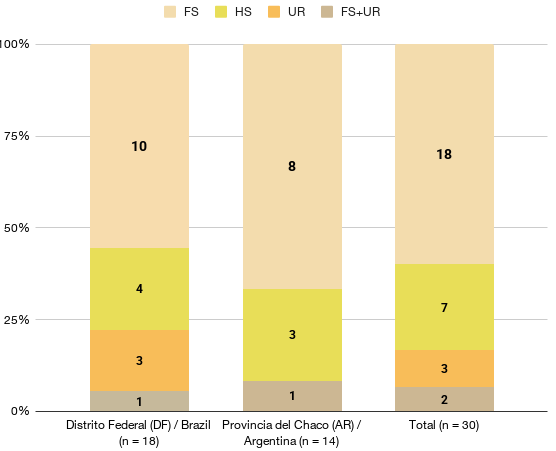
Fig. 1. Proportional distribution of sibship reconstruction categories among Turquoise-fronted Amazon (Amazona aestiva) sampled broods (only those containing two or more nestlings) from two South American populations (Distrito Federal, Brazil; Provincia del Chaco, Argentina) and for the total sample. Bars represent the percentage of broods classified as full siblings (FS), half siblings (HS), unrelated (UR), or mixed broods containing both full-sibling and unrelated nestlings (FS+UR).
Fig. 2
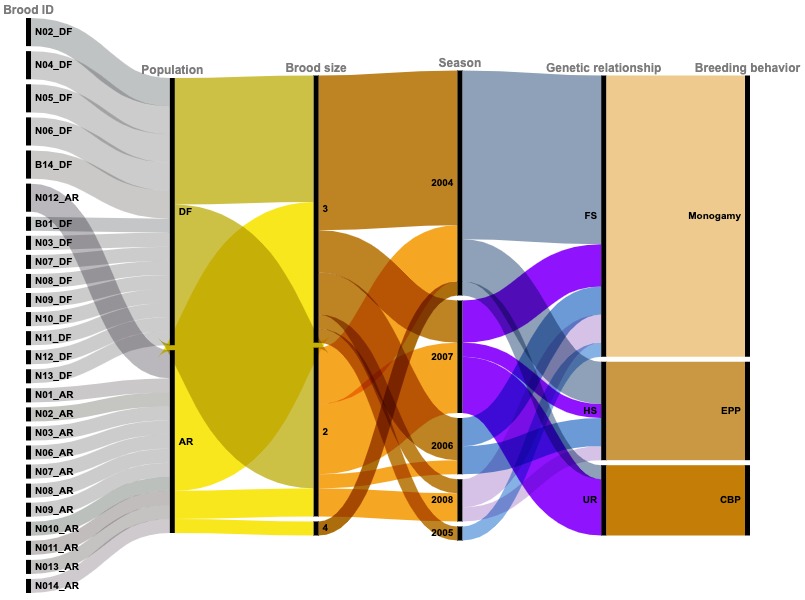
Fig. 2. Sibship reconstruction of Turquoise-fronted Amazon nestlings from natural (N_) and artificial (B_) nests in two wild populations: Distrito Federal, Brazil (_DF) and Provincia del Chaco/Argentina (_AR). Genetic relationships within each brood are classified as full-siblings (FS), half-siblings (HS), or unrelated (UR) and were used to infer breeding behavior, including monogamy, extra-pair paternity (EPP), and conspecific brood parasitism (CBP). Broods containing at least one half-sibling relationship were classified as HS, whereas broods containing a mixture of full-sibling and unrelated nestlings were assigned to both FS and UR categories.
Fig. 3
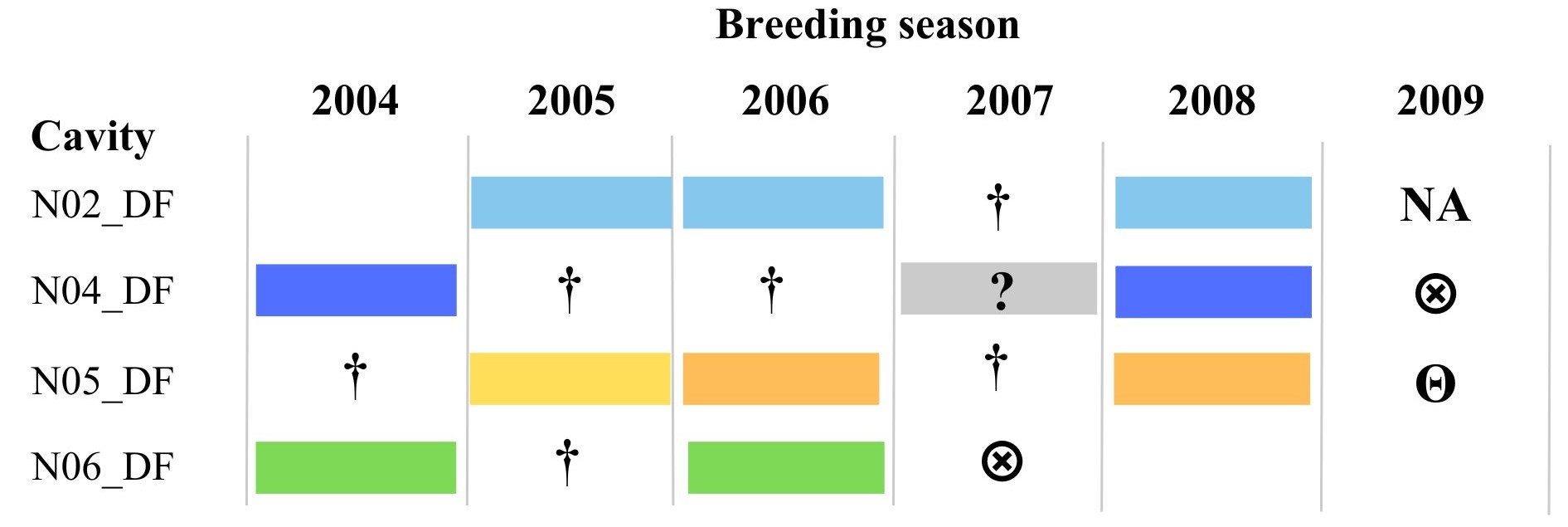
Fig. 3. Scheme of cavity reoccupation based on reconstructed genetic relationships among nestlings from the same cavity across different breeding seasons in the Distrito Federal (DF), Brazil. Identical colors indicate reoccupation by the same Amazon parrot pair (full siblings), whereas different colors indicate different pairs (unrelated nestlings). “?” denotes cases in which relatedness to the pair occupying the cavity in 2004 and 2008 could not be clearly determined (see Results). NA = not analyzed; † = predated, flooded, or poached; ⊗ = nest fell; Θ = cavity occupied by another species (interspecific competion).
Table 1
Table 1. Number of monitored active cavities or nest boxes (N), nesting attempts that contained only eggs and therefore did not result in broods with nestlings, brood size, and number of wild Amazon nestlings observed and sampled for genetic analysis in the Brazilian and Argentine populations (see Table A2 for details). The Brazilian population was monitored for up to six consecutive breeding seasons (2004–2009), whereas the Argentine population was monitored during a single breeding season (2004–2005).
| Location | N | Brood size | Total | ||||||
| Only eggs | Nestlings | Broods | |||||||
| (n = 1 to 3) | 1 | 2 | 3 | 4 | (nestlings/sampled nestlings) | ||||
| Distrito Federal/Brazil | |||||||||
| APAGCV (15.9290° S, 47.9015° W) | 11 | 9 | 3 | 9 | 7 | 0 | 19 (42/39) | ||
| EEAE (15.5527° S, 47.5923° W) | 3 | 1 | 0 | 1 | 2 | 0 | 3 (8/8) | ||
| Província del Chaco/Argentina† (25.4681° S, 61.8911° W) | 14 | 0 | 2 | 2 | 9 | 1 | 14 (37/37) | ||
| Total | 28 | 10 | 5 | 12 | 17 | 1 | 36‡ (87/84) | ||
| APAGCV: Área de Proteção Ambiental Gama Cabeça de Veado; EEAE: Estação Ecológica de Águas Emendadas. † Blood samples from three hatching females captured inside their nests were also obtained. ‡ One brood of three nestlings was not genetically analyzed. | |||||||||