





The following is the established format for referencing this article:
Bertka-Ballard, P. T., M. J. Keriazes, S. H. Chen, S. Barve, M. A. Rego, and G. Del-Rio. 2026. A case of mosaic gynandromorphism in the Eastern Towhee (Pipilo erythrophthalmus). Journal of Field Ornithology 97(3):5.ABSTRACT
Gynandromorphs are individuals that exhibit both male and female phenotypic characteristics. These rare cases can provide valuable insight into the mechanisms underlying sex determination, sexual dimorphism, and behavior. Although gynandromorphism has been relatively well documented in some taxa, particularly insects, it remains poorly studied in birds and other vertebrate groups. Here, we describe a case of mosaic gynandromorphism in a White-eyed Eastern Towhee (Pipilo erythrophthalmus alleni) collected in May 2025 at the Archbold Biological Station, Florida. The individual exhibited predominantly male-like plumage and behavior; however, detailed examination during dissection revealed the presence of both a testis and an ovary, as well as a regressing brood patch and an oviduct. Comparison with 62 museum specimens of the same subspecies indicated that morphometric measurements fell within what would be expected for a male individual, although the specimen displayed pronounced asymmetry in wing length. Had this individual not been collected and anatomically examined, its condition would likely have gone unnoticed, as its external appearance and behavior were largely consistent with those of a male in aberrant formative plumage. This observation raises the possibility that gynandromorphism may be more pervasive in wild avian populations than is currently appreciated, but that it is difficult to detect without a detailed anatomical examination.
RESUMEN
Los ginandromorfos son individuos que presentan simultáneamente características fenotípicas masculinas y femeninas. Estos casos poco frecuentes pueden aportar información valiosa sobre los mecanismos subyacentes de la determinación sexual, el dimorfismo sexual y el comportamiento. Aunque el ginandromorfismo ha sido relativamente bien documentado en algunos taxones, particularmente en insectos, sigue siendo poco estudiado en las aves y otros grupos de vertebrados. Aquí describimos un caso de ginandromorfismo mosaico en un Toquí flanquirrufo de ojos blancos (Pipilo erythrophthalmus alleni), colectado en mayo de 2025 en la Estación Biológica Archbold, Florida. El individuo presentó predominantemente un plumaje y un comportamiento de tipo masculino; sin embargo, un examen detallado durante la disección reveló la presencia tanto de un testículo como de un ovario, así como un parche de incubación en regresión y un oviducto. La comparación con 62 ejemplares de museo de la misma subespecie indicó que las medidas morfométricas se encontraban dentro de lo esperado para un individuo macho, aunque el espécimen mostró una marcada asimetría en la longitud del ala. De no haber sido colectado y examinado anatómicamente, la condición de este individuo probablemente habría pasado inadvertida, ya que su apariencia externa y su comportamiento eran en gran medida consistentes con los de un macho con un plumaje formativo atípico. Esta observación plantea la posibilidad de que el ginandromorfismo sea más frecuente en las poblaciones silvestres de aves de lo que actualmente se reconoce, aunque resulta difícil de detectar sin un examen anatómico detallado.
INTRODUCTION
Gynandromorphs are unusual individuals that display both male and female characteristics. These individuals often arise from errors during meiosis or double fertilization, leading to genetically distinct male and female cell lineages within the same individual (Zhao et al. 2010, Clinton et al. 2012, Murillo et al. 2023). A common form of gynandromorphy among bird species occurs when there is a perfect bilateral symmetry with a distinct line splitting the bird in the middle (e.g., Jones and Bartlett 2017). As a result of this bilateral symmetry, one side of the bird exhibits male characteristics, and the other exhibits female characteristics (Fusco and Minelli 2023). In bilateral avian gynandromorphs, the asymmetry is not only displayed in plumage, but also in the size of different limbs, with the apparent male side being larger, heavier, longer, and/or denser than the apparent female side (Jeffries 1883, Laybourne 1967, Lowther 1977, Patten 1993, Brenner et al. 2019). Other cases exist in which the male and female parts of the organisms seem to follow no specific pattern; these cases are difficult to classify and are described as being mosaic gynandromorphs (Zhao et al. 2010, Clinton et al. 2012, Fusco and Minelli 2023).
Avian gynandromorphs have been reported since the 19th century (Cabanis 1874) in captive chickens (Morris et al. 2018) and in wild bird species from different families (Laybourne 1967, Lowther 1977, Patten 1993, Brenner et al. 2019, Murillo et al. 2023). Within passerines, some reported cases occur among the suboscine families (DaCosta et al. 2007, de Camargo et al. 2017), but especially among oscines in families such as Cardinalidae (Laskey 1969, Bohlen 2006, Peer and Motz 2014, Jones and Bartlett 2017), Parulidae (Patten 1993, Diaz et al. 2013), Fringillidae (Laybourne 1967), Passeridae (Lowther 1977, Abella 2002), and Thraupidae (Murillo et al. 2023).
In New World Sparrows (Passerellidae), reports of gynandromorphism date back to the 19th century, with the genus Pipilo containing at least five documented cases (Jeffries 1883, Laskey 1969, Powdermill 2001, Brenner et al. 2019, National Aviary [date unknown]). One apparent female Green-tailed Towhee (P. chlorurus) was only recognized as a gynandromorph after dissection revealed an ovary on the left side of the body and a testis on the right (Jeffries 1883), in addition to a convoluted oviduct and small but developed ova (Jeffries 1883). Other members of the genus Pipilo exhibit pronounced sexual dimorphism, making the gynandromorphic condition particularly conspicuous when it occurs.
The Eastern Towhee (Pipilo erythrophthalmus) is a sexually dimorphic passerine widely distributed across eastern North America. The Florida “white-eyed” subspecies, P. e. alleni, occurs year-round in early successional scrub habitats of the Florida Peninsula, where breeding densities can be exceptionally high, reaching up to 80 breeding pairs within 40 ha (Sauer et al. 2017, Greenlaw 2020). In Eastern Towhees, previously reported gynandromorphs displayed striking bilateral asymmetry in plumage (Powdermill 2001, Brenner et al. 2019, National Aviary [date unknown]). In one bilateral gynandromorph, asymmetry extended beyond plumage to include differences in body measurements between the “male” and “female” sides of the bird (Powdermill 2001). Another gynandromorphic Eastern Towhee exhibited behaviors typically associated with both sexes, including singing and territorial defense, commonly associated with males, and caring for fledglings while another male was present, a behavior typically associated with females (Brenner et al. 2019).
Because Eastern Towhees are well studied in their ecology, behavior, morphology, and genetics (Nelson 2004, Batten 2008, Martin 2016, Greenlaw 2020, Young 2025), rare developmental anomalies become particularly informative within monitored populations. Here, we describe the first documented case of gynandromorphism in the Florida subspecies Pipilo erythrophthalmus alleni, and provide detailed observations of its external morphology, behavior, and its internal anatomy. Unlike previously reported Eastern Towhee gynandromorphs with conspicuous bilateral asymmetry, the condition in this individual only became apparent after dissection. Together with the relatively large number of documented cases in Pipilo, our findings raise the possibility that gynandromorphism may be more pervasive in wild bird populations than is currently recognized, particularly when external phenotypic expression is subtle.
METHODS
Between 18 and 21 May 2025, we conducted fieldwork at the Archbold Biological Station (Highlands County, Florida) for a broad population genomic study focused on the P. erythrophthalmus complex, which will be published at a later date. During the breeding season, between late April and August, only P. e. alleni is expected to occur at the Station, despite the potential for contact and hybridization with the nominate subspecies elsewhere in Florida (Greenlaw 2020). During this fieldwork, we collected six White-Eyed Eastern Towhee (P. e. alleni) individuals, one of which was the gynandromorph that we describe here.
The Archbold Research Station is primarily composed of Lake Wales ridge scrub habitats. The Lake Wales ridge scrub is a heavily fire-dependent habitat that typically burns every 5–20 years (Main and Menges 1997). The vegetation has a height of up to 3 m in fire-maintained stands, and is predominantly made up of various species of scrubby oaks (Quercus spp.), Sand Pine (Pinus clausa), Saw Palmetto (Serenoa repens), Rusty Lyonia (Lyonia ferruginea), and Florida Rosemary (Ceratiola ericoides; Abrahamson et al. 1984).
To capture the birds, we used four 12 m-long, 36 mm mesh mist nets set in a consecutive lane. In order to lure birds to the nets, we placed speakers with conspecific audio lures near the nets while we worked to slowly flush birds toward the nets. During the luring process, we took notes on individuals’ behavior and ecology, such as feeding behavior and inter- and intraspecific interactions. Upon capture, birds were photographed and then euthanized by cervical dislocation followed by thoracic compression (IACUC protocol IACUC202400000258). For all individuals collected, we obtained high-quality tissue samples and skins for museum specimens that will be used in the broader research study. To compare the captured gynandromorphic individual with conspecifics, we examined 20 female and 42 male specimens of Pipilo erythrophthalmus alleni deposited at the Florida Museum of Natural History, including individuals collected alongside the focal specimen. Collection dates ranged from 1900 to 2025, providing a broad representation of morphological variation within the subspecies. We recorded wing chord (both wings), tail length, exposed culmen, bill length, bill width, bill depth, and tarsus length using digital calipers. All measurements were taken by Preston Bertka-Ballard after specimens had dried to minimize variation associated with specimen shrinkage (Winker 1992). Age determination, feather descriptions, and molt assessments followed the criteria outlined in the Identification guide to North American birds (Pyle 2022).
RESULTS
On 19 May 2025 around 7:30 am, we came across an Eastern Towhee individual behaving like a typical male. The individual perched high on bushes and small trees to actively defend its territory, and responded to playback by producing typical calls and songs. This behavior was in line with that of other males we observed at the same site, and during the same period. We did not observe any Eastern Towhee fledglings during this period, and only males were singing and defending their territories.
Upon capture of this individual, we noticed a primarily dark male-like plumage with some female-like brown feathers mixed in, especially around the head, chest, and back of the bird (Figs. 1, 2). Contour feathers were either entirely black or brown. A closer inspection revealed that this individual had different molt patterns on either side. On the left wing, the greater coverts were abraded and somewhat dusky colored, whereas the primary coverts looked dark and fresh. On the right wing, the primary coverts were black and fresh, and the greater coverts were fresh and dark with rusty edgings.
While preparing the specimen and collecting tissue samples, we observed a wrinkled, regressing brood patch, suggesting prior brood patch development. Internal examination revealed the presence of both male and female gonads, but on opposite sides of the body cavity. A well-developed testis measuring 12 × 10 mm was present on the left side of the body, whereas a relatively small ovary with differentiated ova (< 2 mm) and an approximately 1 mm wide straight oviduct occurred on the right side (Fig. 3). The left testis was enlarged, cream-colored, and glossy in appearance, closely resembling the testes of reproductively developed males collected at the same locality during the same sampling period. Although the ovary contained differentiated ova, there was no evidence of active follicular development or reproductive activity.
We also observed complete skull ossification and the absence of a bursa of Fabricius, which is a structure typically retained in hatch year birds. Combined with the molt pattern and plumage characteristics, these traits indicate that the individual was most likely an adult (one year or older). Among the external measurements, wing chord showed the clearest asymmetry between sides of the body. The right wing measured 76.8 mm, falling closer to the female average for Pipilo erythrophthalmus alleni, whereas the left wing measured 78.0 mm, which is more consistent with the male average (Table 1; Fig. 4).
DISCUSSION
Gynandromorphs provide rare opportunities to examine the relationships among sex determination, morphology, physiology, and behavior in birds. Although numerous cases have been documented across avian families, most studies focus either on external appearance and behavior (Graves et al. 1996, Diaz et al. 2013, Brenner et al. 2019) or on internal anatomy (e.g., Jeffries 1883, Laybourne 1967, DaCosta et al. 2007), rarely integrating both perspectives within the same individual (Murillo et al. 2023). Our observations, therefore, contribute to a still limited understanding of how anatomical and behavioral traits are expressed in gynandromorphic passerines.
Behaviorally, the Eastern Towhee we describe appeared to function primarily as a male. During our observations, the individual actively defended its territory and responded aggressively to conspecific playback with typical calls and song, a behavior that is not seen in females of this species (Greenlaw 2020). Similar male-associated behaviors have been reported in other gynandromorphic birds, including a bilateral gynandromorphic Northern Cardinal (Cardinalis cardinalis) that sang and defended territories (Bohlen 2006). In contrast, a previously reported bilateral gynandromorphic Eastern Towhee in Rhode Island appeared to behave more similarly to a typical female, repeatedly feeding fledglings while associating with an adult male (Brenner et al. 2019). Together, these observations suggest that behavioral expression in gynandromorphs may vary substantially among individuals, and may not align predictably with external plumage patterns alone.
The internal anatomy of the individual reported here further supports the interpretation that it may have functioned predominantly as a male. The testis measured 12 × 10 mm, which is comparable in size to testes measured from four typical males collected during the same fieldwork period. In contrast, the ovary was substantially smaller (6 × 4 mm), although it contained several partially developed ova. Importantly, the oviduct was straight rather than convoluted, suggesting that this individual had likely never laid eggs. A captive bilateral gynandromorphic Zebra Finch (Taeniopygia guttata) remains the best documented example of reproductive behavior in a gynandromorphic bird; that individual copulated repeatedly with a female, although all egg clutches proved to be infertile (Agate et al. 2003). Although we lack direct evidence regarding the reproductive functionality of the Eastern Towhee reported here, the enlarged testis, predominantly male plumage, and male-associated territorial behavior collectively suggest stronger functional masculinization. At the same time, the presence of a brood patch introduces additional complexity, as brood patches are not typically present in male Eastern Towhees, which do not incubate eggs (Greenlaw 2020). It also remains possible that this individual was paired with a nesting female during the breeding season.
Morphologically, the strongest evidence of asymmetry involved wing structure. The left wing of this gynandromorph measured 78.01 mm, which is close to the average male wing length (79.27 mm), whereas the right wing measured 76.8 mm, approaching the female average (75.15 mm). Moreover, the absolute difference between wings (1.21 mm) greatly exceeded the average asymmetry observed in either males (0.389 mm) or females (0.468 mm) within our comparative sample. This asymmetry resembles patterns previously described in bilaterally gynandromorphic birds, where “male” and “female” sides often differ structurally, as well as in plumage (Powdermill Nature Reserve 2001, 2005, Zhao et al. 2010). However, unlike classic bilateral gynandromorphs, asymmetry in this individual was limited and inconsistent across traits. Tail length closely matched the male average, whereas most other measurements fell within overlapping ranges between sexes. Likewise, plumage differences did not follow a clean bilateral division. Instead, female-like feathering appeared mottled irregularly within an otherwise predominantly male plumage pattern.
The molt pattern further emphasizes the atypical nature of this individual. On the left wing, the greater coverts appeared abraded and dusky, whereas the primary coverts remained fresh and dark, suggesting a molt limit opposite to that typically expected in females (Pyle 2022). In contrast, the right wing exhibited a molt pattern more consistent with after hatch year (Definitive Cycle Basic) males. Together, these observations suggest that sexual differentiation in this bird did not occur uniformly across tissues or body regions.
The absence of a clear bilateral partitioning of plumage and morphology in this individual may indicate a developmental origin distinct from the classic bilateral gynandromorph condition described in birds such as the Zebra Finch, Northern Cardinals, and the Green Honeycreeper (Chlorophanes spiza; Agate et al. 2003, Peer and Motz 2014, Murillo et al. 2023). Rather than exhibiting a sharp left-right division of male and female phenotypes, the female-associated plumage traits in this Eastern Towhee were distributed across multiple regions of the body, despite the asymmetric distribution of gonads and wing measurements. One possible explanation is that this individual represents a form of avian sex chromosome chimera, potentially resulting from the fusion of two early fertilized embryos or blastomeres, followed by unequal contribution of genetically distinct cell lineages during development (Hollander 1975). Under this scenario, a predominantly male (ZZ) cell lineage could have contributed to most somatic tissues, whereas a smaller female (ZW) lineage persisted in localized regions, including portions of the plumage and the reproductive tract (Batchtrog et al. 2014). Alternatively, these patterns could also arise through early mitotic errors in sex chromosome segregation and subsequent intermixing of cell populations during embryogenesis. Distinguishing between these mechanisms would require tissue-specific genetic analyses. For now, we suggest that this individual should be treated as a mosaic gynandromorph (Fusco and Minelli 2023).
More broadly, this case highlights how easily subtle gynandromorphs may escape detection in wild bird populations, even in sexually dimorphic species. Unlike previously reported Eastern Towhees with conspicuous bilateral plumage asymmetries, this individual appeared largely inconspicuous in the field, and could easily have been interpreted as a typical male with aberrant or unusual plumage. The gynandromorphic condition only became apparent following dissection. Given the growing number of documented cases in Pipilo, including multiple Eastern Towhees, it is possible that gynandromorphism may be more prevalent in wild bird populations than is currently appreciated, particularly when external phenotypic expression is subtle. Future studies integrating genomics, histology, and tissue-specific analyses across different body regions may provide further insight into the developmental mechanisms underlying mosaic gynandromorphism in birds.
CONCLUSION
This case represents another documented example of mosaic gynandromorphism in a wild passerine, and adds detail to avian sexual mosaicism. With the integration of behavioral observations, internal anatomy, and comparative morphometrics, we have demonstrated that this White-eyed Eastern Towhee exhibits predominantly male-typical behavior and plumage, although retaining elements of both male and female reproductive anatomy. This case contributes to the limited number of documented instances of gynandromorphism in wild birds, and highlights the importance of unusual individuals as valuable opportunities for advancing our understanding of avian sex determination and developmental biology. This observation suggests that gynandromorphism could be more widespread in wild bird populations than has been previously recognized, although it remains challenging to identify without thorough anatomical analysis. Continued documentation of such individuals, paired with targeted genetic and tissue-specific analyses, will be critical for advancing understanding of cell-autonomous sex identity, the development of sexual dimorphism, and reproductive anatomy in birds.
RESPONSES TO THIS ARTICLE
Responses to this article are invited. If accepted for publication, your response will be hyperlinked to the article. To submit a response, follow this link. To read responses already accepted, follow this link.
DATA AVAILABILITY
Data/code sharing is not applicable to this article because no data/code were analyzed in this study.
LITERATURE CITED
Abella, J. 2002. Capture of two probable gynandromorphic House Sparrows (Passer domesticus) in NE Spain. Revista Catalana d'Ornitologia 19:25-29.
Abrahamson, W. G., A. F. Johnson, J. N. Layne, and P. A. Peroni. 1984. Vegetation of the Archbold Biological Station, Florida: an example of the southern Lake Wales Ridge. Florida Scientist 47(4):209-250.
Agate, R. J., W. Grisham, J. Wade, S. Mann, J. Wingfield, C. Schanen, A. Palotie, and A. P. Arnold. 2003. Neural, not gonadal, origin of brain sex differences in a gynandromorphic finch. Proceedings of the National Academy of Sciences of the United States of America 100(8):4873-4878. https://doi.org/10.1073/pnas.0636925100
Bachtrog D., J. E. Mank, C. L. Peichel, M. Kirkpatrick, S. P. Otto, T.-L. Ashman, M. W. Hahn, J. Kitano, I. Mayrose, R. Ming, N. Perrin, L. Ross, N. Valenzuela, J. C. Vamosi, and the Tree of Sex Consortium. 2014. Sex determination: why so many ways of doing it? PLoS Biology 12(7):e1001899. https://doi.org/10.1371/journal.pbio.1001899
Batten, J. S. 2008. The “White-eyed” Eastern Towhee: a molecular assessment of the validity of Pipilo erythrophthalmus alleni. Thesis. University of Nevada, Las Vegas, Nevada, USA.
Bohlen, H. D. 2006. Illinois sightings of bilateral gynandromorphism in birds. Living Museum 68(2,3) https://www.idaillinois.org/digital/collection/ism/id/5397/.
Brenner, S. J., O. A. DaRugna, and S. R. McWilliams. 2019. Observations of certain breeding behaviors in a bilateral gynandromorph Eastern Towhee (Pipilo erythrophthalmus). Wilson Journal of Ornithology 131(3):625-628. https://doi.org/10.1676/18-179
Cabanis, J. 1874. Zwitterbildung bei den Vogeln. Journal für Ornithologie 22:344-345.
Clinton, M., D. Zhao, S. Nandi, and D. McBride. 2012. Evidence for avian cell autonomous sex identity (CASI) and implications for the sex-determination process? Chromosome Research 20:177-190. https://doi.org/10.1007/s10577-011-9257-9
DaCosta, J. M., G. M. Spellman, and J. Klicka. 2007. Bilateral gynandromorphy in a White-ruffed Manakin (Corapipo altera). Wilson Journal of Ornithology 119(2):289-291.
de Camargo, C., H. L. Gibbs, M. C. Costa, L. F. Silveira, C. A. Rainho, P. E. M. Ribolla, A. P. Wasko, and M. R. Francisco. 2017. Triploidy in a sexually dimorphic passerine provides new evidence for the effect of the W chromosome on secondary sexual traits in birds. Journal of Avian Biology 48:1475-1480. https://doi.org/10.1111/jav.01504
Diaz, R., M. Davis, and E. Golden. 2013. Possible gynandromorphism in Black-throated Blue Warblers. North American Birds 67:10-11.
Fusco, G., and A. Minelli. 2023. Descriptive versus causal morphology: gynandromorphism and intersexuality. Theory in Biosciences 142:1-11. https://doi.org/10.1007/s12064-023-00385-1
Graves, G. R., M. A. Patten, and J. L. Dunn. 1996. Comments on a probable gynandromorphic Black-throated Blue Warbler. Wilson Bulletin 108(1):22.
Greenlaw, J. S. 2020. Eastern Towhee (Pipilo erythrophthalmus), version 1.0. in P. G. Rodewald, editor. Birds of the world. Cornell Lab of Ornithology, Ithaca, New York, USA. https://doi.org/10.2173/bow.eastow.01
Hollander, W. F. 1975. Sectorial mosaics in the domestic pigeon: 25 more years. Journal of Heredity 66(4):197-202. https://doi.org/10.1093/oxfordjournals.jhered.a108612
Jeffries, J. A. 1883. Notes on an hermaphrodite bird. Bulletin of the Nuttall Ornithological Club 8:17-21.
Jones, A. W., and H. T. Bartlett. 2017. A bilateral gynandromorph Northern Cardinal from South Bass Island. Ohio Biological Survey Notes 7:14-16.
Laskey, A. R. 1969. Bilateral gynandrism in a Cardinal and a Rufous-sided Towhee. Auk 86(4):760. https://doi.org/10.2307/4083473
Laybourne, R. C. 1967. Bilateral gynandrism in an Evening Grosbeak. Auk 84(2):267-272. https://doi.org/10.2307/4083196
Lowther, P. E. 1977. Bilateral size dimorphism in House Sparrow gynandromorphs. Auk 94:377-380.
Main, K. N., and E. S. Menges. 1997. Archbold Biological Station fire management plan. 97-1 Land Management Publication, Archbold Biological Station, Lake Placid, Florida.
Martin, M. 2016. Winter ecology and behavior of Eastern Towhees at Taylor Fork Ecological Area. Honors Thesis, Eastern Kentucky University, Richmond, Kentucky, USA.
Morris, K. R., C. E. Hirst, A. T. Major, T. Ezaz, M. Ford, S. Bibby, T. J. Doran, and C. A. Smith. 2018. Gonadal and endocrine analysis of a gynandromorphic chicken. Endocrinology 159(10):3492-3502. https://doi.org/10.1210/en.2018-00553
Murillo J., E. Campbell-Thompson, T. F. Bishop, C. W. Beck, and H. G. Spencer. 2023. Report of bilateral gynandromorphy in a Green Honeycreeper (Chlorophanes spiza) from Colombia. Journal of Field Ornithology 94(4):12. https://doi.org/10.5751/JFO-00392-940412
National Aviary. [date unknown]. Forest Gap Project 2024. National Aviary, Pittsburgh, Pennsylvania, USA. https://www.aviary.org/conservation/projects/north-american-habitats/forest-gap-project/
Nelson, B. S. 2004. Dynamics of frequency and amplitude modulations in vocalizations produced by Eastern Towhees, Pipilo erythrophthalmus. Journal of the Acoustical Society of America 115(3):1333-1344. https://doi.org/10.1121/1.1648976
Patten, M. A. 1993. A probable bilateral gynandromorphic Black-throated Blue Warbler. Wilson Bulletin 105:695-698.
Peer, B. D., and R. W. Motz. 2014. Observations of a bilateral gynandromorph Northern Cardinal (Cardinalis cardinalis). Wilson Journal of Ornithology 126(4):778-781 https://doi.org/10.1676/14-025.1
Powdermill Avian Research Center. 2001. Pictorial Highlights, 20-30 November, 2001. Carnegie Museum of Natural History, Rector, Pennsylvania, USA. http://www.powdermillarc.org/archives/Powdermill%20Website%20Original/Pictorial_Highlights_112030_2001.htm
Powdermill Avian Research Center. 2005. Pictorial Highlights, 6-18 September, 2005. Carnegie Museum of Natural History, Rector, Pennsylvania, USA. http://www.powdermillarc.org/archives/Powdermill%20Website%20Original/Pictorial_Highlights_090605.html
Pyle, P. 2022. Identification guide to North American birds, part 1. Second edition. Slate Creek Press, Point Reyes Station, California, USA.
Sauer, J. R., D. K. Niven, J. E. Hines, D. J. Ziolkowski Jr., K. L. Pardieck, J. E. Fallon, and W. A. Link. 2017. The North American breeding bird survey, results and analysis 1966-2015. Version 12.23.2015. U.S. Geological Survey Patuxent Wildlife Research Center, Laurel, Maryland, USA.
Winker, K. 1992. Specimen shrinkage in Tennessee Warblers and Traill’s Flycatchers. Journal of Field Ornithology 64(3):331-336.
Young, K. 2025. Movement ecology of migratory birds using motus technology. Thesis. Purdue University, West Lafayette, Indiana, USA.
Zhao, D., D. McBride, S. Nandi, H. A. McQueen, M. J. McGrew, P. M. Hocking, P. D. Lewis, H. M. Sang, and M. Clinton. 2010. Somatic sex identity is cell autonomous in the chicken. Nature 464:237-242. https://doi.org/10.1038/nature08852
Fig. 1
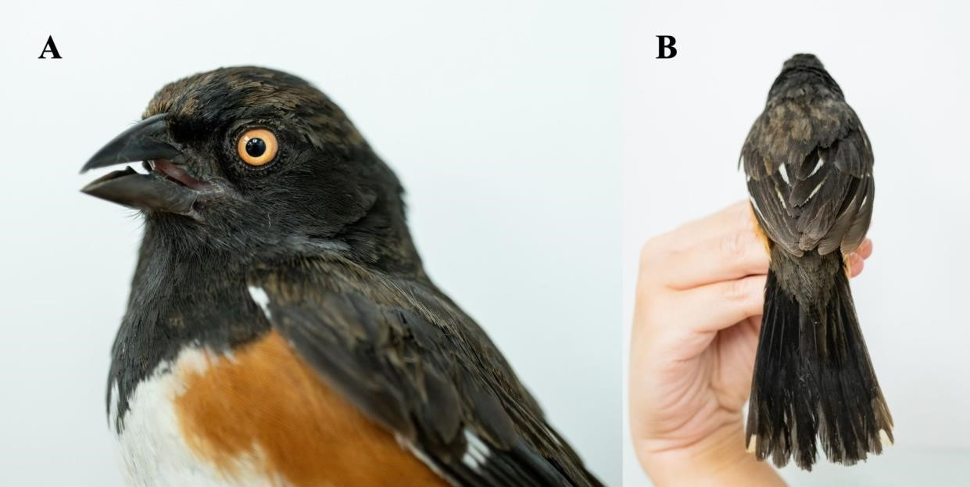
Fig. 1. Photographs of the live gynandromorphic Eastern Towhee (Pipilo erythrophthalmus alleni) showing predominantly male-like plumage with some mixed in female-like plumage. (A) is a closeup headshot of the individual showing predominantly mixed and speckled plumage in the crown and coverts of the wing. (B) is a backside view of the bird, showing more obviously female-like plumage characteristics on the back, wing coverts, and upper-tail coverts.
Fig. 2
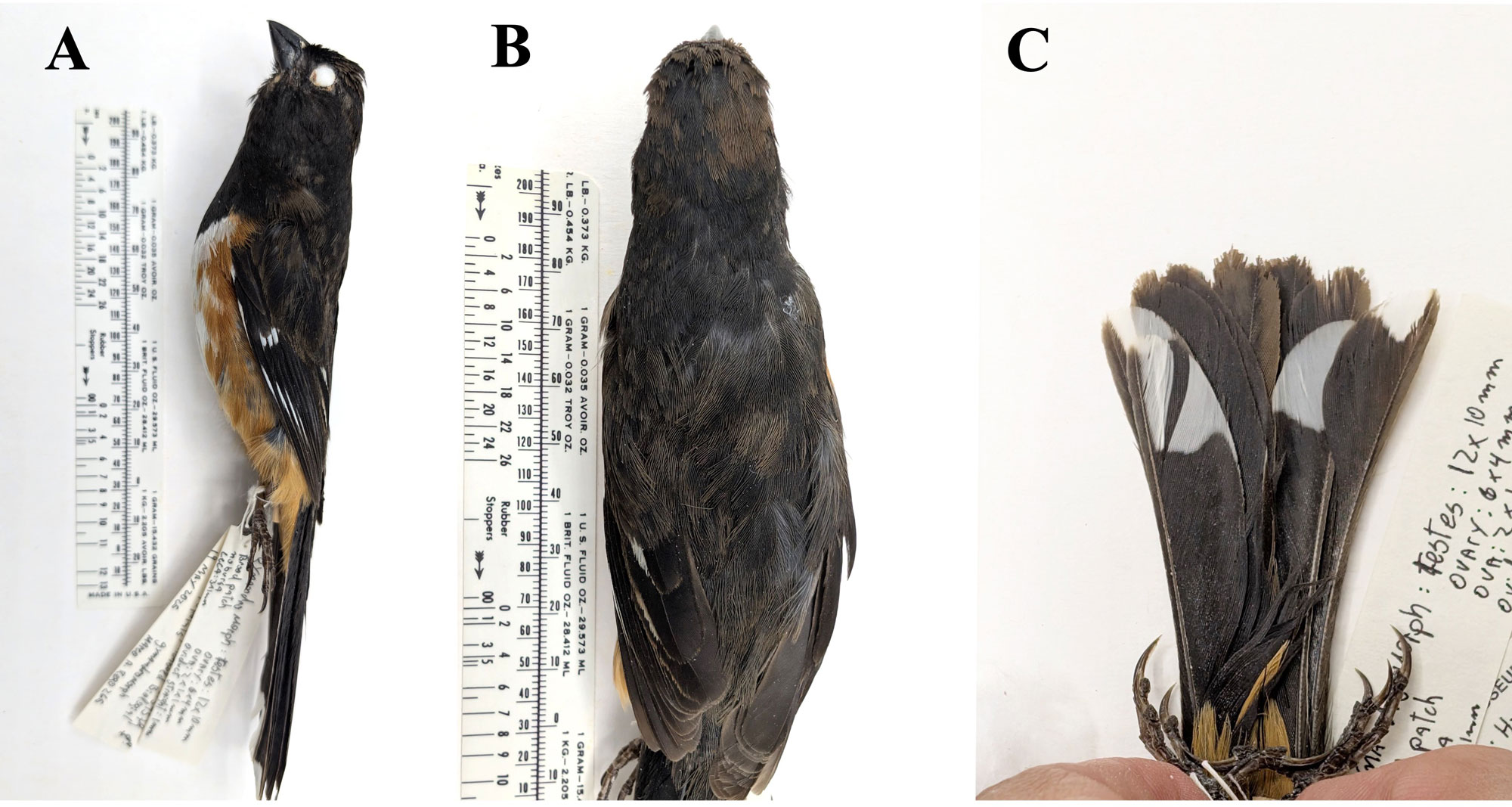
Fig. 2. Photographs of the prepared gynandromorph specimen showing mottled plumage characteristics. (A) is a lateral view of the left side of the gynandromorph. (B) is a dorsal view of the bird, showing the mottled plumage in the back, head, and nape. (C) is a closeup of the partially spread tail of this individual, with some single tail feathers having both male and female plumage characteristics.
Fig. 3
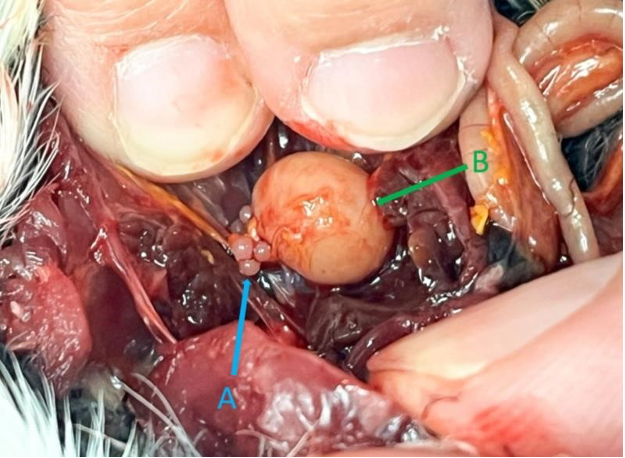
Fig. 3. Overhead view (posterior to anterior) of the internal gonads of the gynandromorph Eastern Towhee (Pipilo erythrophthalmus) showing both the (A) 6 x 4 mm ovary with individual ovum (largest ovum 2 x 2 mm) alongside (B) the singular 12 x 10 mm testis.
Fig. 4
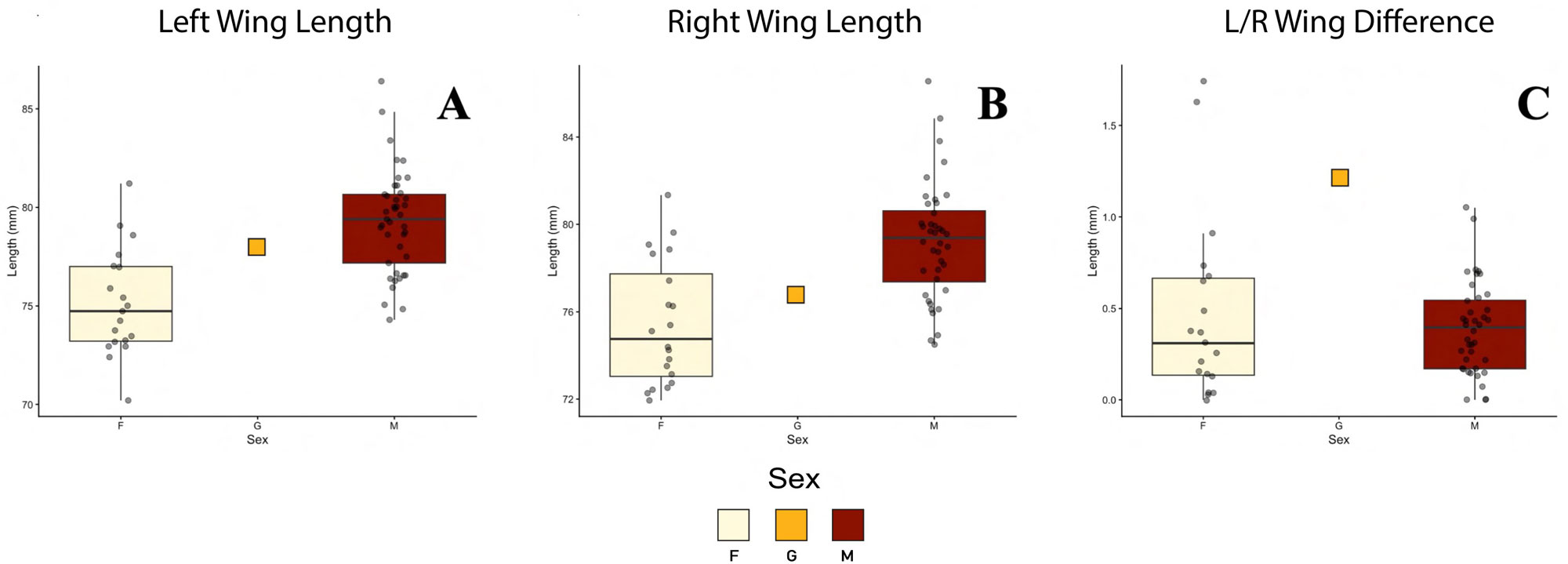
Fig. 4. Boxplots showing the gynandromorph measurements in comparison to the average measurements for male and female White-eyed Eastern Towhee. (A) shows left wing measurements, with females averaging 74.15 mm, males averaging 79.27 mm, and the gynandromorph measuring 78.01 mm. (B) shows right wing measurements, with females averaging 74.45 mm, males averaging 79.20 mm, and the gynandromorph measuring 76.8 mm. (C) shows the difference between the wing lengths of females (average 0.468 mm), males (average 0.389 mm), and the gynandromorph (1.21 mm).
Table 1
Table 1. Measurements taken from the gynandromorphic White-eyed Eastern Towhee (Pipilo erythrophthalmus alleni) collected at the Archbold Biological Station, and averages, with standard deviations, of the same measurements taken from 62 (42 male, 20 female) P. e. alleni specimens housed in the Florida Museum of Natural History.
| Gynandromorph | Male average | Female average | |||||||
| Left wing (mm) | 78.01 | 79.27 ± 2.63 | 75.15 ± 2.71 | ||||||
| Right wing (mm) | 76.8 | 79.20 ± 2.67 | 75.45 ± 2.75 | ||||||
| Wing difference (mm) | 1.21 | 0.389 ± 0.25 | 0.468 ± 0.50 | ||||||
| Tail (mm) | 90.55 | 90.74 ± 3.97 | 87.08 ± 2.59 | ||||||
| Exposed culmen (mm) | 15.06 | 14.56 ± 0.68 | 14.03 ± 0.54 | ||||||
| Bill length (mm) | 10.74 | 10.29 ± 0.51 | 9.95 ± 0.48 | ||||||
| Bill width (mm) | 6.75 | 5.79 ± 0.40 | 6.02 ± 0.33 | ||||||
| Bill depth (mm) | 8.27 | 8.06 ± 0.43 | 8.06 ± 0.39 | ||||||
| Tarsus length (mm) | 25.12 | 26.90 ± 0.88 | 26.28 ± 0.94 | ||||||