





The following is the established format for referencing this article:
Wirth, K.R. 2026. Hover-gleaning decapods from floating sargassum: a novel foraging behavior by Great-tailed Grackle (Quiscalus mexicanus) on Isla Cozumel. Journal of Field Ornithology 97(3):2.ABSTRACT
The Great-tailed Grackle (Quiscalus mexicanus) is widely recognized as a terrestrial, diet-generalist species, yet its use of over-water foraging remains poorly documented. Here, I describe a novel over-water foraging strategy used by Great-tailed Grackles on Isla Cozumel, Mexico. Over 13 hours of observation across 12 days between 24 July and 21 August 2022, I observed brown-plumaged (presumed female) grackles using a consistent sequence of flight modalities to hover-glean sargassum swimming crabs (Portunus sayi) from floating rafts of macroalgae. I recorded 57 foraging excursions when floating sargassum was present, with a median distance from shore of 44 m and a median duration of 10 s. The capture success rate was 60%. An energetic model indicates this strategy is plausible, with an estimated net energy gain of 244–771 J from an average-sized crab (18 mm carapace width) after 22 s of total effort by a female grackle (130 g). This behavior likely emerged in the western Caribbean following the onset of recurring sargassum inundations in 2014 to 2015 and serves as an example of one species’ response to recent environmental change.
RESUMEN
Quiscalus mexicanus es una especie ampliamente reconocida por presentar hábitos terrestres y dieta generalista, aunque el uso de estrategias de forrajeo sobre el agua ha sido escasamente documentado. En este trabajo describo una estrategia novedosa de forrajeo sobre el agua utilizada por Q. mexicanus en la isla de Cozumel, México. Durante más de 13 horas de observación a lo largo de 12 días, entre el 24 de julio y el 21 de agosto de 2022, observé individuos de plumaje pardo (presumiblemente hembras) empleando una secuencia consistente de modalidades de vuelo para capturar, mediante vuelo estacionario y recolección sobre superficies, cangrejos nadadores del sargazo (Portunus sayi) presentes en balsas flotantes de macroalgas. Registré 57 incursiones de forrajeo cuando había sargazo flotante, con una distancia mediana a la costa de 44 m y una duración mediana de 10 s. La tasa de éxito de captura fue del 60 %. Un modelo energético indica que esta estrategia es viable, con una ganancia energética neta estimada de entre 244 y 771 J a partir de un cangrejo de tamaño promedio (18 mm de ancho del caparazón), tras un esfuerzo total de 22 s por parte de una hembra de Q. mexicanus de 130 g. Este comportamiento probablemente surgió en el Caribe occidental tras el inicio de los recurrentes arribazones de sargazo entre 2014 y 2015, y constituye un ejemplo de la respuesta de una especie a los cambios ambientales recientes.
INTRODUCTION
Recent recurrent sargassum inundations have altered coastal habitats across the western Caribbean. Here I describe previously undocumented behavior in which brown-plumaged Great-tailed Grackles on Isla Cozumel forage for decapods from floating sargassum, and I quantify the plausibility of this novel behavior using energetic modeling.
Great-tailed Grackle diet and foraging
The Great-tailed Grackle (Quiscalus mexicanus) is widely known for its varied diet and foraging techniques. As a member of the New World blackbirds (family Icteridae, which includes blackbirds, bobolinks, grackles, meadowlarks, and orioles), the Great-tailed Grackle is a large, sexually dimorphic passerine and year-round resident of Central America, northern South America, and southern portions of central and western North America. It tends to inhabit open areas near water and wetlands, and secondary forests in tropical and subtropical zones (Johnson and Peer 2022). Great-tailed Grackles are also well-adapted to urban and human-modified environments, including agricultural fields, plantations, pastures, and feedlots (e.g., Skutch 1954, Johnson and Peer 2022). The Great-tailed Grackle is an omnivorous forager that uses its bill to capture diverse food types, including insects and larvae, grains, seeds, fruits, berries, and other plant material, small crustaceans, and worms (Skutch 1954). They are also known to frequent landfills and parking lots, farm fields, and livestock feedlots (e.g., Rappole et al. 1989, Bush 2005, Bodenchuk and Bergman 2020).
Range expansion and behavioral flexibility
Evidence of the Great-tailed Grackle’s adaptability also comes from its considerable range expansion. Early records suggest the Great-tailed Grackle originated from the tropical lowlands of eastern Mexico before introduction to the Aztec capital of Mexico City during the late 15th century (Haemig 2012). A stable breeding population of Great-tailed Grackles that was present in southern Texas by the 1880s expanded northward to the Minnesota–North Dakota border by 1995 (Dinsmore and Dinsmore 1993, Wehtje 2003). In addition to the rapid spread of human-modified environments, the social behavior, omnivorous diet, habitat preferences, adaptability, and long association of grackles with human settlements likely contributed to their expansion (Wehtje 2003).
Numerous laboratory and field studies (e.g., Logan 2016, Logan et all 2023, 2025, Breen and Deffner 2024) have linked the rapid range expansion of the Great-tailed Grackle with its behavioral flexibility, which is defined as the ability to modify behavior in the face of changing circumstances (Mikhalevich et al. 2017). Although this study is not about behavioral flexibility, it draws on this literature as a background for why novel foraging behaviors are not unexpected in this species. In comparison with studies of range expansion that emphasize flexibility across geography, this study offers an opportunity to examine adaptability within an established geographic range.
Sargassum habitat
With the sudden appearance of sargassum in the western Caribbean more than a decade ago, coastal habitats of the Great-tailed Grackle have experienced substantial environmental change. Originally confined to the Sargasso Sea, large masses of Sargassum spp., a holopelagic macroalga, first appeared in the Great Atlantic Sargassum Belt in 2011 and have become an annual occurrence along the shores of West Africa, the Caribbean, and the Gulf of Mexico (e.g., Wang et al. 2019, Jouanno et al. 2025, Lapointe et al. 2025).
On the open ocean, floating mats of sargassum provide important habitat for diverse endemic and non-endemic taxa, including sessile and motile invertebrates and fish species (e.g., Martin et al. 2021, van Tussenbroek et al. 2024a, 2024b). Numerous seabirds also forage in association with this important ecosystem (Moser and Lee 2012). Guided by wind, ocean currents, and bottom geometry, approaching masses of sargassum introduce new species and nutrients to coastal environments (e.g., McGillicuddy et al. 2023, van Tussenbroek et al. 2024a). The decay of beach-cast sargassum is associated with numerous environmental, economic, and health impacts (e.g., van Tussenbroek et al. 2017, Rodríguez-Martínez et al. 2025).
Here I document Great-tailed Grackles gleaning crabs from floating sargassum along the west coast of Cozumel Island. This behavior is notable given that grackles are typically terrestrial ground foragers and that the sargassum habitat appeared only recently in the western Caribbean. The aims of this study are to (1) describe the novel foraging strategy, (2) summarize basic metrics of this behavior, and (3) evaluate the energetic plausibility using a simple model.
METHODS
This study is based on 13 hours of observation across 12 days between 24 July and 21 August 2022 on Isla Cozumel, Mexico (Appendix 1). I used opportunistic observations from a single vantage point (ocean-facing balcony), therefore my observations of foraging activities were limited to a 150 m radius. Located on the lee side of the island relative to the prevailing easterly wind, the study site (20°32'11.4" N, 86°56'16.4" W) is situated within a narrow coastal strip of residential properties bordered by inland low tropical forest and tropical semi-deciduous forest. Great-tailed Grackles are common residents on the island, with two to five individuals typically observed per 10 min window at the site, where they forage among the palm trees, sand, structures, and lawns throughout the day.
Observations and data
For this study, I documented grackle behavior whenever sargassum was present and grackles exhibited foraging activity during the study period. Observation sessions lasted 10 to 70 min in duration between 7:30 AM and 7:30 PM local time (Appendix 1) and utilized binoculars (10 x 32) and still photographs. I used the locations of fixed buoy lines and bathymetric features to estimate distances (±10–20%) from shore using Google Earth images. I estimated flight duration by manual counts approximating seconds (± 5%–10%). When possible, I used photo metadata to supplement the manual time estimates. For each foraging event, I recorded the time, duration, number of individuals, sex, maximum distance from shore, foraging success, and type of prey captured. General information about the weather conditions and sargassum distribution were also noted. I used Microsoft Excel and SPSS for data analysis, modeling, and for preparing illustrations.
Models of energy costs and benefits
Here I describe the structure, methods, and key assumptions used to develop a simple model for evaluating the energetic plausibility of over-water foraging for crabs. Additional information, including a table of parameters, sensitivity bounds, and derivations, is in Appendix 1. I estimated the sizes of the foraged crabs from photos by comparing with the length of the grackle’s bill (assumed to average 22 mm; Johnson and Peer 2022). Next, I calculated the wet mass of the crab from the carapace width using a power-law relationship developed using paired data from sargassum swimming crabs from West and Randy Brooks (2018) and from V. Monroy Velazquez (personal communication). I then used the mass data to estimate the energy density of tissue and shell in sargassum swimming crabs using nutrition information from a blue crab proximate (USDA 2024, Fuso et al. 2025) and the digestibility of tissue and shell by passerines, poultry, and seabirds (Potter et al. 1962, Twedt 1985, Jackson et al. 1992, Barrett et al. 2007). For the energetic costs of foraging, I assumed an average foraging time to success of 21.5 s (this study), an average mass of 130 g for female Great-tailed Grackles (Johnson and Peer 2022), and a basal metabolic rate (BMR) of 0.9 W (Lasiewski and Dawson 1967, McKechnie and Wolf 2004). Using data from passerine scaling studies (Bishop 1999, Ward et al. 2001), I estimated the energetic cost of forward flight and hovering to average 13 times the basal metabolic rate.
RESULTS
I observed 57 foraging excursions, averaging 2–13 per hour when floating sargassum was present (Appendix 1). In most cases (> 95%), a brown-plumaged Great-tailed Grackle foraged alone, but I also observed loose foraging groups of up to four individuals. Observations of eye color and plumage characteristics suggest that most of the foraging individuals were mature female grackles. On rare occasions, one or more brown-plumaged (presumed female) grackles were joined by a male on their flight over the ocean, but I never observed a male grackle engaging in active foraging.
Behavior sequence of foraging events
Successful foraging excursions by Great-tailed Grackles over floating sargassum always exhibit five phases. The outbound phase begins when a Great-tailed Grackle leaves a shoreline perch and flies directly toward rafts of sargassum, typically distributed in irregular and elongate masses subparallel to shore (Fig. 1a). During the searching phase, grackles generally assume a more vertical posture as they fly slow and low over the water (Fig. 1b); brief periods of intervening flight with more typical in-flight body posture occur between rafts. Once a grackle identifies potential prey, it momentarily hovers in place (hovering phase), then lowers itself to the surface of the floating sargassum to capture and control the prey (gleaning phase) with its bill (Fig. 1c), before flying back to shore (inbound phase) and consuming the prey (Fig. 1d). It is not uncommon for a bird to cycle through several searching and hovering phases within a single foraging excursion. Because floating sargassum appears to provide insufficient buoyancy, grackles flap their wings as their toes touch the macroalgae. These regularly sequenced behaviors suggest consistent foraging strategies rather than opportunistic chance.
Spatial and temporal characteristics of foraging
Although Great-tailed Grackles forage over floating sargassum up to 180 m from shore, the median distance was 44 m, and < 15% of forages occurred at distances > 80 m from shore (Fig. 2). Foraging events ranged in duration from four to 58 s, with a median of 10 seconds; less than 10 percent of forages were > 30 seconds in duration (Fig. 3). These brief, moderate-distance excursions suggest that over-water foraging is beneficial when prey is accessible and sufficiently distributed.
Foraging success and prey composition
Of the 57 foraging events that I observed, a grackle returned to shore with prey 39 times, for an average prey capture rate of 59.7% and an average foraging time per success of 21.5 s. Upon reaching shore, most inbound Great-tailed Grackles flew to a level surface (e.g., tiled deck, walkway, masonry wall, sand, or grass), where they processed captured crabs by shaking and rubbing them on the ground before consumption; subsequent video observations also indicate that grackles occasionally use their feet to control crabs during processing. In 30 of the 39 successful forages that I observed, I identified the captured prey as sargassum swimming crab (Portunus sayi) from photographs (e.g., Fig. 1D) and from recovered body parts. I could not identify the remaining nine captured prey from binocular observations or photographs. In summary, the over-water foraging strategy exhibited by brown-plumaged (presumed female) grackles appears to be successful for targeting a specific type of prey.
Energetic plausibility of over-water foraging
I developed a model to evaluate the costs and benefits of hover-gleaning decapods by Great-tailed Grackles. Assuming crab sizes similar to those observed in this study (16.9–19.4 mm carapace width) and conservative digestibility estimates for crab tissue and shell (50% and 0%, respectively), the model estimates that an average-sized female grackle would realize a net energy gain of 244–445 J after accounting for the average foraging time per successful capture (Fig. 4). Under this conservative scenario, net energy gains become negative only when crabs are at least 46% smaller (< 9.7 mm carapace width) or when average foraging time per successful capture is more than 126% greater than observed (e.g., > 48.5 s per successful foraging excursion). For comparison, a male grackle averaging 230 g would realize a net energy gain of 115–316 J from consuming an average-sized crab under the same conservative digestive scenario (Fig. 4). Estimated gains were greater under less conservative assumptions about digestibility; for example, a female grackle consuming an 18 mm wide crab would realize an estimated net energy gain of approximately 771 J if 75% of soft tissues and 25% of hard parts were digested.
DISCUSSION
My observations indicate that brown-plumaged (presumed female) Great-tailed Grackles on Isla Cozumel forage decapods from floating sargassum, a newly emergent habitat within their established geographic range. This behavior raises questions about its novelty, constraints, and energetic feasibility.
Novelty of foraging behavior
Many aspects of over-water foraging exhibited by Great-tailed Grackles differ in distinct ways from those previously reported for Great-tailed Grackles and other icterids. Chiefly a ground forager, the Great-tailed Grackle forages in a wide variety of terrestrial habitats, including fields, marshes, beaches, lawns, parking lots, feedlots, agricultural fields, and orchards. Great-tailed Grackles are also known to forage for tadpoles and small fish while walking in shallow water (Miller and Winn 1951, Skutch 1954). Most accounts of grackles foraging for fish over deeper water (e.g., Skutch 1954, Skutch 1958, Johnson and Peer 2022) appear to trace back to a single second-hand report of Great-tailed Grackle seizing minnows from the water surface while flying, and diving to shallow depths “like a tern or kingfisher” (Anthony, as cited in Griscom 1932:400).
There are also several reports of fishing behaviors among other species of grackle. McIlhenny (1937:289) notes that small fish, frogs, and other water creatures from ponds, ditches and marshes are among the favorite foods of the Boat-tailed Grackle (Quiscalus major), and that they thrust “their head completely below the surface in order to secure any small water creature” and that females “frequently hover over shallow water, swooping down gull-like... without touching their bodies to the water.” Similarly, Sprunt (1958:369) describes the Boat-tailed Grackle as a wader in shallow water that it also “hovers like a petrel.” Carib Grackles (Quiscalus lugubris) forage for fish with their beaks while perched on mangrove roots (Rodriguez-Ferraro 2016), and there are reports of Common Grackles (Quiscalus quiscula) hovering over water to catch small fish (Beeton and Wells 1957, Zottoli 1976). So, although there are several reports of in-water and over-water foraging for fish by some other members of the icterid family, there are no previous reports of foraging for decapods from floating macroalgae. Taken together, these comparisons support the conclusion that hover-gleaning decapods from floating sargassum represents a previously undescribed foraging strategy and habitat use for Great-tailed Grackles within their established range.
Mechanics and constraints of foraging
The structured sequence of behaviors exhibited by the Great-tailed Grackles suggests a consistent foraging strategy. The five different foraging phases occur in consistent sequences, defining four types of foraging events. Successful foraging events (Type 1) include all five phases and can include multiple cycles of searching and hovering phases. Foraging events that do not include gleaning (Type 2) or hovering and gleaning (Type 3) phases suggest that the grackle was unable to glean or find the prey, respectively. Type 4 foraging events include only the outbound and inbound flight phases, without searching, hovering, or gleaning, and their purpose remains unclear. Because Great-tailed Grackles rarely fly over the ocean, except to forage over sargassum or as a shortcut across small bays, Type 5 behaviors might represent a more limited attempt to forage when conditions are unfavorable or when experience is lacking.
In Cozumel, this hover-gleaning behavior appears to be a sex-specific behavior practiced exclusively by brown-plumaged (presumed female) grackles. Although possibly a misidentification or sampling artifact resulting from the limited scope of this study, other plausible explanations might include morphology and life history. To explain the lower proportion of animal material in male grackle diets, Davis and Arnold (1972) suggested that the greater size and larger tail of the male Great-tailed Grackle may make it less agile and maneuverable. I observed male grackles attempting to steal crabs from returning brown-plumaged grackles on several occasions, suggesting that males consider Portunus sayi to be a desirable food source, but I never observed a male grackle engaging in hover-gleaning. It is also conceivable that the greater nutritional demands during breeding season cause female grackles to seek higher protein food sources (Davis and Arnold 1972). Following the formal observation period of this study, I opportunistically observed brown-plumaged grackles foraging over sargassum as early as late March and as late as early September, consistent with both the seasonal abundance of sargassum (March–October) and the breeding cycle (mid-March to mid-July; Johnson and Peer 2022). If a sex-specific behavior, it would appear consistent with McIlhenny’s (1937) description of hover-gleaning by female Boat-tailed Grackles.
The novel behavior used by Great-tailed Grackles bears similarities with foraging strategies of some terrestrial passerines and seabirds (e.g., DeGraaf et al. 1985, Remsen and Robinson 1990). In contrast with more typical hover-gleaning behavior, the Great-tailed Grackle extends its toes to the sargassum while gleaning, but the water rarely reaches the tibial feathers. In this sense, the grackle behavior is more akin to a “hover-touch glean.” Some seabirds (e.g., storm petrels) that seize prey from the water surface utilize “pattering” (e.g., Kees and Garthe 2004) to achieve weight support, forward locomotion, and stabilization (Xue et al. 2023). In the case of the Great-tailed Grackle, there is no forward motion at the time of prey capture, so contact with the floating algae might provide a small amount of buoyancy or frame of reference while gleaning in the dynamic environment of the air-water interface. Regardless of the aerodynamic mechanism, the repeated sequence of phases that comprise the different types of foraging events suggest that conditions at the air-water interface, in addition to the accessibility of sargassum rafts and prey, strongly constrain success.
Energy considerations
The model results indicate that capture and consumption of sargassum swimming crabs by Great-tailed Grackles could yield positive net energy returns across a range of plausible assumptions and conservative digestive scenarios. This supports the conclusion that over-water hover-gleaning for decapods is energetically feasible for the foraging conditions observed in this study. However, these estimates should be considered preliminary because few data are available for this specific situation, including the energetic cost of grackle flight, energy density of sargassum swimming crabs, and the digestibility of crab tissue and shell by Great-tailed Grackles. As a result, the model relies heavily on proximate examples and should be viewed as a plausibility study rather than a precise estimate of energetic consequences.
The seasonal availability of sargassum suggests that sargassum swimming crabs are unlikely to become a major part of the Great-tailed Grackle diet. However, the crabs expand the resource base available for this opportunistic species. Foraging for crabs requires some travel costs, specialized handling, and risk, yet the crabs are predictably present, relatively abundant in the floating sargassum, and provide substantial energy gains. By comparison, terrestrial insects such as grasshoppers offer higher energy and require less travel, although search and handling costs may be greater. Human refuse (e.g., a tortilla chip) can yield tremendous energy rewards and requires little travel or specialized handling, but is highly unpredictable in time and space. Overall, the model results support the conclusion that when floating sargassum is accessible and crabs are of typical size, hover-gleaning can yield appreciable net energy gains despite the added costs of travel, handling, and environmental risk.
Ecological drivers and geographic scope
This section addresses three questions: why now?, why here? (including prey availability), and where else?, to explain constraints on the feasibility of this novel foraging behavior. Historical net tows (Butler et al. 1983, Schell et al. 2015), satellite images (Wang and Hu 2017, Johns et al. 2020), and stakeholder interviews (Rosellón-Druker et al. 2023) all reveal only small areas of sargassum in the Caribbean Sea prior to 2011. The marine macroalgae habitat, which is increasing globally (Qi et al. 2025), became a dominant feature of the western Caribbean after 2014–2015 and Great-tailed Grackles apparently took advantage of it.
Local environmental factors likely influence where Great-tailed Grackles practice this novel foraging behavior by affecting both the accessibility of floating sargassum (e.g., its persistence in the nearshore zone) and the suitability for foraging (e.g., raft size and continuity, proximity to breaking surf, decomposition following stranding). In western Cozumel, floating sargassum is generally less abundant and frequent than along windward coastlines, but the more sheltered coastline may make sargassum rafts more accessible and over-water foraging more favorable. I infer that the wind and waves at this site, together with the Yucatan Current (Chávez et al. 2003), may influence the daily to seasonal changes in sargassum distribution. Taken together, these observations are consistent with the idea that this behavior emerged where abundant rafts of sargassum were both accessible and suitable for foraging.
The prey ecology of the sargassum habitat likely also constrains foraging behavior. The dominant prey captured by grackles from floating sargassum is the sargassum swimming crab (Portunus sayi), which could reflect prey abundance, a dietary preference, or ease of foraging and capture. Only once (23 April 2023) have I observed a grackle returning to shore with prey other than a crab: a Sargassum Frogfish (Histrio histrio). In the Caribbean, arthropods (mostly shrimp) comprise about 60% of the individuals in floating sargassum, whereas Portunus sayi averages one to four individuals per kg of wet sargassum (van Tussenbroek et al. 2024a, 2024b). Although amphipods, shrimp, and snails are more abundant, their smaller size (< 1 cm) makes them more challenging foraging targets and a likely lower energy gain than P. sayi. The larger frogfish would yield a much higher energy gain, but it is less abundant (0.12–0.25 individuals per kg; Corbin et al. 2024). In summary, Portunus sayi may not be the most abundant type of prey, but it is among the most energetically profitable prey that can be readily gleaned by grackles.
Preliminary observations at several additional sites suggest patterns of environmental conditions that constrain other locations where over-water foraging behavior might be utilized. In eastern Cozumel, Great-tailed Grackles regularly pick through beached sargassum, but I have never observed over-water foraging along this more exposed coastline, perhaps because floating sargassum rarely persists outside the surf zone before getting beached. In Playa del Carmen, another windward coastline, I have occasionally observed grackles foraging from a long pier along nearshore barriers that trap floating sargassum outside the surf zone (> 100 m from shore). Grackles also use over-water foraging in San Pedro, Belize, where the Mesoamerican Reef protects this windward nearshore environment. During June 2025, I observed several brown-plumaged grackles using the same foraging strategy described from Cozumel to capture Portunus sayi from floating sargassum among the many shoreline structures. These site comparisons support the idea that the foraging strategy is most feasible where nearshore sargassum is persistent and readily accessible, enabling repeated short excursions to capture energetically profitable prey.
Implications for adaptability
This study adds to the literature on the many foraging strategies used by Great-tailed Grackles. Whereas most research on grackle flexibility has focused on adaptations associated with range expansion that occurs when grackles encounter new geographic regions, climates, resources, and competitors through dispersal at the edge of their range, this example from Cozumel is more consistent with an opportunistic response to rapid ecological changes that emerged within an established geographic range.
A key unresolved issue is whether this regionally distributed foraging behavior originated by separate innovations (e.g., Ducatez et al. 2013), or whether it originated at a single site and spread through transmission (e.g., Lefebvre 1995, Aplin et al. 2015). I am not aware of evidence for frequent movement of grackles across the ~18 km Cozumel Channel, and the distance from the northern Yucatan Peninsula to Ambergris Caye is considerable (~300 km). The relative isolation of the western Caribbean sites where grackles use over-water foraging would seem to imply repeated innovations, but distinguishing from among the alternative explanations will require data on movement, relatedness, and the spatiotemporal pattern of occurrence. Knowledge and skills developed from foraging among beached sargassum might also transfer into an over-water skill, and once learned the behavior could diffuse locally through social learning and repeated practice. Regardless of origin, the observations presented here demonstrate that when floating sargassum is accessible, Great-tailed Grackles can incorporate this pelagic resource into their foraging repertoire.
Limitations and future directions
The opportunistic observations described here were made by a single observer at a single site and therefore provide a foundational survey rather than a comprehensive investigation. The primary contribution is to document a novel foraging behavior and motivate future study of its geographic extent and ecological constraints. Individual birds were unmarked and unidentified, so the local prevalence of the behavior (i.e., proportion of individuals at the site) needs further study. The limited duration of the study also precludes conclusions about the relationship of this behavior to the breeding cycle. Although informal observations confirm that Great-tailed Grackles also forage for decapods elsewhere in the western Caribbean, systematic surveys are needed to evaluate where this behavior occurs, and under what conditions. Observations of juvenile behavior, mother-offspring interactions, and geographic distribution may help illuminate the roles of behavioral flexibility, innovation, and social transmission in within-range adaptations.
CONCLUSION
This study provides a first description of Great-tailed Grackle foraging for decapods over floating sargassum, an atypical behavior for terrestrial icterids. Along the western shoreline of Cozumel, brown-plumaged grackles use a consistent sequence of flight modalities to capture sargassum swimming crabs while hovering over sargassum rafts. Together, the observed capture success, short excursion durations, and energetic model indicate that this foraging strategy is a plausible and potentially profitable use of floating sargassum as a foraging habitat.
Recurring sargassum inundations beginning in 2014 to 2015 likely enabled this behavior by making a pelagic resource seasonally accessible in the nearshore zone. Although this study focused on Cozumel Island, additional observations suggest this behavior occurs at several other western Caribbean sites. In contrast with studies linking grackle flexibility to range expansion, this study illustrates how flexibility may also support within-range responses to rapid ecological change. Future research should examine environmental and social drivers of participation and learning pathways.
RESPONSES TO THIS ARTICLE
Responses to this article are invited. If accepted for publication, your response will be hyperlinked to the article. To submit a response, follow this link. To read responses already accepted, follow this link.
ACKNOWLEDGMENTS
V. Monroy Velázquez kindly provided data on the weights and sizes of P. sayi that facilitated energetics modeling. M. Aguilera assisted with translation of the abstract, and E. Jimenez and M. Aguilera have both been instrumental to my ornithological observations in Cozumel.
DATA AVAILABILITY
The final data (.csv), energetics model (.xlsx), and additional media that support this study are openly available from Wirth (2026) at the Open Science Framework: https://doi.org/10.17605/OSF.IO/W6E8Y.
LITERATURE CITED
Aplin, L. M., D. R. Farine, J. Morand-Ferron, A. Cockburn, A. Thornton, and B. C. Sheldon. 2015. Experimentally induced innovations lead to persistent culture via conformity in wild birds. Nature 518:538-541. https://doi.org/10.1038/nature13998
Barrett, R. T., K. Camphuysen, T. Anker-Nilssen, J. W. Chardine, R. W. Furness, S. Garthe, O. Hüppop, M. F. Leopold, W. A. Montevecchi, and R. R. Veit. 2007. Diet studies of seabirds: a review and recommendations. ICES Journal of Marine Science 64(9):1675-1691. https://doi.org/10.1093/icesjms/fsm152
Beeton, A. M., and L. Wells. 1957. A Bronzed Grackle (Quiscalus quiscula) feeding on live minnows. Auk 74(2):263-264. https://doi.org/10.2307/4081725
Bishop, C. M. 1999. The maximum oxygen consumption and aerobic scope of birds and mammals: getting to the heart of the matter. Proceedings of the Royal Society B 266(1435):2275-2281. https://doi.org/10.1098/rspb.1999.0919
Bodenchuk, M. J., and D. L. Bergman. 2020. Grackles. Wildlife Damage Management Technical Series 26. U.S. Department of Agriculture: Animal and Plant Health Inspection Service, Fort Collins, Colorado, USA.
Breen, A. J., and D. Deffner. 2024. Risk-sensitive learning is a winning strategy for leading an urban invasion. eLife 12:RP89315. https://doi.org/10.7554/eLife.89315
Bush, T. 2005. Nesting birds of a tropical frontier: the lower Rio Grande valley of Texas. Perspectives on South Texas. Texas A&M University Press. College Station, Texas, USA.
Butler J. N., B. F. Morris, J. Cadwallader, and A. W. Stoner. 1983. Studies of sargassum and the sargassum community. Bermuda Biological Station Special Publication 22. Ferry Reach, St. George's, Bermuda.
Chávez, G., J. Candela, and J. Ochoa. 2003. Subinertial flows and transports in Cozumel Channel. Journal of Geophysical Research 108:3037. https://doi.org/10.1029/2002JC001456
Corbin, M., K. Alleyne, H. A. Oxenford, and H. Vallès. 2024. Clinging fauna associated with nearshore pelagic sargassum rafts in the Eastern Caribbean: implications for coastal in-water harvesting. Journal of Environmental Management 352:120077. https://doi.org/10.1016/j.jenvman.2024.120077
Davis, W. R., and K. A. Arnold. 1972. Food habits of the Great-tailed Grackle in Brazos County, Texas. Condor: Ornithological Applications 74(4):439-446. https://doi.org/10.2307/1365896
DeGraaf, R. M., N. G. Tilghman, and S. H. Anderson. 1985. Foraging guilds of North American birds. Environmental Management 9:493-536. https://doi.org/10.1007/BF01867324
Dinsmore, J. J., and S. J. Dinsmore. 1993. Range expansion of the Great-tailed Grackle in the 1900s. Journal of the Iowa Academy of Science 100(2):54-59. https://scholarworks.uni.edu/jias/vol100/iss2/4
Ducatez, S., J. N. Audet, and L. Lefebvre 2013. Independent appearance of an innovative feeding behaviour in Antillean bullfinches. Animal Cognition 16:525-529. https://doi.org/10.1007/s10071-013-0612-4
Fuso, A., E. Paris, N. Orsoni, F. Bonzanini, S. Larocca, and A. Caligiani. 2025. Chemical composition of blue crabs from Adriatic sea. Italian Journal of Food Science 37(3):279-285. https://doi.org/10.15586/ijfs.v37i3.2575
Griscom, L. 1932. The distribution of bird-life in Guatemala: a contribution to a study of the origin of Central American bird-life. Bulletin of the American Museum of Natural History 64, New York, New York, USA.
Haemig, P. D. 2012. Introduction of the Great-Tailed Grackle (Quiscalus mexicanus) by Aztec Emperor Auitzotl: provenance of the historical account. Auk 129(1):70-75. https://doi.org/10.1525/auk.2011.11058
Jackson, S., A. R. Place, and L. J. Seiderer. 1992. Chitin digestion and assimilation by seabirds. Auk 109(4):758-770. https://doi.org/10.2307/4088151
Johns, E. M., R. Lumpkin, N. F. Putman, R. H. Smith, F. E. Muller-Karger, D. T. Rueda-Roa, C. Hu, M. Wang, M. T. Brooks, L. J. Gramer, and F. E. Werner. 2020. The establishment of a pelagic Sargassum population in the tropical Atlantic: biological consequences of a basin-scale long distance dispersal event. Progress in Oceanography 182:102269. https://doi.org/10.1016/j.pocean.2020.102269
Johnson, K., and B. D. Peer. 2022. Great-tailed Grackle (Quiscalus mexicanus), version 2.0. In P. G. Rodewald and B. K. Keeney, editors. Birds of the world. Cornell Lab of Ornithology, Ithaca, New York, USA. https://doi.org/10.2173/bow.grtgra.02
Jouanno, J., R. Almar, F. Muller-Karger, G. Morvan, B. van Tussenbroek, R. Benshila, P. Marchesiello, and K. A. Addo. 2025. Socio-ecological vulnerability assessment to Sargassum arrivals. Scientific Reports 15(1):9998. https://doi.org/10.1038/s41598-025-94475-3
Kees, C. J., and S. Garthe. 2004. Recording foraging seabirds at sea standardised recording and coding of foraging behaviour and multi-species foraging associations. Atlantic Seabirds 6(1):1-32.
Lapointe, B. E., D. F. Webber, and R. A. Brewton. 2025. Productivity, growth, and biogeochemistry of pelagic Sargassum in a changing world. Harmful Algae 150:102940. https://doi.org/10.1016/j.hal.2025.102940
Lasiewski, R. C., and W. R. Dawson. 1967. A re-examination of the relation between standard metabolic rate and body weight in birds. Condor 69(1):13-23. https://doi.org/10.2307/1366368
Lefebvre, L. 1995. The opening of milk bottles by birds: evidence for accelerating learning rates, but against the wave-of-advance model of cultural transmission. Behavioural Processes 34(1):43-53. https://doi.org/10.1016/0376-6357(94)00051-H
Logan, C. J. 2016. Behavioral flexibility and problem solving in an invasive bird. PeerJ 4:e1975. https://doi.org/10.7717/peerj.1975
Logan, C., K. McCune, C. LeGrande-Rolls, Z. Marfori, J. Hubbard, and D. Lukas. 2023. Implementing a rapid geographic range expansion–the role of behavior changes. Peer Community Journal 3:e85. https://doi.org/10.24072/pcjournal.320
Logan, C. J., K. B. McCune, C. Rowney, and D. Lukas. 2025. Behavioral flexibility is similar in two closely related species where only one is rapidly expanding its geographic range. Peer Community Journal 5:e75. https://doi.org/10.24072/pcjournal.582
Martin, L. M., M. Taylor, G. Huston, D. S. Goodwin, J. M. Schell, and A. N. Siuda. 2021. Pelagic Sargassum morphotypes support different rafting motile epifauna communities. Marine Biology 168:115. https://doi.org/10.1007/s00227-021-03910-2
McGillicuddy Jr, D. J., P. L. Morton, R. A. Brewton, C. Hu, T. B. Kelly, A. R. Solow, and B. E. Lapointe. 2023. Nutrient and arsenic biogeochemistry of Sargassum in the western Atlantic. Nature Communications 14:6205. https://doi.org/10.1038/s41467-023-41904-4
McKechnie, A. E., and B. O. Wolf. 2004. The allometry of avian basal metabolic rate: good predictions need good data. Physiological and Biochemical Zoology 77(3):502-521. https://doi.org/10.1086/383511
McIlhenny, E. A. 1937. Life history of the Boat-tailed Grackle in Louisiana. Auk 54(3):274-295.
Mikhalevich, I., R. Powell, and C. Logan. 2017. Is behavioural flexibility evidence of cognitive complexity? How evolution can inform comparative cognition. Interface Focus 7(3):720160121. https://doi.org/10.1098/rsfs.2016.0121
Miller, R. R. and H. E. Winn. 1951. Observations on fish-eating by the Great-tailed Grackle in Southeastern Arizona. Wilson Bulletin 63(3):30. https://digitalcommons.usf.edu/wilson_bulletin/vol63/iss3/30
Moser, M. L., and D. S. Lee. 2012. Foraging over Sargassum by western North Atlantic seabirds. Wilson Journal of Ornithology 124(1):66-72. https://doi.org/10.1676/11-067.1
Potter, L. M., W. J. Pudelkiewicz, L. Webster, and L. D. Matterson. 1962. Metabolizable energy and digestibility evaluation of fish meal for chickens. Poultry Science 41(6):1745-1752. https://doi.org/10.3382/ps.0411745
Qi, L., M. Wang, B. B. Barnes, D. G. Capone, J. I. Goes, E. J. Carpenter, Y. Xie, and C. Hu. 2025. Global floating algae blooms are expanding. Nature Communications 17:612. https://doi.org/10.1038/s41467-025-66822-5
Rappole, J. H., A. H. Kane, R. H. Flores, A. R. Tipton, and N. Koerth. 1989. Seasonal variation in habitat use by Great-tailed Grackles in the lower Rio Grande valley. Great Plains Wildlife Damage Control Workshop Proceedings 407. University of Nebraska, Lincoln, Nebraska, USA.
Remsen, J. V., and S. K. Robinson. 1990. A classification scheme for foraging behavior of birds in terrestrial habitats. Studies in Avian Biology 13(1):144-160. https://digitalcommons.usf.edu/sab/vol13/iss1/22
Rodríguez-Ferraro, A. 2016. Fishing behavior of the Carib grackle (Quiscalus lugubris) in Venezuela. Ornitologia Neotropical 26:207-209. https://doi.org/10.58843/ornneo.v26i2.28
Rodríguez-Martínez, R. E., E. G. Torres-Conde, J. Rosellón-Druker, N. Cabanillas-Terán, and U. Jáuregui-Haza. 2025. The Great Atlantic Sargassum Belt: impacts on the central and western Caribbean–a review. Harmful Algae 144:102838. https://doi.org/10.1016/j.hal.2025.102838
Rosellón-Druker, J., L. McAdam-Otto, J. J. Suca, R. Seary, A. Gaytán-Caballero, E. Escobar-Briones, E. L. Hazen, and F. Muller-Karger. 2023. Local ecological knowledge and perception of the causes, impacts and effects of Sargassum massive influxes: a binational approach. Ecosystems and People 19(1):2253317. https://doi.org/10.1080/26395916.2023.2253317
Schell, J. M., D. S. Goodwin, and A. N. Siuda. 2015. Recent Sargassum inundation events in the Caribbean: shipboard observations reveal dominance of a previously rare form. Oceanography 28(3):8-10. https://doi.org/10.5670/oceanog.2015.70
Skutch, A. F. 1954. Life histories of Central American birds. Pacific coast avifauna 31. Cooper Ornithological Society, Berkeley, California, USA. https://doi.org/10.5962/bhl.title.155273
Skutch, A. F. 1958. Life history of Cassidix mexicanus mexicanus. Pages 335-350 in A. C. Bent, editor. Life histories of North American Blackbirds, orioles, tanagers, and allies. Bulletin of the United States National Museum, USA.
Sprunt, Jr., A. 1958. Cassidix mexicanus torreyi. Pages 365-374 in A. C. Bent, editor. Life histories of North American blackbirds, orioles, tanagers, and allies. Bulletin of the United States National Museum, USA.
Twedt, D. J. 1985. The effect of dietary protein and feed size on the assimilation efficiency of starlings and blackbirds. Pages 40-48 in Great Plains Wildlife Damage Control Workshop Proceedings (Lincoln, Nebraska, USA). https://digitalcommons.unl.edu/gpwdcwp/154/
U.S. Department of Agriculture, Agricultural Research Service, Beltsville Human Nutrition Research Center (USDA; 2024). Food data central: Food details (FDC ID 2684446), nutrients. https://fdc.nal.usda.gov/fdc-app.html#/food-details/2684446/nutrients
van Tussenbroek, B. I., H. A. H. Arana, R. E. Rodríguez-Martínez, J. Espinoza-Avalos, H. M. Canizales-Flores, C. E. González-Godoy, M. G. Barba-Santos, A. Vega-Zepeda, and L. Collado-Vides. 2017. Severe impacts of brown tides caused by Sargassum spp. on near-shore Caribbean seagrass communities. Marine Pollution Bulletin 122(1-2):272-281. https://doi.org/10.1016/j.marpolbul.2017.06.057
van Tussenbroek, B. I., L. V. Monroy-Velázquez, M. García-Sánchez, A. C. Ruiz-Fernández, G. Valencia-Castañeda, F. Paéz-Osuna, P. Arenas, R. I. Rojas-González, and A. Gracia. 2024a. Biochemistry and associated fauna of holopelagic Sargassum spp. in the Caribbean Sea. Marine Biology 171:198. https://doi.org/10.1007/s00227-024-04517-z
van Tussenbroek, B. I., L. V. Monroy-Velázquez, D. Rodríguez, L. P. Suescún-Bolívar, P. E. Thomé, D. Cerqueda-García, J. Q. García-Maldonado, I. G. Martínez-López, J. A. López-Portillo, M. G. Barba-Santos, M. A. Gómez-Reali, and J. E. Escalante-Mancera. 2024b. Monitoring drift and associated biodiversity of nearshore rafts of holopelagic Sargassum spp. in the Mexican Caribbean. Aquatic Botany 195:103792. https://doi.org/10.1016/j.aquabot.2024.103792
Wang, M., and C. Hu. 2017. Predicting Sargassum blooms in the Caribbean Sea from MODIS observations. Geophysical Research Letters 44(7):3265-3273. https://doi.org/10.1002/2017GL072932
Wang, M., C. Hu, B. B. Barnes, G. Mitchum, B. Lapointe, and J. P. Montoya. 2019. The great Atlantic sargassum belt. Science 365(6448):83-87. https://doi.org/10.1126/science.aaw7912
Ward, S., U. Möller, J. M. V. Rayner, D. M. Jackson, D. Bilo, W. Nachtigall, and J. R. Speakman. 2001. Metabolic power, mechanical power and efficiency during wind tunnel flight by the European Starling Sturnus vulgaris. Journal of Experimental Biology 204(19):3311-3322. https://doi.org/10.1242/jeb.204.19.3311
Wehtje, W. 2003. The range expansion of the Great‐tailed Grackle (Quiscalus mexicanus Gmelin) in North America since 1880. Journal of Biogeography 30(10):1593-1607. https://doi.org/10.1046/j.1365-2699.2003.00970.x
West, L. E., and W. Randy Brooks. 2018. Host location and selection by the symbiotic sargassum crab Portunus sayi: the role of chemical, visual and tactile cues. Symbiosis 76(2):177-185. https://doi.org/10.1007/s13199-018-0561-4
Xue, J., F. Han, B. K. van Oorschot, G. Clifton, and D. Fan. 2023. Exploring storm petrel pattering and sea-anchoring using deep reinforcement learning. Bioinspiration and Biomimetics 18(6):066016. https://doi.org/10.1088/1748-3190/ad00a2
Zottoli, S. J. 1976. Fishing behavior of common grackles. Auk 93(3):31. https://digitalcommons.usf.edu/auk/vol93/iss3/31
Fig. 1
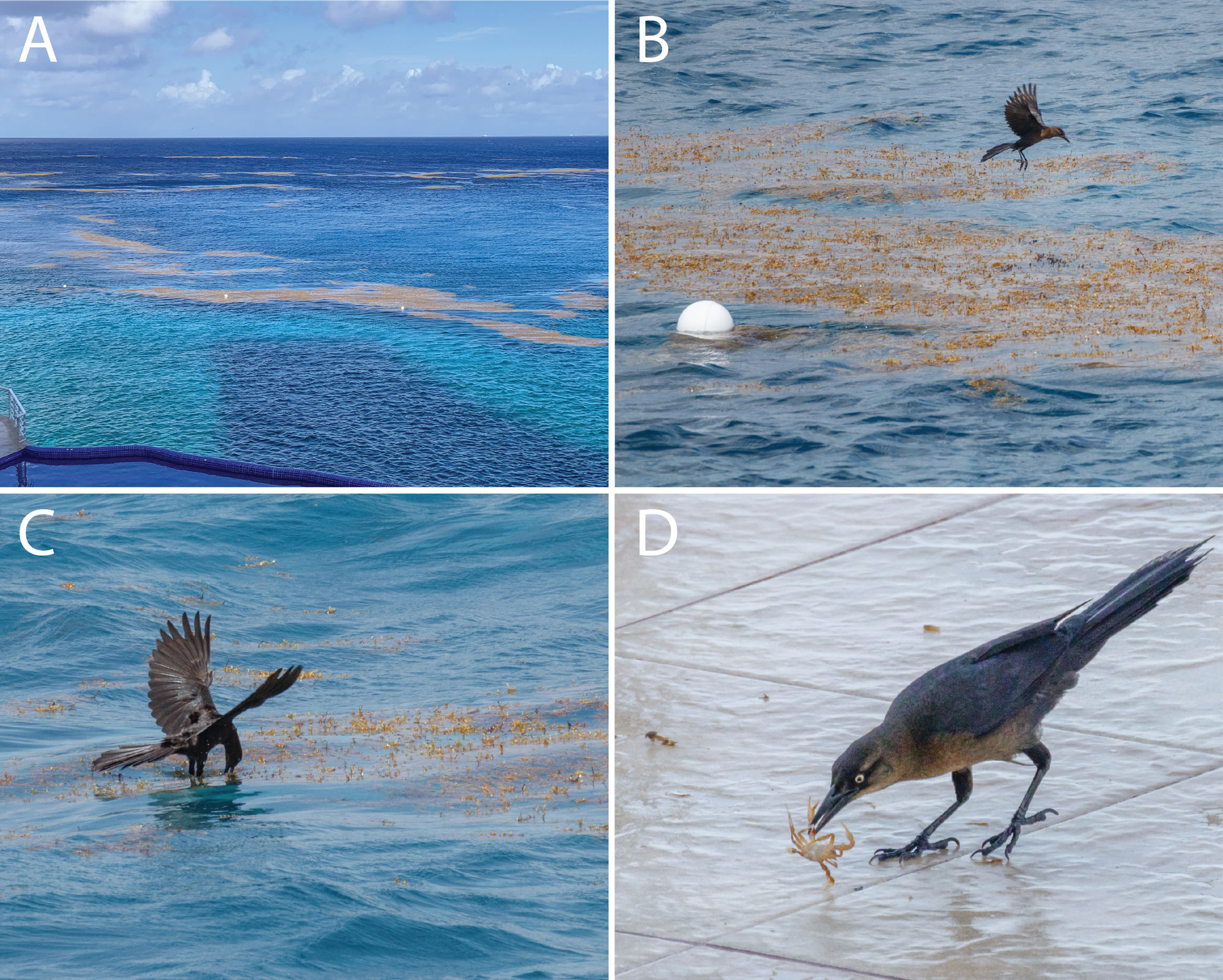
Fig. 1. Photographs illustrating the study site and Great-tailed Grackle (Quiscalus mexicanus) foraging behavior. (A) Floating mats of Sargassum spp. on 24 July 2022. The line of white buoys marking the innermost sargassum rafts is subparallel to shore and 34 m distance; the most distant sargassum rafts are ~200 m from shore. (B) A brown-plumaged Great-tailed Grackle hovering over a sargassum raft at ~36 m from shore on 25 July 2022. (C) A Great-tailed Grackle hover-gleaning from floating sargassum at ~37 m from shore on 31 July 2022. Note, the bird’s toes are touching floating sargassum while hovering and gleaning. (D) A brown-plumaged Great-tailed Grackle preparing to eat a crab after a successful foraging excursion out to ~85 m from shore on 24 July 2022.
Fig. 2
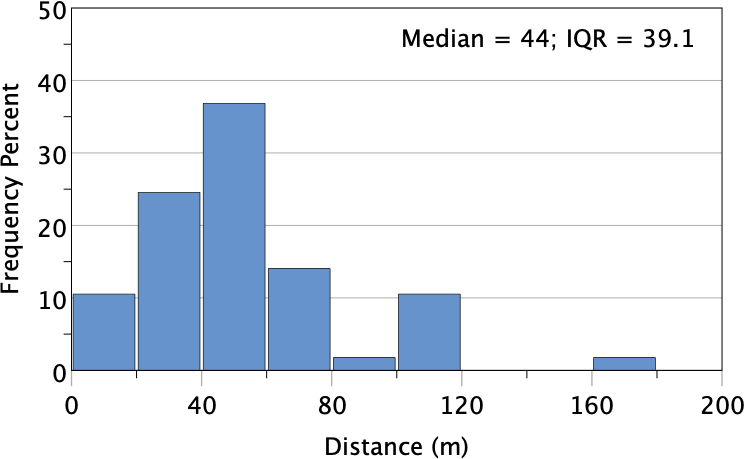
Fig. 2. Histogram of foraging distances (n = 57).
Fig. 3
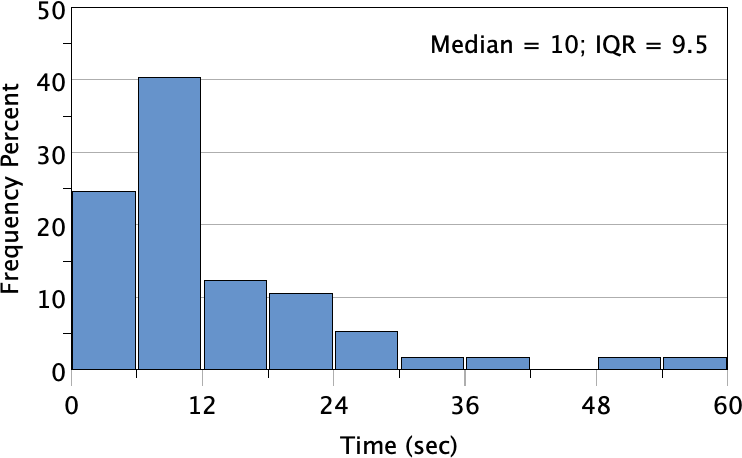
Fig. 3. Histogram of foraging durations (n = 57).
Fig. 4
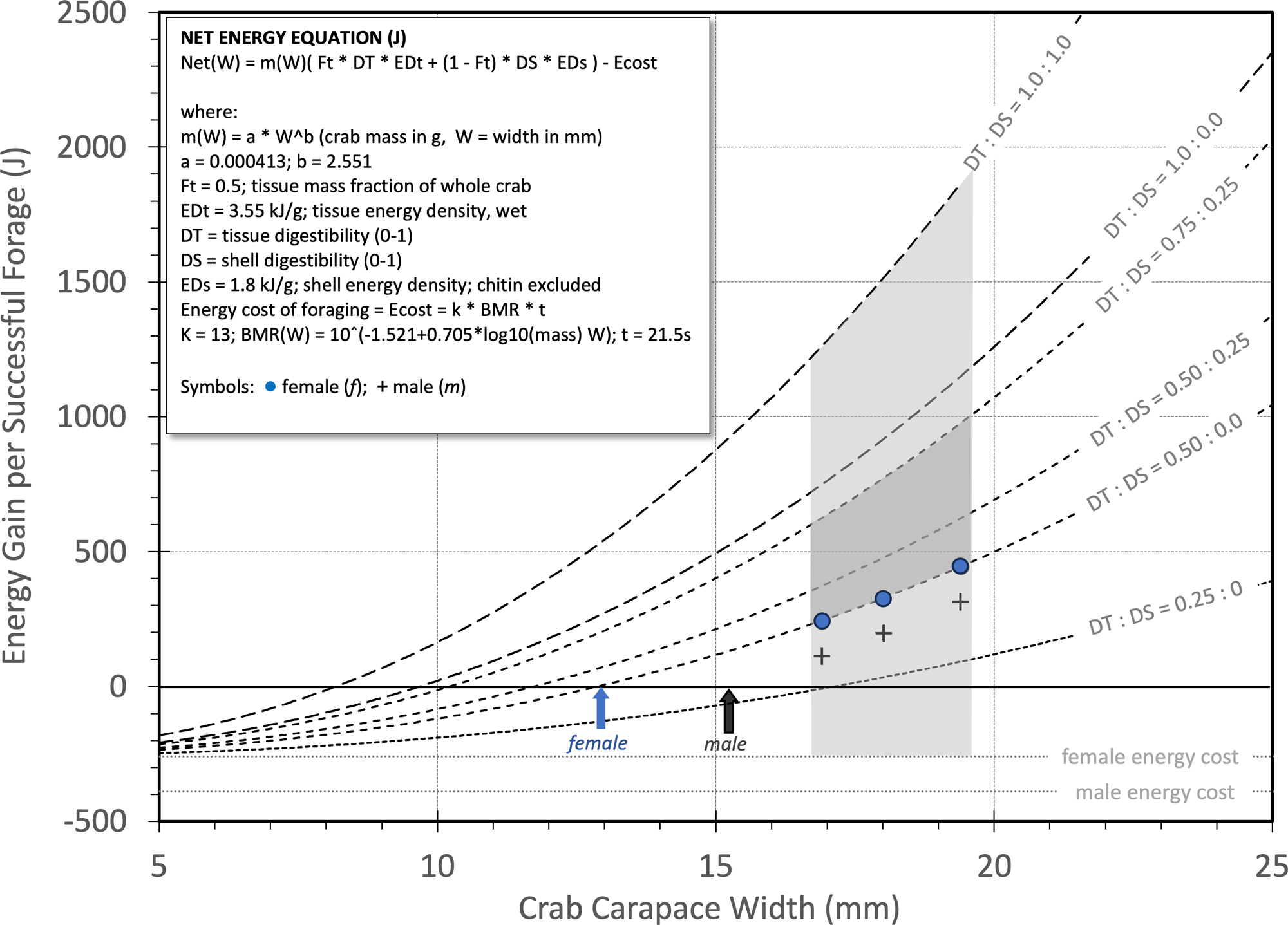
Fig. 4. Plot of net energy gain of successful forages as a function of crab size. Curves show the net energy gains for female grackles over a range of crab sizes and different tissue (Dt) and shell (Ds) digestive scenarios. The lowest curve, modeled after a conservative scenario based on human processing and consumption, illustrates the net energy gain if a grackle digests only 25% of soft parts (12.5% wet mass); the uppermost curve illustrates the limit of net energy gained based on a theoretical scenario in which the grackle completely digests all soft and hard parts. Filled circles show the estimated energy gains for female grackles and crosses indicate those for males. The light gray polygon outlines the energy gains resulting from a range of foraging and digestive; the dark gray shading indicates energy gains resulting from successful forages and conservative scenarios considered likely. Arrows indicate break-even crab sizes for female and male grackles, assuming a digestive scenario of soft to hard parts = 0.50 : 0.0.