





The following is the established format for referencing this article:
Carrión-Tacuri, J., C. R. Gil-Jaramillo, C. Sevilla, B. Fessl, and J. P. Gibbs. 2026. Persistence of the Brujo Flycatcher (Pyrocephalus nanus) on Cerro Azul Volcano, Isabela Island, Galápagos. Journal of Field Ornithology 97(3):1.ABSTRACT
The Brujo Flycatcher (Pyrocephalus nanus) is endemic to the Galápagos Archipelago, where its population has declined and even disappeared from three islands. Cerro Azul Volcano, the southwesternmost volcano of Isabela Island, has lacked confirmed records of this species in recent decades, with BirdLife International listing it as presumed extinct there. In February 2023, during systematic surveys for giant tortoises (Chelonoidis vicina) on Cerro Azul Volcano, we opportunistically recorded 19 individuals of P. nanus. These included 11 adult males, four adult females, and three nestlings on the volcano’s northern flank, as well as one adult male on its northwestern flank. No individuals were encountered elsewhere on the volcano. Detections of P. nanus were concentrated on the volcano’s northern flank, an area characterized by arid conditions and relatively low levels of exotic plant invasion. Our findings provide new evidence of the presence and reproduction of P. nanus on Cerro Azul Volcano, confirming its occurrence after several decades without verified reports and underscoring the conservation importance of this area for the species.
RESUMEN
Pyrocephalus nanus es endémico del archipiélago de Galápagos, donde su población ha disminuido e incluso ha desaparecido de tres islas. El volcán Cerro Azul, el más sudoccidental de la isla Isabela, no ha contado con registros confirmados de esta especie en las últimas décadas, por lo que BirdLife International la ha clasificado como presuntamente extinta en esa zona. En febrero de 2023, durante unos estudios sistemáticos sobre las tortugas gigantes (Chelonoidis vicina) en el volcán Cerro Azul, registramos de forma fortuita 19 ejemplares de P. nanus. Estos incluyeron 11 machos adultos, cuatro hembras adultas y tres polluelos en el flanco norte del volcán, así como un macho adulto en su flanco noroeste. No se detectaron individuos en otras zonas del volcán. Los avistamientos de P. nanus se concentraron en el flanco norte del volcán, una zona caracterizada por condiciones áridas y niveles relativamente bajos de invasión de plantas exóticas. Nuestros hallazgos proporcionan nueva evidencia sobre la presencia y reproducción de P. nanus en el volcán Cerro Azul, confirmando su ocurrencia después de varias décadas sin reportes verificados y resaltando la importancia de conservación de esta área para la especie.
INTRODUCTION
The avifauna of the Galápagos Islands is emblematic of both evolutionary diversification and notable conservation vulnerability. Of the 28 native species of small landbirds (passerines, cuckoos, and doves) recognized in the archipelago, nearly half are threatened with extinction, according to the IUCN Red List (Fessl et al. 2017, Dvorak et al. 2021), because of declines or disappearances of many species’ populations during the past century, particularly on inhabited islands (Causton et al. 2006, Dvorak et al. 2012, 2017, 2020, Fessl et al. 2018, Bulgarella et al. 2019, Mosquera et al. 2022). Recent surveys have documented local extinction of several landbird species on Floreana and San Cristóbal Islands (Dvorak et al. 2020, 2021), highlighting the vulnerability of the archipelago’s small and isolated landbird populations.
The Brujo Flycatcher (Pyrocephalus nanus), a small insectivorous Tyrannid endemic to Galápagos, is among the threatened passerines in the archipelago. Formerly treated as part of the widespread P. rubinus, genetic analyses confirm its status as a distinct species, along with its congener P. dubius of San Cristóbal Island, now considered extinct (Carmi et al. 2016, Dvorak et al. 2020, Anchundia et al. 2026). During the past two decades, P. nanus has suffered severe declines, having disappeared from Floreana and Santa Fé Islands (Merlen 2013) and was last reported on Santiago Island in 2016 (Fessl et al. 2017). On Santa Cruz Island, restoration efforts are currently underway to prevent the extirpation of P. nanus there (Merlen 2013, Anchundia et al. 2024, BirdLife International 2025; Fig. 1). The main threats identified for P. nanus include nest failure due to parasitism by the avian vampire fly Philornis downsi and degradation of breeding habitats by exotic, invasive plants (Leuba et al. 2020, Mosquera et al. 2022, Anchundia et al. 2024).
On Isabela Island, P. nanus remains relatively common on four of its five volcanoes (Wolf, Darwin, Alcedo, Sierra Negra), occupying arid and transitional habitats (Fessl et al. 2017). In contrast, no confirmed records are available from Cerro Azul Volcano prior to 2023, despite ornithological searches conducted on the southern slopes of the volcano in 2018 (Charles Darwin Foundation, Landbird Conservation Program, unpublished data), resulting in P. nanus being categorized as possibly extinct on the volcano (BirdLife International 2025; Fig. 1).
Our study focuses on a small breeding population of P. nanus we located on the northern flank of Cerro Azul Volcano, based on incidental records obtained during a population survey for giant tortoises (Chelonoidis vicina) across the volcano in 2023. Descriptions of the distribution, age, and sex of the P. nanus individuals we observed, along with their ecological conditions, may explain the species’ persistence on the volcano and highlight the importance of the area for the conservation of this declining species.
MATERIALS AND METHODS
Study area
Cerro Azul Volcano (0°58′S, 91°25′W) is the southwesternmost of the five major volcanoes that comprise Isabela Island, Galápagos, rising to 1640 m above sea level. Southeasterly trade winds bring greater humidity and rainfall to the volcano’s southern and southeastern slopes, whereas the northern and northwestern flanks are more arid because of orographic effects (Trueman and d’Ozouville 2010). The volcano hosts extensive arid and transitional shrubland interspersed with recent, intermediate and older lava flows (Naumann and Geist 2000). Exotic plants, mainly blackberry (Rubus niveus) and guava (Psidium guajava), have invaded most flanks of the volcano but to a lesser degree on its northern flank (Rivas-Torres et al. 2018; J. Carrión-Tacuri, Galápagos Conservancy Inc., personal observation). This likely reflects its isolation from humid windward areas where these invasive plants typically proliferate. In addition, a large number of feral cattle (Bos taurus) and feral pigs (Sus scrofa) occur on all flanks of the volcano and disturb the vegetation.
Field surveys
Fieldwork was conducted 10–20 February 2023 as part of a population survey and habitat characterization of the volcano’s endemic species of giant tortoise (Chelonoidis vicina). Teams of three observers simultaneously walked pre-defined polygons ranging between six and eight km² in area on each flank of the volcano, ensuring comparable effort and survey coverage across all flanks of the volcano, with their trajectories tracked by handheld GPS units. Although the surveys were aimed at recording tortoises, occurrences of other species of interest, including P. nanus, were also noted.
Pyrocephalus nanus observations
Whenever a P. nanus was observed, its position was georeferenced with hand-held GPS unit (accurate to ± five m). Designation of apparent sex and age class (adult male, adult female, juvenile) of each individual was noted based on plumage. No individuals were captured or handled. Because individuals were not marked, individual identity could not be confirmed such that nearby detections of adult males (e.g., < 100 m apart) could represent repeated observations of the same individual. Accordingly, detection points were interpreted conservatively as indicators of spatial occurrence, and no attempt was made to estimate population size. Survey trajectories were later mapped to illustrate their spatial coverage and P. nanus detections mapped to highlight the species’ distribution on the volcano. Research was conducted under authorization PC-05-22 provided by the Galápagos National Park Directorate.
RESULTS
We recorded a total of 19 individuals of P. nanus during our surveys (Fig. 2; Table 1). Of these, 18 were observed on the volcano’s northern flank, sympatric with the giant tortoise population, known as Gavilanes, in an area of approximately 15.7 km². Observations at Gavilanes included 11 adult males, four adult females, and three nestlings detected between 627 and 968 m above sea level. One adult male was detected on the volcano’s northwestern flank in the tortoise area known as Tablas (Fig. 2; Table 1) at 569 m above sea level (Table 1). Despite extensive survey effort and systematic coverage across all flanks of the volcano (Fig. 2), no P. nanus were detected on the volcano’s eastern, western, or southern sectors of Cerro Azul Volcano, where searches collectively covered approximately 82.7 km².
Adult males and females were identified based on plumage characteristics, as documented in Fig. 3. The three nestlings observed in a cup nest at Gavilanes were estimated to be 9–11 days old based on developmental features, including sparse down, dull coloration, and overall body size, interpreted using field experience and general patterns of nestling development in passerine birds. Nestlings were assigned to P. nanus based on their distinct nestling plumage and association with attending adults. The nest was built approximately three m above ground in a Palo Santo (Bursera graveolens) tree, a tree widely distributed in this sector of the volcano (Fig. 4). Five older and inactive nests (without adults, eggs, or nestlings; unknown if previously used), were opened to search for traces of the presence of puparia of Philornis downsi. Because of the parasitic larvae pupate in the nest, nest infestation and its severity can be assessed after nesting activity has ceased (Fessl et al. 2006); however, no pupal remains were found. This procedure did not affect active breeding attempts or individuals.
DISCUSSION
Pyrocephalus nanus has been considered as possibly extinct on Cerro Azul Volcano (BirdLife International 2025), and systematic surveys conducted on the southern slope of the volcano in 2018 did not detect the species (Charles Darwin Foundation, Landbird Conservation Program, unpublished data). However, our field observations of adult males, females, and nestlings demonstrate that a small breeding population persists on the volcano, suggesting that the species may have remained undetected in spatially restricted habitats rather than being absent there.
Our surveys were conducted across all flanks of Cerro Azul Volcano as part of a systematic giant tortoise census, providing extensive spatial coverage of the volcano. Despite this broad survey effort, P. nanus was detected exclusively on the northern flank, and no individuals were recorded in other sectors of the volcano. The pattern is consistent with the lack of detections during systematic surveys on the southern slope in 2018 (M. Dvorak, University of Vienna, Austria, unpublished data) and further supports the interpretation that P. nanus persists in spatially restricted habitats on Cerro Azul Volcano.
The restriction of observations of P. nanus to the northern and northwestern flanks of Cerro Azul Volcano may reflect variation in habitat quality for the species around the volcano. Our field observations indicated that the northern and northwestern flanks are comparatively less invaded by exotic plants than the volcano’s other flanks (J. Carrión-Tacuri, Galápagos Conservancy Inc., personal observation). This pattern is confirmed by vegetation mapping that has demonstrated reduced proliferation of invasive plants on the northern flanks of the volcano (Rivas-Torres et al. 2018). The interpretation that P. nanus is associated with areas less invaded by exotic plants is further supported by patterns observed on the northern volcanoes of Isabela Island, including those of Alcedo, Darwin and Wolf, where P. nanus maintains relatively robust populations, and where invasive plants such as guava and blackberry are largely absent or not yet widespread. Positive population responses of P. nanus to invasive plant reductions have been reported on Santa Cruz Island (Fessl et al. 2017, Anchundia et al. 2024), where habitat restoration and control of invasive plants in the highlands have been associated with recruitment of new individuals into the local P. nanus population. These cases highlight the central role of invasive plant management for the conservation of P. nanus across the archipelago.
The presence of many giant tortoises on the volcano’s northern flank may also contribute to local habitat suitability for P. nanus. Associations between P. nanus and giant tortoises during foraging, whereby flycatchers exploit insects flushed by the tortoises’ movements, have been documented on Wolf Volcano (Galápagos Conservancy, unpublished data). However, tortoises are abundant in many areas elsewhere on Isabela Island where P. nanus is rare or absent, so this interaction alone is unlikely to explain P. nanus’ distribution.
Despite this encouraging rediscovery, the long-term viability of the P. nanus population on Cerro Azul Volcano population remains uncertain. The species likely faces similar threats to those documented on other islands, including nest parasitism by the invasive fly and avian parasite Philornis downsi (Fessl et al. 2018, Leuba et al. 2020, Mosquera et al. 2022), which is known to cause high nestling mortality in humid habitats but may have reduced prevalence under the arid conditions of northern Cerro Azul Volcano, as has been reported for small and arid islands in Galápagos (Fessl and Tebbich 2002, Wiedenfeld et al. 2007). The orientation and dry climate of the northern sector of the volcano may also limit both the establishment of invasive plants and the severity of Philornis downsi parasitism, in contrast with the volcano’s more humid southern flanks. Without targeted management, however, ongoing spread of invasive plants into the volcano’s northern sector could undermine it as a refuge for P. nanus.
Our study was based on opportunistic detections of P. nanus made during systematic surveys of giant tortoises, rather than standardized avian censuses, limiting our ability to estimate P. nanus abundance or density. However, the extensive spatial coverage of survey tracks across all flanks of Cerro Azul Volcano supports the conclusion that P. nanus is currently restricted to the volcano’s northern and northwestern flanks. The number of individuals recorded likely represents only a subset of the population, because P. nanus detectability is expected to be imperfect and to vary across habitats. In addition, the observed male-biased sex ratio may reflect differences in detectability rather than true population structure, because males are more conspicuous and active, making them easier to detect than females. Future research should include systematic assessment of population size, reproductive success, and habitat quality, as well as the management of invasive species and ongoing assessment of the potential impacts of Philornis downsi.
The discovery of P. nanus on Cerro Azul Volcano confirms that the species remains distributed across all of Isabela Island and highlights the island’s importance as host to populations of P. nanus in the archipelago. The species is now considered extinct on Floreana and Santa Fé Islands and critically reduced on Santa Cruz Islands, where only a small remnant population persists (Merlen 2013, Leuba et al. 2020, Dvorak et al. 2021, Anchundia et al. 2024). On San Cristóbal Island, its congener P. dubius is considered to be extinct (Carmi et al. 2016, Dvorak et al. 2020). By comparison, populations of P. nanus on Isabela Island have remained relatively stable across all the island’s five volcanoes. Persistence on Sierra Negra Volcano is possibly due to management of the invasive fly and avian parasite Philornis downsi there over several reproductive seasons (Fessl et al. 2017, Leuba et al. 2020, Mosquera et al. 2022).
Our documentation of P. nanus on Cerro Azul Volcano demonstrates that the species persists in habitats where it had not been detected in recent decades. This finding highlights the conservation relevance of Cerro Azul Volcano as habitat for the species on Isabela Island and underscores the importance of protecting the volcano’s relatively intact northern flank from further invasion by exotic plants and feral animals. By documenting both presence and evidence of reproduction of P. nanus, our study supports the inclusion of Cerro Azul Volcano in future management strategies for P. nanus and other Galápagos landbirds.
RESPONSES TO THIS ARTICLE
Responses to this article are invited. If accepted for publication, your response will be hyperlinked to the article. To submit a response, follow this link. To read responses already accepted, follow this link.
AUTHOR CONTRIBUTIONS
Conceptualization: J.C-T., C.G-J., and J.G. Data curation: J.C-T., C.G-J. and J.G. Formal analysis: J.C-T., C.G-J., B.F., and J.G. Funding acquisition: J.C-T., and J.G. Supervision: J.C-T., and J.G. Investigation: J.C-T., and C.G-J. Methodology: J.C-T., C.G-J., C.S., and J.G., Project administration: J.C-T., and C.S. Supervision. J.C-T., and J.G. Validation: J.C-T., C.G-J., B.F., and J.G. Visualization: J.C-T., C.G-J., and J.G. Writing–original draft: J.C-T., and C.G-J. Writing–review & editing: B.F., and J.G.
ACKNOWLEDGMENTS
Our special thanks to the Galápagos National Park Directorate for providing the research authorization PC-05-22. We are especially grateful to park rangers Ángel Velásquez, Marcelo Uvidia, Wilson Villafuerte, Jibson Valle, Danny García, Marlon Ramón, Milton Calva, and Félix Armas for their exceptional commitment during the expedition. We also thank the staff of Galápagos Conservancy for their essential contributions to this work, both in the field and through their broader institutional support.
DATA AVAILABILITY
All relevant data supporting the findings of this study are provided within the manuscript and associated tables and figures. The study is based on field observations and spatial records, and no custom analytical code was generated or required.
LITERATURE CITED
Anchundia, D., A. W. Lam, J. B. Henderson, M. Van Dam, C. L. Pike, S. Tebbich, B. Fessl, H. Richner, and J. P. Dumbacher. 2026. Phylogeny, population structure, and conservation genomics of Galapagos Vermilion Flycatchers (genus Pyrocephalus). Molecular Phylogenetics and Evolution 216:108524. https://doi.org/10.1016/j.ympev.2025.108524
Anchundia, D. J., R. Green, C. L. Pike, G. Gutiérrez, P. Pibaque, R. Chango, C. Sevilla, B. Fessl, and S. Tebbich. 2024. Habitat restoration to conserve the Little Vermilion Flycatcher Pyrocephalus nanus on Santa Cruz Island, Galapagos. Bird Conservation International 34:34:e14. https://doi.org/10.1017/S0959270924000091
BirdLife International. 2025. Species factsheet: Brujo Flycatcher Pyrocephalus nanus. BirdLife DataZone. https://datazone.birdlife.org/species/factsheet/brujo-flycatcher-pyrocephalus-nanus
Bulgarella, M., M. A. Quiroga, and G. E. Heimpel. 2019. Additive negative effects of Philornis nest parasitism on small and declining Neotropical bird populations. Bird Conservation International 29:339-360. https://doi.org/10.1017/S0959270918000291
Carmi, O., C. C. Witt, A. Jaramillo, and J. P. Dumbacher. 2016. Phylogeography of the Vermilion Flycatcher species complex: multiple speciation events, shifts in migratory behavior, and an apparent extinction of a Galápagos-endemic bird species. Molecular Phylogenetics and Evolution 102:152-173. https://doi.org/10.1016/j.ympev.2016.05.029
Causton, C. E., S. B. Peck, B. J. Sinclair, L. Roque-Albelo, C. J. Hodgson, and B. Landry. 2006. Alien insects: threats and implications for conservation of Galápagos Islands. Annals of the Entomological Society of America 99:121-143. https://doi.org/10.1603/0013-8746(2006)099[0121:AITAIF]2.0.CO;2
Dvorak, M., B. Fessl, E. Nemeth, D. Anchundia, J. Cotín, C. H. Schulze, W. Tapia, and B. Wendelin. 2020. Survival and extinction of breeding landbirds on San Cristóbal, a highly degraded island in the Galápagos. Bird Conservation International 30:381-395. https://doi.org/10.1017/S0959270919000285
Dvorak, M., B. Fessl, E. Nemeth, S. Kleindorfer, and S. Tebbich. 2012. Distribution and abundance of Darwin’s finches and other land birds on Santa Cruz Island, Galápagos: evidence for declining populations. Oryx 46:78-86. https://doi.org/10.1017/S0030605311000597
Dvorak, M., E. Nemeth, B. Wendelin, and B. Fessl. 2021. More extinctions on the Galápagos Islands? An unsuccessful search for 4 landbirds on Floreana. Wilson Journal of Ornithology 133(3):514-518. https://doi.org/10.1676/21-00049
Dvorak, M., E. Nemeth, B. Wendelin, P. Herrera, D. Mosquera, D. Anchundia, C. Sevilla, S. Tebbich, and B. Fessl. 2017. Conservation status of landbirds on Floreana: the smallest inhabited Galápagos Island. Journal of Field Ornithology 8813:2-145. https://doi.org/10.1111/jofo.12197
Fessl, B., D. Anchundia, J. Carrión-Tacuri, A. Cimadom, J. Cotín, F. Cunninghame, M. Dvorak, D. Mosquera, E. Nemeth, C. Sevilla, S. Tebbich, and C. Causton. 2017. Galapagos landbirds (passerines, cuckoos, and doves): status, threats, and knowledge gaps. Pages 149-150 in Galápagos Reports 2015-2016. Galapagos National Park Directorate, Governing Council of Galapagos, Charles Darwin Foundation, and the Galapagos Conservancy. Puerto Ayora, Galapagos, Ecuador. https://www.researchgate.net/profile/Charlotte-Causton/publication/321869539_Galapagos_landbirds_passerines_cuckoos_and_doves_Status_threats_and_knowledge_gaps/links/5a36cae7aca27247ede1c340/Galapagos-landbirds-passerines-cuckoos-and-doves-Status-threats-and-knowledge-gaps.pdf
Fessl, B., G. E. Heimpel, and C. E. Causton. 2018. Invasion of an avian nest parasite, Philornis downsi, to the Galapagos Islands: colonization history, adaptations to novel ecosystems, and conservation challenges. Pages 213-266 in P. G. Parker, editor. Disease ecology: Galapagos birds and their parasites. Springer International Publishing, Cham, USA. https://doi.org/10.1007/978-3-319-65909-1_9
Fessl, B., and S. Tebbich. 2002. Philornis downsi—a recently discovered parasite on the Galápagos archipelago—a threat for Darwin’s finches? Ibis 144:445-451. https://doi.org/10.1046/j.1474-919X.2002.00076.x
Fessl, B., S. Kleindorfer, and S. Tebbich. 2006. An experimental study on the effects of an introduced parasite in Darwin’s finches. Biological Conservation 127:55-61. https://doi.org/10.1016/j.biocon.2005.07.013
Leuba, C., S. Tebbich, E. Nemeth, D. Anchundia, E. Heyer, D. A. Mosquera, H. Richner, M. L. Rojas Allieri, C. Sevilla, and B. Fessl. 2020. Effect of an introduced parasite in natural and anthropogenic habitats on the breeding success of the endemic little vermilion flycatcher Pyrocephalus nanus in the Galápagos. Journal of Avian Biology 51:e02438. https://doi.org/10.1111/jav.02438
Merlen, G., 2013. Gone, gone...going: the fate of the Vermilion Flycatcher on Darwin´s islands. Galapagos Report 2012:180-188.
Mosquera, D., B. Fessl, D. Anchundia, E. Heyer, C. Leuba, E. Nemeth, M. L. Rojas, C. Sevilla, and S. Tebbich. 2022. The invasive parasitic fly Philornis downsi is threatening Little Vermilion Flycatchers on the Galápagos Islands. Avian Conservation and Ecology 17(1):6. https://doi.org/10.5751/ACE-02040-170106
Naumann, T., and D. Geist. 2000. Physical volcanology and structural development of Cerro Azul Volcano, Isabela Island, Galápagos: implications for the development of Galápagos-type shield volcanoes. Bulletin of Volcanology 61:497-514. https://doi.org/10.1007/s004450050001
Rivas-Torres, G. F., F. L. Benítez, D. Rueda, C. Sevilla, and C. F. Mena. 2018. A methodology for mapping native and invasive vegetation coverage in archipelagos: an example from the Galápagos Islands. Progress in Physical Geography: Earth and Environment 42:83-111. https://doi.org/10.1177/0309133317752278
Trueman, M., and N. d’Ozouville. 2010. Characterizing the Galapagos terrestrial climate in the face of global climate change. Galapagos Research 67:26-37. https://www.darwinfoundation.org/en/resources/galapagos-research/gr-67-2010/
Wiedenfeld, D., G. Jiménez, B. Fessl, S. Kleindorfer, and C. Valarezo. 2007. Distribution of the introduced parasitic fly Philornis downsi (Diptera, Muscidae) in the Galapagos Islands. Pacific Conservation Biology 13:14-19. https://doi.org/10.1071/PC070014
Fig. 1
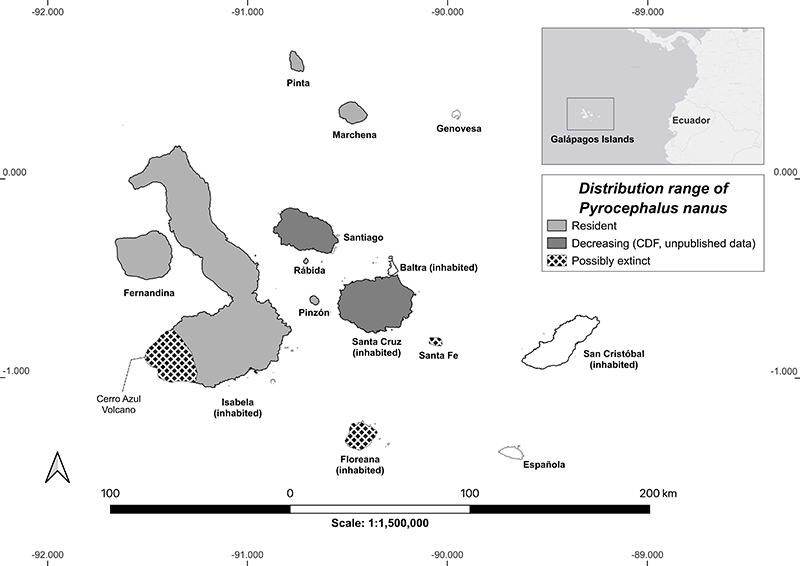
Fig. 1. Map of the Galápagos Islands showing the current distribution of the Brujo Flycatcher (Pyrocephalus nanus), indicating islands or places where the species is resident, decreasing, possibly extinct, or extinct according to BirdLife International (2025). San Cristóbal Island was home of P. dubius, now considered extinct.
Fig. 2
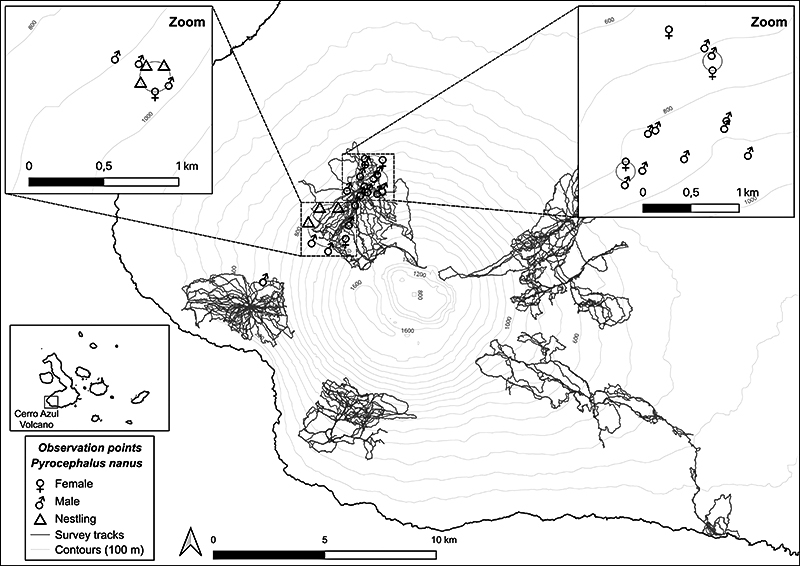
Fig. 2. Cerro Azul Volcano, Isabela Island, showing locations where Brujo Flycatcher (Pyrocephalus nanus) individuals were recorded (♀ = Female, ♂ = Male, Triangle = Nestling), as well as tracks (darker lines) of field surveys carried out in February 2023.
Fig. 3
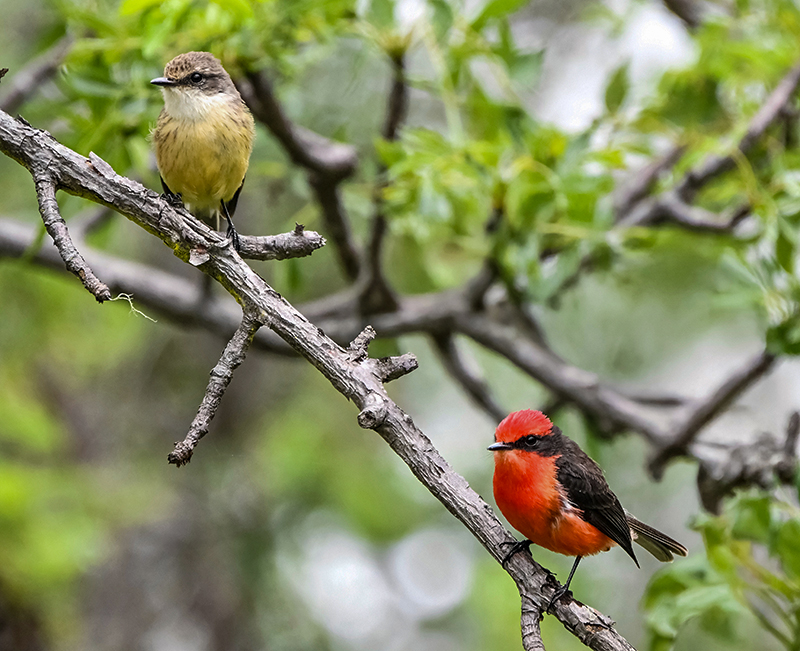
Fig. 3. Pair of adult Brujo Flycatchers (Pyrocephalus nanus) photographed on Cerro Azul Volcano, Isabela Island, in February 2023. The male (below) shows the characteristic bright vermilion plumage, whereas the female (above) exhibits a grayish-brown coloration. (Photo credit: Jorge Carrión-Tacuri.)
Fig. 4
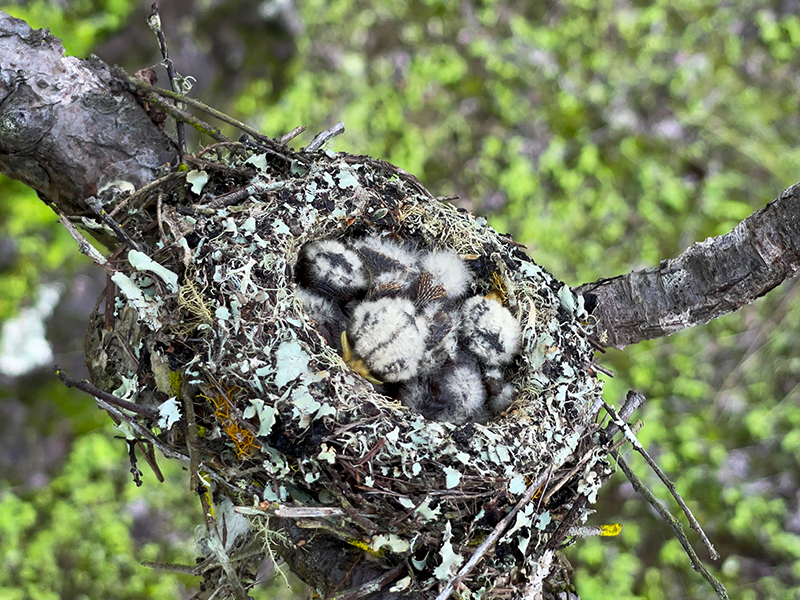
Fig. 4. Cup nest containing Brujo Flycatchers (Pyrocephalus nanus) in a palo santo tree (Bursera graveolens), containing three nestlings aged 9–11 days, on the northern flank of Cerro Azul Volcano, Isabela Island, Galápagos, February 2023. (Photo credit: Jorge Carrión-Tacuri.)
Table 1
Table 1. Records of Brujo Flycatchers (Pyrocephalus nanus) individuals observed on Cerro Azul Volcano, Isabela Island, Galápagos, in February 2023, including sex (M = Male; F = Female; U = Undetermined), age (A = Adult; N = Nestling), locality, coordinates, elevation (m.a.s.l.), and date of observation.
| Sex | Age | Locality | Latitude (°) | Longitude (°) | Elevation | Date | |||
| F | A | Gavilanes | -0.88489 | -91.41518 | 821 | 2023-02-11 | |||
| M | A | Gavilanes | -0.88488 | -91.41518 | 821 | 2023-02-11 | |||
| M | A | Gavilanes | -0.88442 | -91.41354 | 839 | 2023-02-11 | |||
| M | A | Gavilanes | -0.88094 | -91.41302 | 792 | 2023-02-11 | |||
| M | A | Gavilanes | -0.88064 | -91.41233 | 799 | 2023-02-11 | |||
| M | A | Gavilanes | -0.87973 | -91.40569 | 842 | 2023-02-11 | |||
| M | A | Gavilanes | -0.88333 | -91.40964 | 873 | 2023-02-11 | |||
| M | A | Gavilanes | -0.89769 | -91.42744 | 890 | 2023-02-11 | |||
| M | A | Gavilanes | -0.89899 | -91.42508 | 953 | 2023-02-12 | |||
| F | A | Gavilanes | -0.89899 | -91.42508 | 953 | 2023-02-12 | |||
| U | N | Gavilanes | -0.89899 | -91.42508 | 953 | 2023-02-12 | |||
| U | N | Gavilanes | -0.89899 | -91.42508 | 953 | 2023-02-12 | |||
| U | N | Gavilanes | -0.89899 | -91.42508 | 953 | 2023-02-12 | |||
| M | A | Gavilanes | -0.88301 | -91.40369 | 890 | 2023-02-13 | |||
| M | A | Gavilanes | -0.87453 | -91.40708 | 718 | 2023-02-13 | |||
| F | A | Gavilanes | -0.87452 | -91.40707 | 718 | 2023-02-13 | |||
| M | A | Tablas | -0.91976 | -91.45181 | 569 | 2023-02-16 | |||
| M | A | Gavilanes | -0.89796 | -91.42601 | 912 | 2023-02-17 | |||
| F | A | Gavilanes | -0.87158 | -91.41115 | 627 | 2023-02-17 | |||