





The following is the established format for referencing this article:
Bell, S., M. Buswell, C. J. Wilhite, M. Hagemann, D. Risch, L. Luther, L. Elliott, R. S. Sprague, T. M. Work, and M. R. Price. 2026. Mortality in the Hawaiian Short-eared Owl (Pueo, Asio flammeus sandwichensis): causes and spatial trends. Journal of Field Ornithology 97(2):6.ABSTRACT
Trends in wildlife mortality can be particularly challenging to identify in low-density species where mortalities are less likely to be detected or documented. The Pueo, or Hawaiian Short-eared Owl (Asio flammeus sandwichensis), is the only native raptor that breeds on all the main Hawaiian Islands. The Pueo is state-listed as endangered on the island of Oʻahu, but drivers of population dynamics are not well known, including causes of mortality. In this study, existing records from organizations across the Hawaiian Islands were compiled to evaluate the causes of mortality in Pueo. Here, 242 unique records spanning the years 1993 to 2024 from state, federal, and private organizations were evaluated for causes of Pueo death. Trauma due to collisions with vehicles, wind turbines, fences, and other human-made objects was the leading detected cause of death (62%) followed by emaciation (13%) and disease (6%), with 19% of deaths due to unknown causes. The islands of Hawaiʻi and Kauaʻi, both with relatively low human populations, had the highest total number of reported mortalities (n = 77, 32%). The highest number of recorded mortalities was in the month of July (16%), and mortalities were generally higher from June through August. Although our study has detection biases, our results are consistent with global studies suggesting that blunt force trauma from vehicles, wind turbines, and other infrastructure are potentially important sources of mortality in raptors. Similar to other studies, rodenticide effects and infectious disease were potentially underestimated as sources of mortality, because most birds did not undergo a full necropsy. Further, there may be confounding variables due to ad hoc data collection. Development of a state-wide system for reporting and recording wildlife mortality along with future studies that include necropsies may improve our ability to discern which sources of mortality may be mitigated.
RESUMEN
Las tendencias en la mortalidad de la fauna silvestre pueden ser particularmente difíciles de identificar en especies de baja densidad donde es menos probable que se detecten o documenten las muertes. El Pueo, o Búho campestre hawaiano (Asio flammeus sandwichensis), es la única ave rapaz nativa que se reproduce en todas las islas hawaianas principales. El Pueo está catalogado como especie en peligro de extinción en la isla de Oʻahu, pero los factores que impulsan la dinámica poblacional no se conocen bien, incluyendo las causas de mortalidad. En este estudio, se recopilaron registros existentes provenientes de organizaciones distribuidas en las islas hawaianas para evaluar las causas de mortalidad en el Pueo. Aquí, se evaluaron 242 registros únicos, que abarcan los años 1993 a 2024, provenientes de organizaciones estatales, federales y privadas, para determinar las causas de muerte del Pueo. El trauma causado por colisiones con vehículos, aerogeneradores, cercas y otros objetos construidos por el ser humano fue la principal causa de muerte detectada (62%), seguido por la emaciación (13%) y las enfermedades (6%), mientras que el 19% de las muertes se debió a causas desconocidas. Las islas de Hawaiʻi y Kauaʻi, ambas con poblaciones humanas relativamente bajas, tuvieron el mayor número total de muertes reportadas (n = 77, 32%). El mayor número de muertes registradas fue en el mes de julio (16%) y la mortalidad fue generalmente más alta entre junio y agosto. Aunque nuestro estudio presenta sesgos de detección, nuestros resultados son consistentes con estudios globales que sugieren que el trauma contundente causado por vehículos, aerogeneradores y otras infraestructuras constituye una fuente potencialmente importante de mortalidad en las aves rapaces. Al igual que en otros estudios, los efectos de los rodenticidas y las enfermedades infecciosas fueron potencialmente subestimados como fuentes de mortalidad, debido a que la mayoría de las aves no fueron sometidas a una necropsia completa. Además, puede haber variables de confusión debido a la recolección de datos ad hoc. El desarrollo de un sistema estatal para reportar y registrar la mortalidad de la fauna silvestre, junto con futuros estudios que incluyan necropsias, podría mejorar nuestra capacidad para discernir qué fuentes de mortalidad pueden ser mitigadas.
INTRODUCTION
The Short-eared Owl (Asio flammeus) is a globally distributed species in the Americas, Europe, Asia, and Africa, and islands in the Pacific and Atlantic Oceans. Many Short-eared Owl populations are declining across the globe (Burfield 2008, Booms et al. 2014, Calladine et al. 2024), and they are acknowledged to be a poorly understood species (Wiggins 2004, Wiggins 2008, Booms et al. 2014, Fernández-Bellon et al. 2021). In Canada, Short-eared Owls are listed as “threatened” (COSEWIC 2021), and many regions within the United States, including Hawaiʻi, have listed Short-eared Owls as “endangered” or “threatened” at the state level (Gahbauer et al. 2021), leading to a USFWS status of “Bird of Conservation Concern,” which identifies species of high conservation priority (https://www.fws.gov/media/birds-conservation-concern-2021). Causes of endangerment and decline are thought to include habitat degradation, shooting by humans, limited food resources, and collisions with vehicles (Cooper 2000, Calladine et al. 2012, Mostello and Conant 2018).
The Pueo (Hawaiian Short-eared Owl, Asio flammeus sandwichensis) is a subspecies of Short-eared Owl endemic to the Hawaiian Islands (Berger 1981). The Pueo is culturally important, appearing in many moʻolelo, or stories, as ancestral guardians, with owls acting as a guide and considered by some as incarnations of past family members (Goldman 2010, Stormcrow 2023). Short-eared owls in Hawaiʻi have a diverse prey base, consuming birds, insects, rodents, bats, and reptiles (Snetsinger et al. 1994; Work and Hale 1996; Mostello and Conant 2018). Two other raptors that breed and live on the Hawaiian Islands and may provide competition are the ʻIo, or the Hawaiian Hawk (Buteo solitarius), an endemic species that primarily occurs on Hawaiʻi Island, with rare occurrences on Maui, as well as American Barn Owl (Tyto furcata) which was introduced to the Hawaiian Islands in the late 1950s and early 1960s as a biocontrol for rodent populations impacting agricultural production (Tomich 1962). As the only native raptor on most islands, Pueo may play an important role as a native apex predator. Similar to Short-eared Owls globally, populations of Pueo have declined, and in 2005 they were listed by the state as endangered on the island of Oʻahu (Hawaiʻi DLNR 2005).
Previous studies of mortality in owls across the Hawaiian Islands included very few Pueo; of 86 owls examined by Work and Hale (1996) only five were Pueo, and Aye et al. (1995) only included one. In the last century there were reports of large die-offs of owls due to “sick owl syndrome,” where owls were observed displaying neurological abnormalities across the Hawaiian Islands (Telfer 1972, Gassmann-Duvall and Telfer 1987, Gassmann-Duvall 1988, Aye et al. 1995). A total of 116 owls, largely American Barn Owls but a few Pueo as well, were found dead and lethargic from 1987 to 1988 (Gassmann-Duvall 1988); causes were largely attributed to trauma and exposure to rodenticides. Work and Hale (1996), using systematic necropsies, showed the major causes of death in owls were trauma, the parasite Trichomonas gallinae, and starvation.
Despite its importance, little is known regarding Pueo population dynamics, although studies over the last decade are beginning to provide a baseline understanding of key aspects of natural history. Known threats to Short-eared Owls in Hawaiʻi and elsewhere include predation on eggs and chicks by introduced predators, such as rats (Rattus spp.), feral cats (Felis catus), and the small Indian mongoose (Urva auropunctata), competition with the introduced American Barn Owl, habitat loss and fragmentation, and trauma resulting from car strikes or wind turbines (Hawaiʻi DLNR 2015, Mostello and Conant 2018, Gomez et al. 2023). However, the Hawaiian Islands lack a comprehensive evaluation of the relative impact of various threats to Pueo. Thus, in this study our goal was to compile available records on Pueo mortality throughout the Hawaiian Islands to identify the leading causes of mortality and discern potential trends among islands.
METHODS
A snowball sampling (Johnson 2014) approach was used to obtain mortality records from state, federal, and private organizations via email. Organizations included land management organizations such as government agencies, wind farms, as well as those who received carcasses or birds in need of care, such as museums, wildlife rehabilitation organizations or veterinary facilities, and laboratories dedicated to determining cause of death in native wildlife in the Hawaiian Islands. Once initial responses were received, recommendations of additional points of contact were sought until the contact pool reached saturation, indicated by receiving duplicate records or recommendations of organizations whom we had already contacted.
Analyses
The records provided were categorized by date, island, and cause of death. Duplicate records were identified and then combined to gather as much information as possible from each record. Deaths per month and year were evaluated for the records provided to the authors, which covered a 32-year time frame (1993–2024). We note that we did not ask for a specific time frame, so these are assumed to represent all available records from these organizations. Cause of death was determined both by the record keepers, either with an observational diagnosis or necropsy testing, and by us, using information within the records, including descriptions of the injury and location. If multiple causes of death were indicated, but descriptions indicated that one cause of death appeared to be the immediate cause of death, the primary cause of death was recorded but the additional potential contributing factors were noted. If a record lacked sufficient information, the cause of death was noted as unknown. Records that indicated euthanasia as the cause of death were assigned to the underlying issue (trauma, emaciation, disease, unknown) rather than to “euthanasia.” Animals in records originating from the U.S. Geological Survey (n = 35) underwent a complete external and internal examination including histopathology, which then guided any additional ancillary laboratory diagnostics (Work and Hale 1996).
Chi-square analyses were used to evaluate whether the cause of death differed amongst categories with all records combined, and whether cause of death differed among categories within individual islands. Linear regression analyses were used to determine whether the number of records increased or decreased over time. Monthly variation in Pueo mortality was evaluated using a Poisson generalized linear model with month as a categorical predictor, and significance of month effects was assessed using likelihood-ratio tests and post-hoc estimated marginal means. All analyses were conducted in R (v4.4.x; R Core Team 2025) with RStudio (v2024.12.1+563), using the tidyverse (v2.0.0; Wickham et al. 2019) and lubridate (v1.9.4; Grolemund and Wickham 2011) packages. A spatial analysis at a higher resolution than “island” was not possible because specific locations, such as GPS points, were unavailable for most records. Likewise, other potential factors such as age, sex, and mass of individuals were not available for most records but were noted when available for descriptive purposes. We note that any use of trade, firm, or product names is for descriptive purposes only and does not imply endorsement by the U.S. Government.
RESULTS
A total of 242 unique mortality records were identified from 1993 to 2024 from 10 organizations (Table 1). The highest number of mortalities was recorded on the islands of Hawaiʻi (n = 77, 32%) and Kauaʻi (n = 77, 32%), followed by Maui (n = 44, 18%), Lānaʻi (n = 20, 8%), Oʻahu (n = 14, 6%), and Molokaʻi (n = 10, 4%; Fig. 1). The highest number of mortalities was recorded in the months of July (n = 38, 16%) and August (n = 36, 15%), and the lowest number of mortalities was recorded in January (n = 9, 4%) and September (n = 10, 4%; Fig. 2). The number of reported mortalities ranged from one to 24 per year, increasing over time with a positive slope of 0.44 records per year (p < 0.001; Fig. 3).
Overall, the leading cause of death was trauma (n = 150, 62% of records), followed by emaciation (n = 32, 13%), and disease (n = 14, 6%); the cause of death was unknown in 46 cases (19%). Records where the primary cause of death was trauma sometimes noted the source of trauma, including collisions with vehicles (n = 65), wind turbines (n = 20), fences (n = 6), and utility lines (n = 5). On wind farms, up to three mortalities per year were reported over the last 16 years (2009–2024). Emaciation was the second highest recorded cause of death on the islands of Hawaiʻi (n = 14) and Lānaʻi (n = 3; Table 2; Fig. 1). For animals that underwent a complete necropsy exam (n = 35), trauma was the leading cause of death (37%) followed by disease (23%), emaciation (20%), and unknown (20%).
Although ultimate cause of death was utilized for analyses, we note that the records sometimes contained notes providing insight into factors potentially contributing to the cause of death. For example, in 12 of the trauma records, potential underlying causes were noted as emaciation (n = 7), rodenticide exposure (n = 3), and parasitism (n = 2). In 18 of the emaciation records, prior trauma (n = 8), rodenticide exposure (n = 5), parasitism (n = 3), and hypothermia (n = 2) were noted. In 11 records of disease, potential underlying causes were noted as parasites (n = 10), and rodenticide exposure (n = 1). The types of disease included parasitic infection (n = 5), specifically trichomoniasis, and one record each of pulmonary helminthiasis, aspergillosis, and pasteurellosis. Overall, suspected rodenticide poisoning was indicated in a total of nine records, where the ultimate cause of death was attributed to other sources such as emaciation (n = 5), trauma (n = 3), and disease (n = 1). In 35 Pueo where systematic necropsies were done, of eight cases with disease, 38% (n = 3) were due to trichomoniasis, 38% (n = 3) to pulmonary helminthiasis, and the remainder were attributed to miscellaneous causes (bacteria, ophthalmitis, hemorrhage of unknown origin).
DISCUSSION
This study aimed to fill a knowledge gap regarding the causes of mortality in Pueo by collating records from across the Hawaiian Islands. The most commonly reported (62%) cause of death for Pueo across all islands was trauma, similar to a previous study in the Hawaiian Islands that largely consisted of American Barn Owls (Work and Hale 1996). Of the 150 records of trauma, 66% (n = 99) indicated either direct vehicle collision or trauma occurring near a roadway. These results differ from a study in Europe in which the majority of reported deaths were from being shot (69%), followed by trauma from traffic collisions (15%) or collisions with other man-made objects (5%; Calladine et al. 2012). Studies using transmitters have suggested that predation by other raptors may be a substantial cause of mortality (Johnson et al. 2017), but emaciation and collision trauma were also documented, similar to our study (Calladine et al. 2024). To our knowledge there are no records of resident Barn Owl or ʻIo hunting adult Pueo, but Peregrine Falcons (Falco peregrinus) are winter migrants in the islands and may hunt Pueo. Importantly, continental studies found that mortality was higher during long migrations (Johnson et al. 2017, Calladine et al. 2024). Although not a comparatively large movement, Pueo were recently documented flying between islands (Garcia-Heras and Price 2024), but more research is needed to determine whether interisland movements are associated with higher mortality.
We note that specimens on the road are more likely to be spotted and collected compared to those in a location with less human traffic; therefore, vehicle collisions are likely overrepresented in ad hoc reporting data because of detection bias (Morishita et al. 1998). Despite this acknowledged detection bias, mortality due to vehicle collisions is recognized as a major threat for birds globally, including Short-eared Owls (Scott 1938, Hodson and Snow 1965, Molina-López et al. 2011, Smith et al. 2018, Cococcetta et al. 2022, Šálek et al. 2023). Roadways are inferred to provide an attractive hunting area for raptors because of open habitat with perching sites, carrion from roadkill, and short grass on either side of the road for hunting, facilitating sighting of prey (Tomich 1971). A few owl species, including Short-eared Owls, hunt at the same height as vehicles, causing them to be particularly prone to collisions (Jacobson 2005). Owls that capture prey on the road may land to consume the item, potentially leaving them vulnerable to fast-moving vehicles (Work and Hale 1996).
Of concern given the relatively recent emergence of wind farms (Appendix 1), 13% of the trauma-related deaths were detected under wind turbines. Impacts from wind turbines appeared to be highest on Maui, where 36% (n = 16) of all mortality records occurred near wind turbines. The larger wind farms in operation today were built starting in 2006, with three wind farms each on Oʻahu, Maui, and Hawaiʻi islands (Appendix 1). However, given that Pueo are not listed as endangered on islands other than Oʻahu, mitigation is typically lacking on these islands to address Pueo casualties due to wind turbines (https://dlnr.hawaii.gov/wildlife/hcp). Given the impacts of global climate change on biodiversity, renewable energy methods are crucial to long-term sustainability efforts; however, wildlife impacts should be considered if wind farms significantly impact conservation goals for sensitive species (Drewitt and Langston 2006, Thaxter et al. 2017).
Other potential sources of trauma indicated in the records included utility lines and fences, which collectively were indicated in 11 (7%) of trauma cases. Utility lines have been noted as a source of raptor mortality globally (Molina-López et al. 2011, Slater et al. 2020, Lukesova et al. 2021, Escobar-Ibáñez et al. 2022, Šálek et al. 2023). Recently, Travers et al. (2023) determined utility line collisions to be a prevalent threat to native and endangered birds in the Hawaiian Islands, including Pueo. Birds may break their necks colliding with utility lines, receive electric burns that affect feathers and skin, and/or die from electrocution (Melero et al. 2013). The reporting in Travers et al. (2023) resulted in the implementation of bird-friendly utility line modifications that were the first of their kind in the region, demonstrating the need for wildlife research to inform effective management strategies.
Multiple records in this study included notations of trauma, emaciation, and disease in the same individual, typically highlighting that the immediate cause of death was trauma but that there were potential indicators of other factors. Further, most records did not include a necropsy, which is often necessary to determine the exact cause of death. Death in wild birds is often caused by a combination of health-related factors, many of which may not be revealed upon initial examination (Kelly et al. 2013, González-Astudillo et al. 2016). For example, an owl experiencing disease or emaciation from lack of food might be more likely to hunt along the roadside where it is easier to find mammalian prey, potentially increasing its chances of vehicular collision (Work et al. 2015). The apparent cause of death would be trauma, but a necropsy could potentially detect underlying conditions that made the bird more prone to vehicular collision. Conversely, past injury due to collisions with vehicles or wind turbines could reduce the ability of an owl to hunt, leading to emaciation or susceptibility to disease (Cococcetta et al. 2022).
Emaciation and disease were documented in 19% of the records in this study, with additional records noting potential rodenticide exposure, parasites, or other signs of illness. Rodenticide poisoning was only noted in nine records (4%) with most of these records occurring on the island of Hawaiʻi (n = 8), but the observations were based solely on the record keeper’s recognition of symptoms such as bleeding from the mouth, internal hemorrhaging, bruising, and anemia, rather than toxicologic analyses of tissue samples. During the 1980s, chemical agents were suspected to be responsible for sick owl syndrome and apparent owl population declines in the Hawaiian Islands (Gassmann-Duvall 1988), but systematic necropsies along with toxicologic analyses failed to show evidence of pesticide or rodenticide exposure as cause of death (Work and Hale 1996). Recent studies of raptors in the Hawaiian Islands have demonstrated a relatively high degree of exposure to rodenticides (13–36% of the liver samples tested across three species; Siers et al. 2018), but no study to date has provided definitive evidence that exposure to rodenticides is resulting in hemorrhaging or contributing to increased risk of trauma. Both first-generation and second-generation anticoagulant rodenticides impede vitamin K production and can lead to hemorrhaging (Elliott et al. 2024). Negative effects of secondary rodenticide poisoning could contribute to Pueo mortality, increasing the probability of emaciation or trauma from hindered hunting ability. Future studies that compare toxins in injured and healthy populations of Pueo would be useful to determine whether exposure to toxins contributes to risk of trauma-related injury or death (Blus 2024).
Trichomoniasis, a known cause of mortality in American Barn Owls (Work and Hale 1996), was also detected in Pueo, indicating a possible shared prey reservoir. Given that Columbiform birds are common carriers and the parasite is present in Zebra Doves (Geopelia striata) in Hawaiʻi (Kocan and Banko 1974), transmission likely occurs through these or similar species. Pulmonary helminths, reported only in Pueo (Work and Hale 1996), could not be identified to species without molecular testing, but are well documented in avian lungs and pulmonary trematodes in Blackbirds (Turdus merula; Galosi et al. 2019). Because helminths are acquired through diet (Delaski et al. 2015), their presence suggests Pueo probably consume infected intermediate hosts. Future investigations should bank frozen lung tissues to enable retrospective molecular identification and clarify host-parasite dynamics.
There were a few temporal patterns in records identified in this study. The number of reports of Pueo mortality have increased over time, with the highest number of reports in 2017 (n = 24, 10%). It is difficult to say whether this is indicative of higher mortality in recent years, population growth resulting in a higher incidence of mortality, or increased monitoring and interest in Pueo. The months of July (n = 38) and August (n = 36) had the highest number of mortality records (31% combined) compared to other months throughout the year, but monthly trends were not statistically significant. In this study, 18 (7%) of the total records were recorded as “immature” Pueo, with most (n = 17) of the recorded immature mortalities occurring between March and August. Barn Owls within their first year of life are more likely to experience mortality than adults, particularly from vehicle collisions because of post-fledging dispersal (Boves and Belthoff 2012). However, because the age class designations in this study represent the individual collectors’ estimations, and are not based on standardized definitions or criteria, further research is needed regarding Pueo mortality risk at each life stage.
There were also a few geographic trends in records (Table 2). The islands of Hawaiʻi and Kauaʻi had the highest number of mortality records (32% each). The island of Oʻahu, which has the largest human population overall and the highest density of humans per area, did not have the highest number of Pueo mortality records, suggesting that the higher numbers of reported Pueo mortalities on the islands of Hawaiʻi and Kauaʻi are not simply due to a higher number or density of people, and therefore a higher chance of discovery. The island of Hawaiʻi is the largest island, and as such may contain the largest population of Pueo, resulting in a proportionately higher number of deaths. On the island of Kauaʻi, Pueo occupancy rates per area are higher than on any other island (Wilhite 2021), potentially explaining the proportionally higher number of reported mortalities. The islands with the highest numbers of mortality records, Hawaiʻi and Kauaʻi, are also the islands that have wildlife rehabilitation organizations headquartered there (Hawaiʻi Wildlife Center and Save Our Shearwaters, respectively). These organizations act as hubs for native species veterinary care, receiving animals from their own as well as nearby islands, although records were assigned to the birds’ islands of origin. Community awareness of the native wildlife rehabilitation facilities located on Kauaʻi and Hawaiʻi island may increase reporting of native wildlife that are sick, injured, or orphaned on these islands. For example, the public may be more likely to report injured/downed native birds if they know there is a resource available to help nearby.
Because our study relied on records kept by various organizations, the level of detail differed among records and was often limited in scope, a challenge that has hindered monitoring of raptors globally (Kovács et al. 2008, Derlink et al. 2018). Because no study to date has been conducted to determine statewide population numbers, we are unable to estimate the percent mortality that these numbers represent. We highlight the need to increase reporting to the federal wildlife disease database WHISPers (https://www.usgs.gov/centers/nwhc/science/whispers), which would substantially increase capacity within the region to compare regional trends with those of national wildlife.
Based on our results, we suggest some avenues for potential conservation actions to reduce mortality in Pueo, while acknowledging that few conservation actions have been rigorously tested in Short-eared Owls to determine their efficacy. To minimize vehicular collisions, diversion poles or short fences along highway medians have been suggested (Jacobson 2005), but these poles could simply increase hunting perches for Pueo, rather than reducing hunting behavior near the roads. We recommend consideration of potential Pueo mortality when designing windfarms and developing plans for minimization and mitigation. Continued outreach efforts to raise awareness of Pueo conservation may increase reporting and may help the public understand secondary impacts of rodenticide use. Modifications to reduce vehicular collisions and increased awareness of avian mortality due to rodenticide exposure will benefit Pueo conservation and many other native avian species that hunt and fly along roadways.
CONCLUSIONS
Trauma appears to be the leading cause of death detected in Pueo. This result is consistent with findings from the only other study of owl mortality in the Hawaiian Islands to date, which largely focused on non-native American Barn Owls (Work and Hale 1996). The number of detected mortalities varied among islands, but we were not able to determine whether this was due to differences in reporting, population size, or threats. Although the findings of this study may be influenced by reporting biases and therefore may not fully reflect broader mortality trends, our study highlights important knowledge gaps that may be addressed by future field and laboratory investigations into the causes of Short-eared Owl mortality. In particular, future research should examine the potential link between Short-eared Owl mortality and rodenticide exposure by comparing toxin levels in healthy, injured, and deceased individuals. When considered alongside other global studies, this work may help address existing knowledge gaps and contribute to a more comprehensive understanding of the factors driving global declines in Short-eared Owl populations.
RESPONSES TO THIS ARTICLE
Responses to this article are invited. If accepted for publication, your response will be hyperlinked to the article. To submit a response, follow this link. To read responses already accepted, follow this link.
ACKNOWLEDGMENTS
Thank you to the organizations that provided records. Thank you to Dr. Renee Breeden for providing expertise. Any use of trade, firm, or product names is for descriptive purposes only and does not imply endorsement by the U.S. Government.
DATA AVAILABILITY
Data are available upon request, because of some organizational and locational privacy concerns.
LITERATURE CITED
Aye, P. P., R. M. Nakamura, T. R. Sawa, and P. Silva. 1995. Mortality of owls in Hawaii. Elepaio 55:9-12.
Berger, A. J. 1981. Hawaiian birdlife. University of Hawaiʻi Press, Honolulu, Hawaiʻi, USA. https://doi.org/10.1515/9780824885649
Blus, L. J. 2024. Effects of pesticides on owls in North America. Journal of Raptor Research 30(4).
Booms, T. L., G. L. Holroyd, M. A. Gahbauer, H. E. Trefry, D. A. Wiggins, D. W. Holt, J. A. Johnson, S. B. Lewis, M. D. Larson, L. K. Keyes, and S. Swengel. 2014. Assessing the status and conservation priorities of the Short-eared Owl in North America. Journal of Wildlife Management 78:772-778. https://doi.org/10.1002/jwmg.719
Boves, T. J., and J. R. Belthoff. 2012. Roadway mortality of Barn Owls in Idaho, USA. Journal of Wildlife Management 76:1381-1392. https://doi.org/10.1002/jwmg.378
Burfield, I. J. 2008. The conservation status and trends of raptors and owls in Europe. AMBIO 37:401-407. https://doi.org/10.1579/0044-7447(2008)37[401:TCSATO]2.0.CO;2
Calladine, J., C. du Feu, and R. du Feu. 2012. Changing migration patterns of the Short-eared Owl Asio flammeus in Europe: an analysis of ringing recoveries. Ornithology 153:691-698. https://doi.org/10.1007/s10336-011-0786-y
Calladine, J., G. T. Hallgrimsson, N. Morrison, C. Southall, H. Gunnarsson, F. Jubete, F. Sergio, and F. Mougeot. 2024. Remote tracking unveils intercontinental movements of nomadic Short-eared Owls (Asio flammeus) with implications for resource tracking by irruptive specialist predators. Ibis 166:896-908. https://doi.org/10.1111/ibi.13304
Cococcetta, C., T. Coutant, T. Collarile, A. Vetere, F. Di Ianni, and M. Huynh. 2022. Causes of raptor admission to the Wildlife Rehabilitation Centre in Abruzzo (Central Italy) from 2005-2016. Animals 12(15):1916. https://doi.org/10.3390/ani12151916
Committee on the Status of Endangered Wildlife in Canada (COSEWIC). 2021. COSEWIC assessment and status report on the Short-eared Owl, Asio flammeus, in Canada. COSEWIC, Ottawa, Ontario, Canada.
Cooper, J. L. 2000. Special animal abstract for Asio flammeus (Short-eared Owl). Michigan Natural Features Inventory, Lansing, Michigan, USA.
Delaski, K. M., S. Nelson, N. O. Dronen, T. M. Craig, J. Pond, and K. C. Gamble. 2015. Detection and management of air sac trematodes (Szidatitrema species) in captive multispecies avian exhibits. Journal of Avian Medicine and Surgery 29(4):345-353. https://doi.org/10.1647/2015-085
Derlink, M., C. Wernham, I. Bertoncelj, A. Kovács, P. Saurola, G. Duke, P. Movalli, and A. Vrezec. 2018. A review of raptor and owl monitoring activity across Europe: its implications for capacity building towards pan-European monitoring. Bird Study 65:S4-S20. https://doi.org/10.1080/00063657.2018.1447546
Drewitt, A., and R. H. W. Langston. 2006. Assessing the impacts of wind farms on birds. Ibis 148:29-42. https://doi.org/10.1111/j.1474-919X.2006.00516.x
Elliott, J. E., V. Silverthorn, S. G. English, P. Mineau, S. Hindmarch, P. J. Thomas, S. Lee, V. Bowes, T. Redford, F. Maisonneuve, and J. Okoniewski. 2024. Anticoagulant rodenticide toxicity in terrestrial raptors: tools to estimate the impact on populations in North America and globally. Environmental Toxicology and Chemistry 43(5):988-998. https://doi.org/10.1002/etc.5829
Escobar-Ibáñez, J. F., J. L. Aguilar-López, O. Muñoz-Jiménez, and R. Villegas-Patraca. 2022. Power lines, an understudied cause of avian mortality in Mexico. Tropical Conservation Science 15. https://doi.org/10.1177/19400829221130479
Fernández-Bellon, D., J. Lusby, J. Bos, T. Schaub, A. McCarthy, A. Caravaggi, S. Irwin, and J. O'Halloran. 2021. Expert knowledge assessment of threats and conservation strategies for breeding Hen Harrier and Short-eared Owl across Europe. Bird Conservation International 31:268-285. https://doi.org/10.1017/S0959270920000349
Gahbauer, M. A., R. A. Miller, N. Paprocki, A. Morici, A. C. Smith, and D. A. Wiggins. 2021. Status and monitoring of Short-eared Owls (Asio flammeus) in North and South America. Airo 29:115-142.
Galosi, L., P. Heneberg, G. Rossi, J. Sitko, G. E. Magi, and S. Perrucci. 2019. Air sac trematodes: Morishitium polonicum as a newly identified cause of death in the common blackbird (Turdus merula). International Journal for Parasitology: Parasites and Wildlife 9:74-79. https://doi.org/10.1016/j.ijppaw.2019.03.021
Garcia-Heras, M.-S., and M. R. Price. 2024. First description of a double clutch, and interisland movements of a Pueo (Hawaiian Short-eared Owl; Asio flammeus sandwichensis) in Hawaii, USA. Raptor Research 58(3):387-391. https://doi.org/10.3356/JRR-23-66
Gassmann-Duvall, R. 1988. Update on owl die-off. Elepaio 48:94.
Gassmann-Duvall, R., and T. Telfer. 1987. An urgent request for sick owls. Elepaio 47:114.
Goldman, R. 2010. Hawaiʻi's spirit guardians. Maui Magazine, November-December.
Gomez, E. A., H. L. Prestridge, and J. A. Smith. 2023. Anthropogenic threats to owls: insights from rehabilitation admittance data and rodenticide screening in Texas. PLoS ONE 18(8):e0289228. https://doi.org/10.1371/journal.pone.0289228
González-Astudillo, V., S. M. Hernandez, M. J. Yabsley, D. G. Mead, K. M. Keel, B. A. Munk, J. R. Fischer, M. G. Ruder, J. D. Brown, V. E. Peters, and N. M. Nemeth. 2016. Mortality of selected avian orders submitted to a wildlife diagnostic laboratory (Southeastern Cooperative Wildlife Disease Study, USA): a 36-year retrospective analysis. Journal of Wildlife Diseases 52(3):441-458. https://doi.org/10.7589/2015-05-117
Grolemund, G., and H. Wickham. 2011. Dates and times made easy with lubridate. Journal of Statistical Software 40(3):1-25. https://doi.org/10.18637/jss.v040.i03
Hawaiʻi Department of Land and Natural Resources. 2005. DLNR fact sheet: Pueo or Hawaiian Short-eared Owl Asio flammeus sandwichensis in Hawaiiʻs comprehensive wildlife conservation strategy. Hawaiʻi Department of Land and Natural Resources, Honolulu, Hawaiʻi, USA.
Hawaiʻi Department of Land and Natural Resources. 2015. Hawaiʻi’s state wildlife action plan. Prepared by H. T. Harvey and Associates, Honolulu, Hawaiʻi, USA.
Hodson, N. L., and D. W. Snow. 1965. The road deaths enquiry, 1960-61. Bird Study 12:90-99. https://doi.org/10.1080/00063656509476091
Jacobson, S. L. 2005. Mitigation measures for highway-caused impacts to birds. Pages 1043-1050 in C. J. Ralph and T. D. Rich, editors. Bird conservation implementation and integration in the Americas: Proceedings of the Third International Partners in Flight Conference. 2002 March 20-24. General Technical Report, Volume 2 PSW-GTR-191. U.S. Forest Service, Pacific Southwest Research Station, Albany, California, USA.
Johnson, J. A., T. L. Booms, L. H. DeCicco, and D. C. Douglas. 2017. Seasonal movements of the Short-eared Owl (Asio flammeus) in western North America as revealed by satellite telemetry. Raptor Research 51(2):115-128. https://doi.org/10.3356/JRR-15-81.1
Johnson, T. P. 2014. Snowball sampling: Introduction. In N. Balakrishnan, T. Colton, B. Everitt, W. Piegorsch, F. Ruggeri, and J. L. Teugels, editors. Wiley StatsRef: Statistics Reference Online. John Wiley & Sons, Hoboken, New Jersey, USA. https://doi.org/10.1002/9781118445112.stat05720
Kelly, T. R., R. H. Poppenga, L. A. Woods, Y. Z. Hernandez, W. M. Boyce, F. J. Samaniego, S. G. Torres, and C. K. Johnson. 2013. Causes of mortality and unintentional poisoning in predatory and scavenging birds in California. Veterinary Record Open 1(1):e000028. https://doi.org/10.1136/vropen-2014-000028
Kocan, R. M., and W. Banko. 1974. Trichomoniasis in the Hawaiian barred dove. Journal of Wildlife Diseases 10(4):359-360. https://doi.org/10.7589/0090-3558-10.4.359
Kovács, A., U. C. C. Mammen, and C. V. Wernham. 2008. European monitoring for raptors and owls: state of the art and future needs. AMBIO 37:408-412. https://doi.org/10.1579/0044-7447(2008)37[408:EMFRAO]2.0.CO;2
Lukesova, G., E. Voslarova, V. Vecerek, and M. Vucinic. 2021. Causes of admission, length of stay and outcomes for common kestrels in rehabilitation centres in the Czech Republic. Scientific Reports 11:17269. https://doi.org/10.1038/s41598-021-96688-8
Melero, M., F. González, O. Nicolás, I. López, M. Jiménez, S. Jato-Sánchez, and J. Sánchez-Vizcaíno. 2013. Detection and assessment of electrocution in endangered raptors by infrared thermography. BMC Veterinary Research 9:149. https://doi.org/10.1186/1746-6148-9-149
Molina-López, R. A., J. Casal, and L. Darwich. 2011. Causes of morbidity in wild raptor populations admitted at a wildlife rehabilitation centre in Spain from 1995-2007: a long term retrospective study. PLoS ONE 6:e24603. https://doi.org/10.1371/journal.pone.0024603
Morishita, T. Y., A. T. Fullerton, L. J. Lowenstine, I. A. Gardner, and D. L. Brooks. 1998. Morbidity and mortality in free-living raptorial birds of northern California: a retrospective study, 1983-1994. Journal of Avian Medicine and Surgery 12(2):78-81.
Mostello, C. S., and S. Conant. 2018. Diets of native and introduced apex predators in Hawai‘i. Pacific Conservation Biology 24:25-34. https://doi.org/10.1071/PC17042
R Core Team. 2025. R: A language and environment for statistical computing. R Foundation for Statistical Computing, Vienna, Austria. https://doi.org/10.32614/R.manuals
Šálek, M., M. Bažant, P. Klvaňa, Z. Vermouzek, and R. Václav. 2023. Historical changes in mortality patterns of diurnal and nocturnal raptors in the Czech Republic, Central Europe: 1913-2017. Biological Conservation 282:110073. https://doi.org/10.1016/j.biocon.2023.110073
Scott, T. G. 1938. Wildlife mortality on Iowa highways. American Midland Naturalist 20:527-539. https://doi.org/10.2307/2420289
Siers, S. R., S. F. Volker, C. G. Payne, R. T. Sugihara, A. B. Shiels, C. E. Swift, J. T. Nelson, and W. C. Pitt. 2018. Screening of Hawaiian bird and bat carcasses for rodenticide residues. Final Report QA-2240. USDA, APHIS, WS, NWRC, Hilo, Hawaiʻi, USA.
Slater, S. J., J. F. Dwyer, and M. Murgatroyd. 2020. Conservation letter: raptors and overhead electrical systems. Journal of Raptor Research 54:198-203. https://doi.org/10.3356/0892-1016-54.2.198
Smith, K. A., G. D. Campbell, D. L. Pearl, C. M. Jardine, F. Salgado-Bierman, and N. M. Nemeth. 2018. A retrospective summary of raptor mortality in Ontario, Canada (1991-2014), including the effects of West Nile virus. Journal of Wildlife Diseases 54:261-271. https://doi.org/10.7589/2017-07-157
Snetsinger, T. J., S. G. Fancy, J. C. Simon, and J. D. Jacobi. 1994. Diets of owls and feral cats in Hawaiʻi. Elepaio 54:47-49.
Stormcrow, K. 2023. Indigenous knowledge and factors influencing detectability of Pueo (Hawaiian Short-eared Owl, Asio flammeus sandwichensis). Thesis. University of Hawaiʻi at Mānoa, Honolulu, Hawaiʻi, USA.
Telfer, T. 1972. Barn Owl deaths puzzle on Kauaʻi. Elepaio 32:103.
Thaxter, C. B., G. M. Buchanan, J. Carr, S. H. M. Butchart, T. Newbold, R. E. Green, J. A. Tobias, W. B. Foden, S. O'Brien, and J. W. Pearce-Higgins. 2017. Bird and bat species’ global vulnerability to collision mortality at wind farms revealed through a trait-based assessment. Proceedings of the Royal Society B 284(1862):20170829. https://doi.org/10.1098/rspb.2017.0829
Tomich, P. Q. 1962. Notes on the Barn Owl in Hawaiʻi. Elepaio 23:16-17.
Tomich, P. Q. 1971. Notes on foods and feeding behavior of raptorial birds in Hawaiʻi. Elepaio 31:111-114.
Travers, M. S., S. Driskill, C. Scott, K. Hanna, S. R. Flaska, M. Bache, and A. F. Raine. 2023. Spatial overlap in powerline collisions and vehicle strikes obscures the primary cause of avian mortality. Journal for Nature Conservation 75:126470. https://doi.org/10.1016/j.jnc.2023.126470
Wang, O. 2022. Breeding ecology and management of Pueo (Hawaiian Short-eared Owl; Asio flammeus sandwichensis). Thesis. University of Hawaiʻi at Mānoa, Honolulu, Hawaiʻi, USA.
Wickham, H., M. Averick, J. Bryan, W. Chang, L. D. McGowan, R. François, G. Grolemund, A. Hayes, L. Henry, J. Hester, M. Kuhn, T. L. Pedersen, E. Miller, S. M. Bache, K. Müller, J. Ooms, D. Robinson, D. P. Seidel, V. Spinu, K. Takahashi, D. Vaughan, C. Wilke, K. Woo, and H. Yutani. 2019. Welcome to the tidyverse. Journal of Open Source Software 4(43):1686. https://doi.org/10.21105/joss.01686
Wiggins, D. A. 2004. Short-eared Owl (Asio flammeus): a technical conservation assessment. U.S. Forest Service, Rocky Mountain Region, Golden, Colorado, USA.
Wiggins, D. A. 2008. Assessment and status report on the Short-eared Owl Asio flammeus in Canada. Committee on the Status of Endangered Wildlife in Canada, Ottawa, Ontario, Canada.
Wilhite, C. J. 2021. Population dynamics and habitat use of the Pueo (Hawaiian Short-eared Owl; Asio flammeus sandwichensis). Thesis. University of Hawaiʻi at Mānoa, Honolulu, Hawaiʻi, USA.
Work, T. M., and J. Hale. 1996. Causes of owl mortality in Hawaiʻi, 1992 to 1994. Journal of Wildlife Diseases 32:266-273. https://doi.org/10.7589/0090-3558-32.2.266
Work, T. M., J. Dagenais, R. Rameyer, and R. Breeden. 2015. Mortality patterns in endangered Hawaiian Geese (Branta sandvicensis). Journal of Wildlife Diseases 51(3):688-695. https://doi.org/10.7589/2014-11-256
Fig. 1

Fig. 1. Mortality records by island regarding cause of death in the Hawaiian Short-eared Owl, or Pueo (Asio flammeus sandwichensis). The highest number of records were from the largest island (Hawaiʻi), and the fourth largest island (Kauaʻi).
Fig. 2
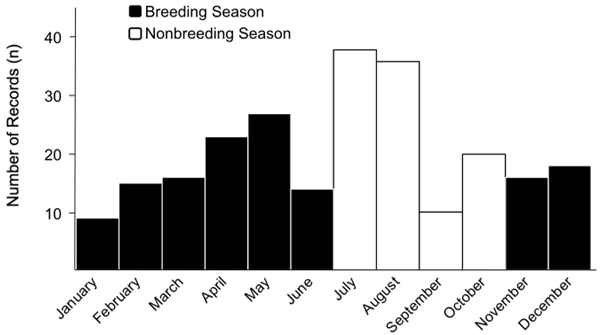
Fig. 2. Number of Pueo (Hawaiian Short-eared Owl, Asio flammeus sandwichensis) mortality records by month collated from 1993 to 2024 across the Hawaiian Islands. Bars are shaded to indicate breeding (black) and nonbreeding (white) seasons, but we note that the “breeding season” is not well-defined in the literature; the earliest breeding behaviors have been observed in October and pre-fledge owlets have been observed as late as July (Wang 2022). Although mortality records were highest in July (n = 38) and August (n = 36) and lowest in January (n = 9) and September (n = 10), a Poisson generalized linear model indicated that month was not a significant predictor of mortality when accounting for interannual variability (likelihood-ratio χ² = 10.97, df = 11, p = 0.45).
Fig. 3
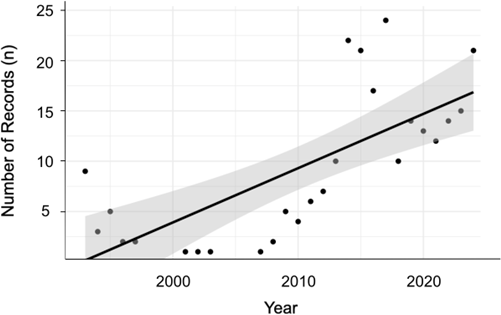
Fig. 3. Number of Pueo (Hawaiian Short-eared Owl, Asio flammeus sandwichensis) mortality records by year from 1993 to 2024 across the Hawaiian Islands. Reported mortalities increased significantly over time (β = 0.54 ± 0.11 SE, t = 4.92, p < 0.001). The shaded area represents the 95% confidence interval around the fitted regression line. The highest number of records occurred in 2014 (n = 22) and 2017 (n = 24).
Table 1
Table 1. Pueo (Hawaiian Short-eared Owl; Asio flammeus sandwichensis) mortality records were obtained from 10 organizations in the Hawaiian Islands. Duplicate records were identified and removed, resulting in a total of 242 non-duplicate records. Organizations with data specific to the island on which they are based have the island stated in parentheses. All other organizations serve multiple islands.
| Organization | Records (n) | ||||||||
| Archipelago Research and Conservation (Kauaʻi) | 25 | ||||||||
| Bernice Pauahi Bishop Museum | 14 | ||||||||
| Hawaiʻi Department of Land & Natural Resources, Division of Forestry & Wildlife | 9 | ||||||||
| Hawaiʻi Wildlife Center | 70 | ||||||||
| Save Our Shearwaters (Kauaʻi) | 28 | ||||||||
| Maui Nui Seabird Recovery Project (Maui) | 33 | ||||||||
| Nēnē o Molokaʻi | 10 | ||||||||
| Pulama Lānaʻi (Lānaʻi) | 8 | ||||||||
| United States Fish and Wildlife Service | 10 | ||||||||
| United States Geological Survey | 35 | ||||||||
| Total | 242 | ||||||||
Table 2
Table 2. The number of recorded causes of death by island for Pueo (Hawaiian Short-eared Owl; Asio flammeus sandwichensis), as well as human population and size (area) of each island. Trauma was most often identified as the cause of death, followed by emaciation.
| Island | Area (km²) | Human population | Total records | Trauma | Emaciation | Disease | Unknown | ||
| Hawaiʻi | 10,430 | 200,629 | 77 | 47 | 14 | 7 | 9 | ||
| Kauaʻi | 562 | 73,214 | 77 | 54 | 9 | 1 | 13 | ||
| Lānaʻi | 140 | 3,367 | 20 | 15 | 3 | 0 | 2 | ||
| Maui | 727 | 154,100 | 44 | 24 | 5 | 3 | 12 | ||
| Molokaʻi | 260 | 7,369 | 10 | 4 | 0 | 0 | 6 | ||
| Oʻahu | 597 | 1,016,508 | 14 | 6 | 1 | 3 | 4 | ||
| Total | 12,716 | 1,254,558 | 242 | 150 | 32 | 14 | 46 | ||